Robotics Briefing — compiled and curated by Chris Lee
China's foreign-investment security office prohibits SoftBank's $5.375 billion purchase of ABB Robotics inside China, thirteen months after the deal was signed
Week of November 3 – November 10, 2026
SoftBank said it was notified on November 4 that China's Office of the Working Mechanism for Foreign Investment Security Review had prohibited its acquisition of ABB's robotics business in China. The agreement, signed October 8, 2025 at an enterprise value of $5.375 billion, was supposed to close in the second half of this year. Neither company has called it off. Agility Robotics began trading on Nasdaq as AGLT on November 5, opening at $11.26, while the S-4 behind the listing shows $1.78 million in 2025 sales, a $138.1 million net loss and a going-concern note. At CoRL on November 9, NVIDIA's Jim Fan presented GR00T 2, a world action model that reaches 95% average success on 50 bimanual tasks after five demonstrations each, with code promised for December. Boston Dynamics put scooter wheels on Atlas's ankle actuators to run its motors at sustained torque and speed, launched Stretch Gen 2 with 81% less internal cabling, and was reported by The Elec to be using 70 Samsung SDI 2170 cells in the Atlas pack. And two open-source builds arrived with real numbers: NYU's MABEL, a 56-degree-of-freedom bimanual robot on an $8,056 parts list, and Apple's HALO, a Unitree G1 stack trained entirely in 1,000 procedurally generated homes that hit 91% across 360 real-world trials.
Markets
China prohibits SoftBank's acquisition of ABB Robotics in China, the $5.375 billion deal's biggest market, and both sides say they are "working constructively"
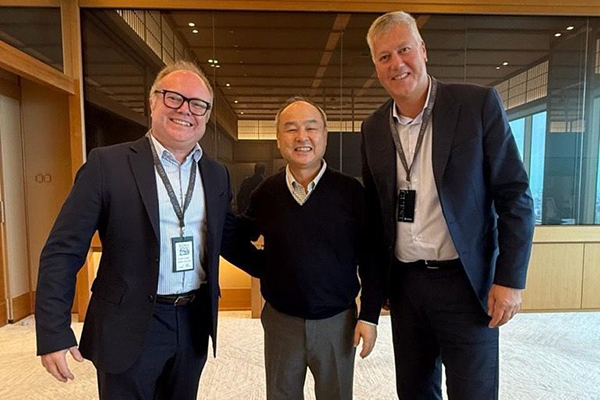
Marc Segura, president of ABB Robotics, Masayoshi Son, chairman and CEO of SoftBank Group, and Morten Wierod, CEO of ABB, when the divestment was announced in October 2025. Credit: Marc Segura (via LinkedIn), via Robotics 24/7.
The two statements are short. ABB's, posted November 5, says the regulatory process "is managed by SoftBank" and that ABB "has been informed by SoftBank that the Office of the Working Mechanism for Foreign Investment Security Review in China has prohibited the acquisition of the ABB Robotics business in China." SoftBank's, posted November 6 in Tokyo, confirms it received the notification on November 4. Neither gives a reason, and neither names a next step beyond the same sentence: "ABB and SoftBank are in close dialogue and are working constructively on the transaction." SoftBank adds that it "will promptly announce any decisions on matters requiring disclosure." The Financial Times reported the block first. Verdict, citing Reuters, says Chinese authorities were concerned that sensitive robotics data could end up in the United States, and points to SoftBank's ties to OpenAI and to Japan-China tensions as factors. None of that is in the official notice, which has not been published.
What was blocked is the China part of a global deal. ABB agreed in October 2025 to sell its whole Robotics division to SoftBank for an enterprise value of $5.375 billion, abandoning a plan to spin it off as a separately listed company. The division had revenue of about $2.3 billion in 2024, roughly 7% of ABB Group, with an operational EBITA margin of 12.1% and about 7,000 employees. ABB expected about $5.3 billion in cash after costs, a pre-tax book gain of about $2.4 billion, separation costs around $200 million, and closing in the second half of 2026. China is the division's largest market. The AI Insider, citing Reuters, puts it at roughly 30% of the robotics business. The New York Times, cited by Robotics 24/7, reports that about 90% of the machines ABB sells to Chinese customers are built in China. The business runs from a $150 million, 67,000 m² factory in Shanghai that opened in December 2022 and is the division's global headquarters, plus a Zhuhai site from 2015. Removing the Chinese operations from the sale is not a carve-out of a sales office. It is the manufacturing base and the head office.
The office that issued the prohibition is China's foreign-investment security review body, the one that in April ordered Meta to unwind its purchase of Manus. Robotics 24/7 notes the FT named the National Development and Reform Commission as the body that informed SoftBank; the two primary releases name the Office, so the NDRC attribution is unconfirmed. The deal remains subject to approvals in other jurisdictions, and neither company has said which have been obtained. The options are the obvious ones: a restructured deal that leaves China out, a price cut, or a return to the spin-off. ABB has not said which it prefers, and the usual trade groups have said nothing. Yahoo Finance's page showed SoftBank Group down 10.8% and ABB down 0.8% at the time of reading; those are live widget values, not reported closes for a specific day. The substantive change is that the largest robotics M&A deal of the past year now has a hole where its largest market was, with 13 months on the clock and no replacement structure announced.
Agility opens on Nasdaq at $11.26, and the S-4 behind the listing shows $1.78 million in 2025 sales, a $138 million loss and a going-concern note
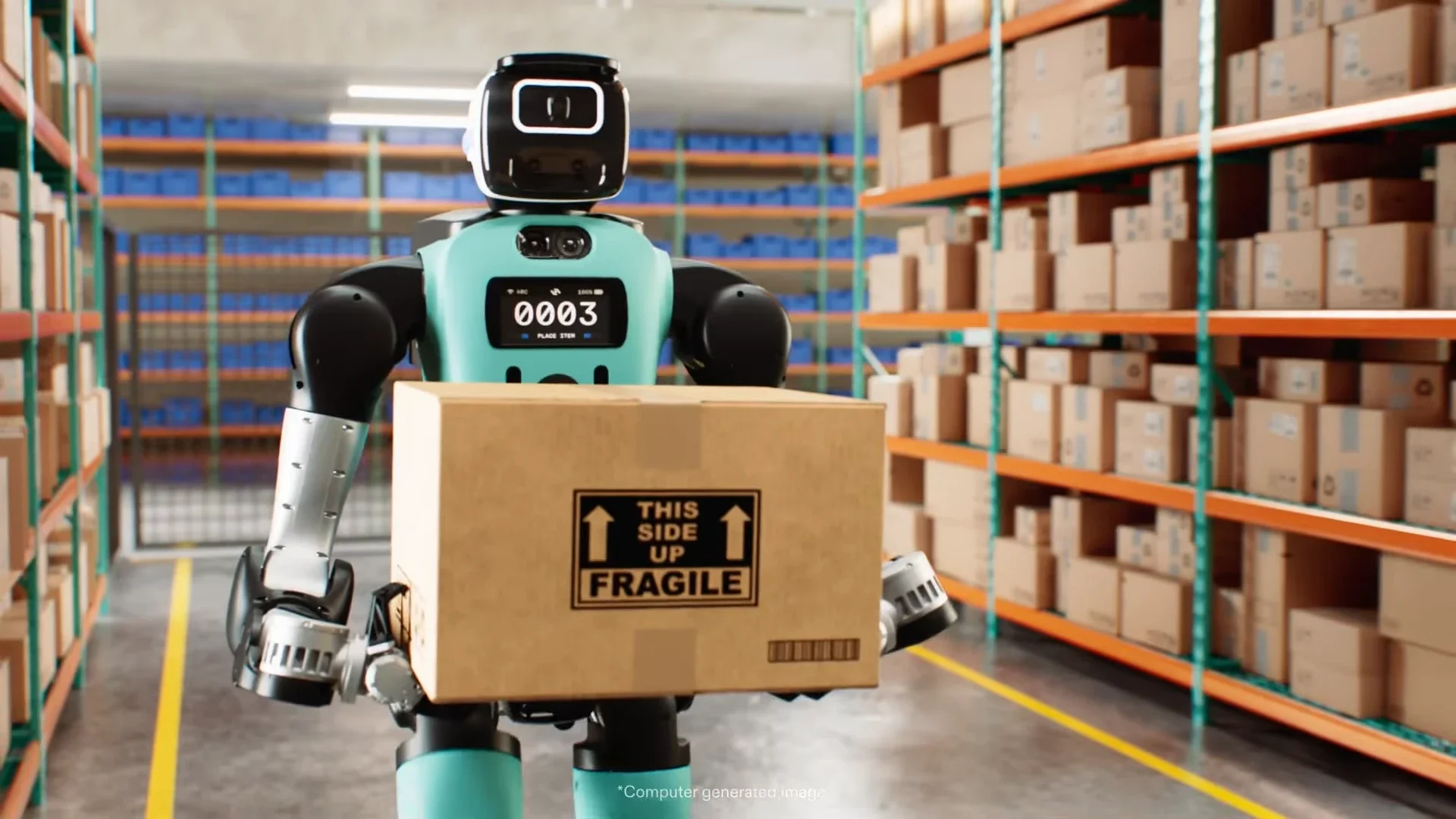
Digit 5 carrying a box, from Agility's company overview video. This is a computer-generated image, not a photograph of a working robot. Credit: Agility Robotics, via Humanoids Daily.
Last week's issue covered the shareholder vote and the $465 million raise. This week the stock exists. The Churchill Capital Corp XI merger closed November 4, and AGLT and the AGLTW warrants began trading on Nasdaq on November 5. Tech Times, citing TipRanks, reports an opening price of $11.26 and a drop of nearly 10% in the first hours, staying above the $10 PIPE price. No outlet in this set printed a confirmed close, market capitalization or share count, so those are still to be read off a quote screen. The release calls Agility "the first U.S. publicly listed pure-play humanoid robotics company," a claim Humanoids Daily limits to U.S. exchanges: UBTech has traded in Hong Kong since December 2023 and Unitree on Shanghai's STAR Market since August. CEO Peggy Johnson's line for the day: "Today marks an important milestone for Agility, but the bigger story is what it means for the future of work."
The numbers worth reading are in the Form S-4 that made the listing possible, as reported by Tech Times and Humanoids Daily. Net sales for 2025 were $1,781,967, up from $310,301 in 2024. Of that, $1,131,860, about 64%, came from related parties. Cost of goods sold was $4.47 million, so the gross loss was $2.69 million, a gross margin of about minus 151%. Operating loss was $140.2 million and net loss $138.1 million. Cash at the end of 2025 was $103.0 million, and management concluded there was "substantial doubt" about the company's ability to continue as a going concern, the standard language for a company that needed this deal to close. Tech Times works the $2.5 billion pre-money valuation out to roughly 1,400 times sales. The $300 million in committed Digit 5 orders turns out to be a single three-year robots-as-a-service contract for 1,000 robots with a related-party customer as of May 2026, carrying warrants for 453,000 shares that vest as robots deploy; the filing says the revenue accounting is still being evaluated. The RaaS pricing in the S-4 is about $8,500 a month plus $25,000 for deployment, about $535,000 per robot over five years, against a Digit 4 bill of materials of about $125,000. Management claims a unit contribution margin above 70% over five years, before R&D and overhead.
Two outside readings from the Tech Times piece, via Mergermarket. Scott Stevens of Grays Peak Capital says customers can cancel, so backlog is usually overstated, and gives little weight to orders for products still in development. Nicolas Sauvage of TDK Ventures, which backed Agility in 2020, says the metrics to watch are deployments, uptime, utilization and return on investment. The release repeats the figure of more than 65,000 operating hours; Tech Times notes Forbes has pointed out the number has not been updated in months. The schedule has not moved: early access to Digit 5 in the first half of 2027, general availability by the end of 2027, with CE marking not yet obtained and some safety features still in development. The company's own projection is about 800 Digit 5 units in service in 2027, 7,000 by 2030, and up to 25,000 by 2035. The 2025 sales line says how far that is from today.
NVIDIA's GR00T 2 predicts the video and the actions together, hits 95% on 50 bimanual tasks after five demonstrations each, and ships its code in December
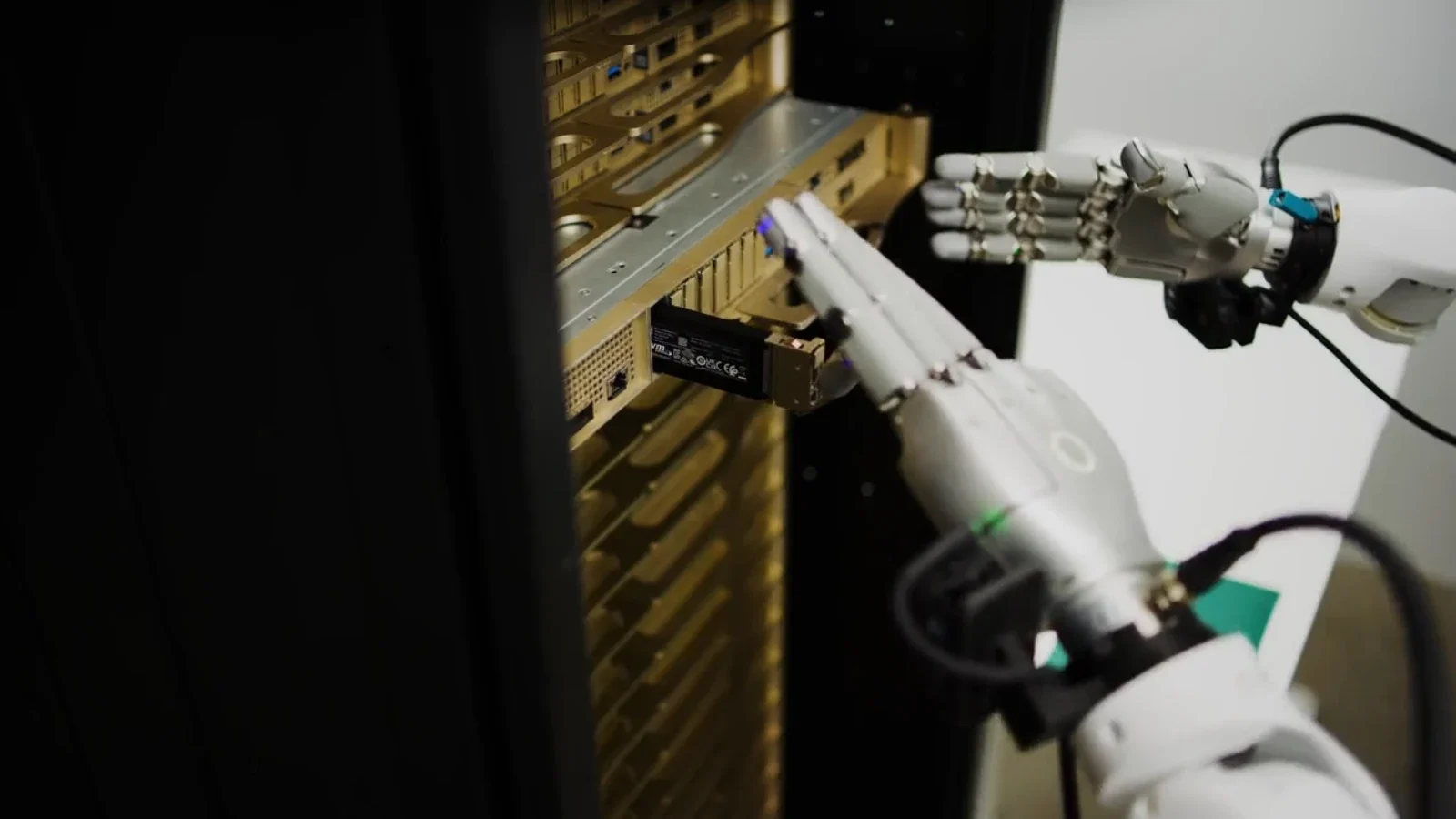
GR00T 2 on a bimanual robot with Sharpa hands removing and reseating a memory module in a GB300 server, a task NVIDIA reports at 85% success. Credit: NVIDIA, via Humanoids Daily.
Jim Fan gave the closing talk of CoRL's first afternoon session on November 9, and the project page went up the same day. GR00T 2 is what NVIDIA calls a world action model: one diffusion transformer takes a language instruction, several camera views and the robot's state, then denoises the next few frames of video and the next chunk of actions together, executes the chunk, and repeats. Earlier GR00T releases were vision-language-action models that skipped the video prediction. The training data is listed on the page: 402,730 hours of egocentric video of people at work, 10,184 hours of handheld UMI gripper demonstrations across 2,897 tasks, and 23,500 hours of robot teleoperation across parallel-gripper arms (YAM and Franka), dexterous hands (Sharpa and Wuji) and the Unitree G1. The headline benchmark is 50 tasks on a bimanual robot with two 22-degree-of-freedom Sharpa hands. Zero-shot, from the instruction alone, the model succeeds in 40% of trials and completes 40 of the 50 tasks at least once. One demonstration per task lifts the average to 71%. Five demonstrations, under three minutes of robot data in total, lift it to 95%, with 37 tasks succeeding in every trial. Each adaptation is a 30-minute LoRA fine-tune on a single RTX 5090.
The cross-embodiment results are the part a builder should read twice. Shown only demonstrations recorded with a handheld UMI gripper, a different gripper from the robot's own, a YAM arm assembles a toy dump truck end to end in 60% of trials, a task that runs up to four minutes. A separate result on the Sharpa-handed robot puts toy-truck assembly at 65%. Humanoids Daily's summary added that the human-video transfer and the toy-truck result were the same thing; the project page separates them, and the 60% figure is UMI data, not human video. GR00T 2 Turbo is the same architecture with a higher-compression video encoder and a smaller 2-billion-parameter joint transformer; a prediction takes 38 ms on an RTX 5090 and 124 ms on the Jetson Thor inside a Unitree G1, with the SONIC whole-body controller running at 50 Hz on a separate Jetson Orin NX. Fan showed a G1 serving popcorn at 48 of 48 trials, a robot reseating a memory module in a GB300 server at 85%, and an agent harness called ASPIRE that mixes GR00T 2 with code the agent writes, which assembled 292 of 300 toys across three designs against 71 to 84 per toy without it. Partners named: Foxconn for server manufacturing, Siemens evaluating industrial use, Nexuni for laundry, MicroAGI for cable swapping. Alongside it, Isaac Lab 3.0 adds a multi-backend physics architecture with Newton beside PhysX; the docs still label 3.0 a beta.
What is open and when: the project page's button reads "Code Available in December." It does not say weights, and no license terms are posted. Humanoids Daily reports Fan saying the GR00T 2 and Turbo weights plus the cross-embodiment adaptation recipe come in December, and that a 100,000-hour egocentric human video set, Human-1M-100K, is on Hugging Face now. The DexUMI exoskeleton and the UMI gripper and robot-neck hardware designs are described as available; Fan's phrase was "now you can build it in your own garage." Humanoids Daily also described the model as 2 billion parameters built on Cosmos; the page gives 2B only for Turbo, does not state the full model's size, and does not mention Cosmos. Every success rate here is NVIDIA's own, on NVIDIA's task set, with no independent evaluation yet. The RoboColosseum benchmark that launched November 4 with Unitree support is the kind of third-party test that would settle it, and its early G1 results say current policies are far from reliable.
Boston Dynamics bolts scooter rims to Atlas's ankle actuators to run the motors flat out, launches Stretch Gen 2 with 81% less cabling, and is reported to use 70 Samsung SDI cells per Atlas
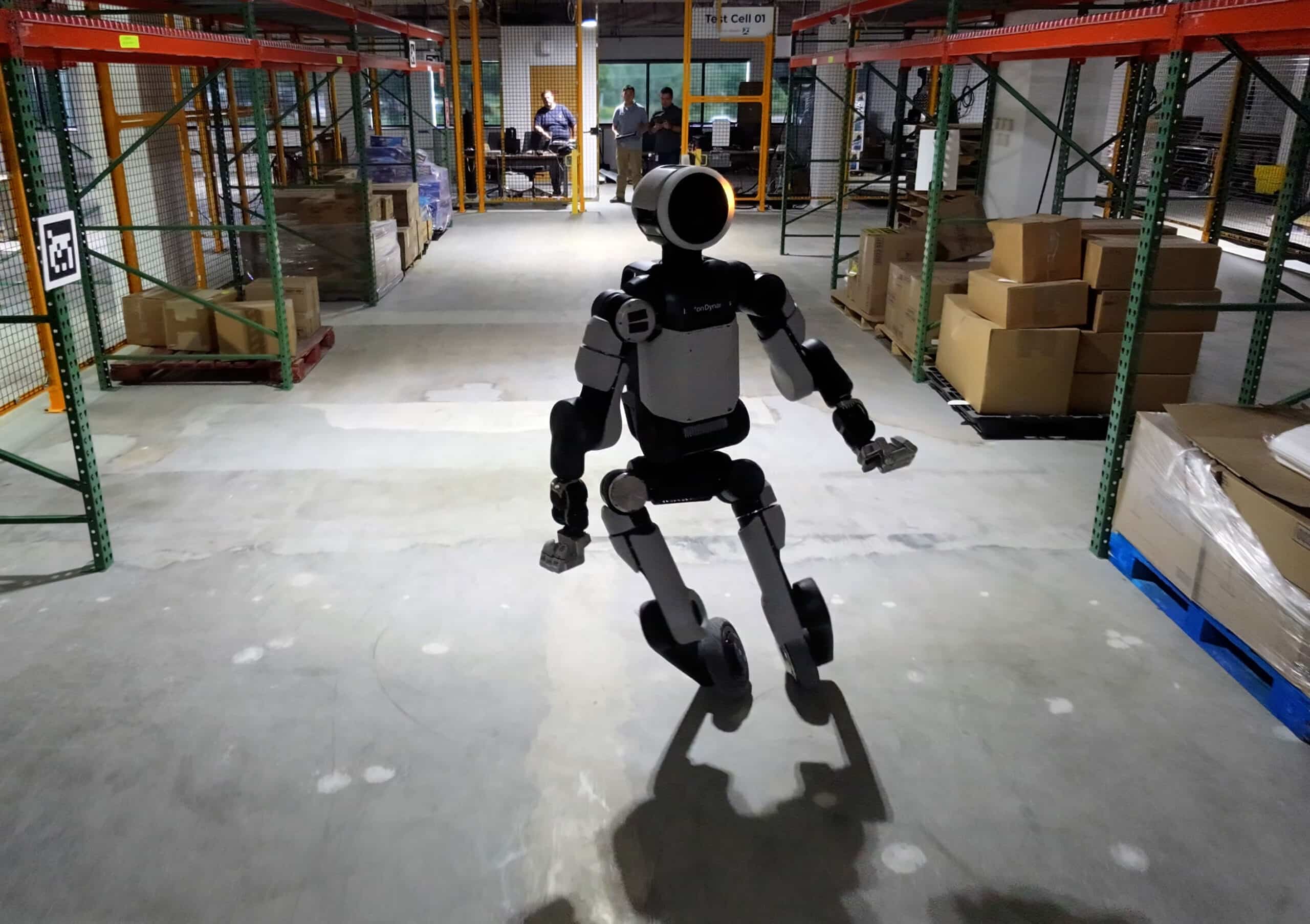
Atlas rolling backward through a test warehouse on wheels mounted to its ankle actuators. Credit: Boston Dynamics, via the Boston Dynamics blog.
Xiaoyu (Andy) Wu, a controls engineer on the Atlas team, wrote up the wheels on the company blog on November 9. "A wheeled Atlas isn't a product. It's a research testbed." The goal was to find a scenario where the motors "had to deliver high torque and high speed continuously, carrying real load the whole time," because walking never holds an actuator at its limits for long and rolling does. The hardware change is one part: "A single custom adapter mounts an off-the-shelf scooter rim onto our existing ankle actuator, and that's the only new part in the whole build." The ankle motor drives the wheel directly. On the software side each wheel is "simply modeled as an 'ankle' that can spin continuously," with no rotation limit, and the changes to the reinforcement-learning setup were limited to the reward terms, the range of commands the policy trains on, and how it holds posture. The physics ran in MuJoCo, with Google DeepMind's Yuval Tassa credited. The team checked that low-level control parameters matched across software stacks, ran characterization experiments, and tuned the simulated motor model; Wu says the policy then transferred "basically perfectly on hardware." The video shows a side dash with a jump, a 360-degree spin jump that worked on the first hardware attempt, drifting, and backward skating. What the post does not give is a single number: no wheel diameter, speed, torque, motor temperature or gear ratio. Wu says the findings are already being folded back into the legged configuration. Humanoids Daily adds that this is the robot Hyundai plans to put in its plants; that sentence is theirs, not the blog's.
The product news came November 3. Stretch Gen 2 is the second generation of the trailer-unloading robot, and the release is a list of what took the first one offline. Boston Dynamics says it drew on more than 100,000 operating hours and "tens of millions of boxes." The arm joints now rotate continuously past 360 degrees so they stop hitting hard stops. Internal cabling is cut 81%, "about a half-mile's worth," by replacing dynamic cables and harnesses with heavy-duty automotive-grade connectors. A swerve drive module swaps in about an hour instead of a day. The gripper has new valve systems and more precise sensing, the emergency stop sits lower and is recessed, there is onboard lighting for dark trailers, and a redesigned compute platform. Throughput is "up to 1000 cases per hour," which the company itself qualifies as "highly dependent on factors like case weight and how neat or disorderly cases are stacked," with a multipick mode for peak rates. The battery lasts two shifts and a fast charger reaches 90% in about 75 minutes. Brian Donnelly, vice president and general manager of logistics robotics: "With Gen 2, we focused on the things that actually took robots offline in the real world." No price, availability date, box-weight limit or named customer is in the release, and the only image is a render.
The third item is a report, not an announcement. Humanoids Daily, citing Korea's The Elec on November 7, says Atlas uses 70 Samsung SDI 2170 cylindrical cells rated at 5,000 mAh each, for a pack of about 1.3 kWh, with Samsung SDI handling most of the initial supply and LG Energy Solution also selected. No chemistry, pack voltage or weight is given, and Boston Dynamics has not confirmed any of it. For scale, 70 cells at 5 Ah is a small pack for a machine that carries its own compute and hydraulics-free actuators all day; Agility put a 9-minute-charge Nyobolt pack in Digit 5 and Boston Dynamics' own product announcement has Atlas walking to a station and swapping its own battery. The pack figure on its own says little about productive hours. It does say which cell supplier a Hyundai subsidiary picked, and that the format is the same one in a cordless drill.
Two open builds with real bills of materials: NYU's MABEL puts 56 degrees of freedom on an $8,056 parts list, and Apple's HALO runs a Unitree G1 through six unmapped rooms at 91%
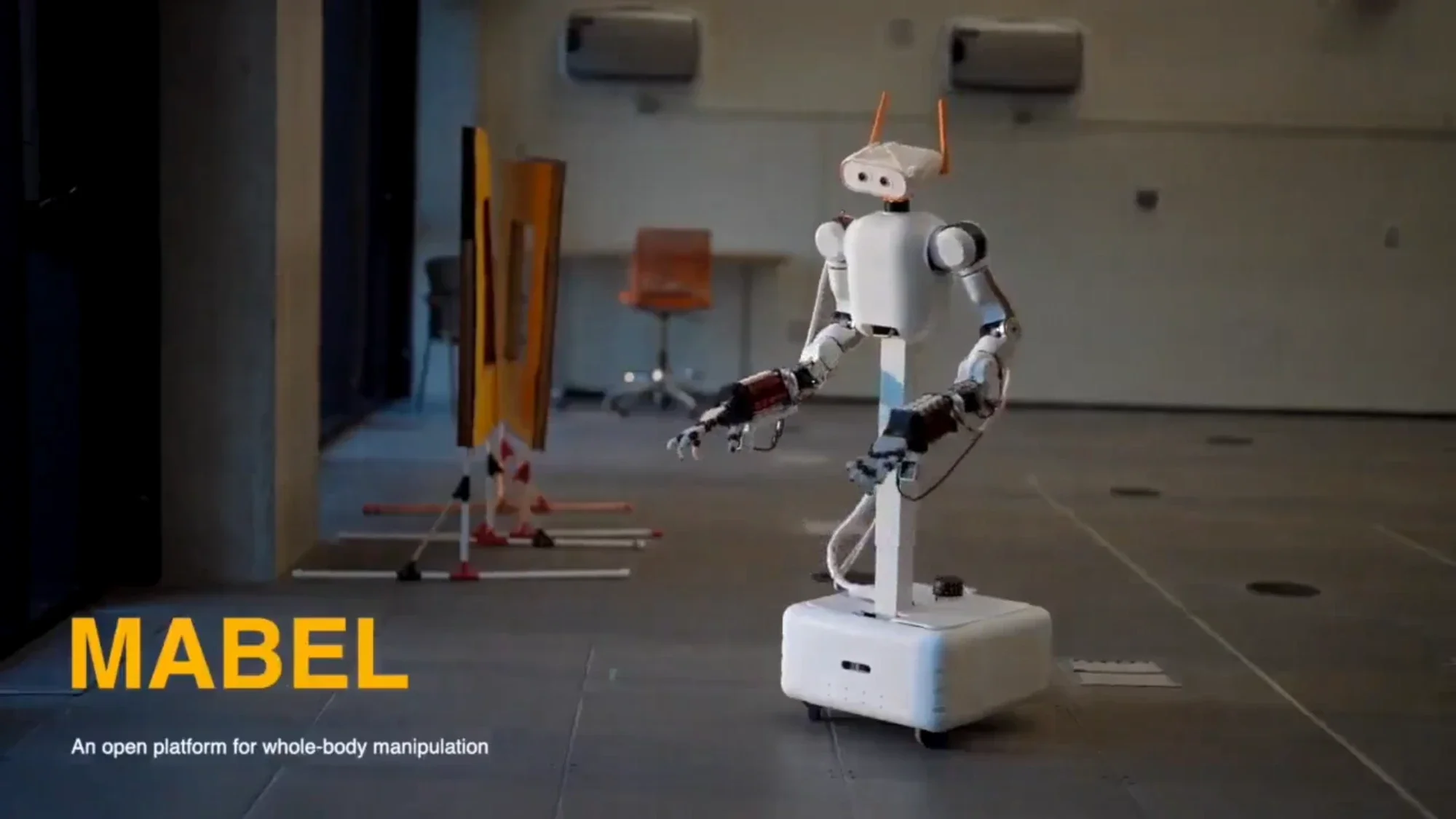
MABEL in its launch video: two 7-DoF arms, two 17-DoF ORCA hands, a desk-column lift and a swerve-drive base. Credit: the MABEL authors, via Humanoids Daily.
MABEL comes from Ludovic Righetti's group at NYU, with Qilong Cheng as first author, on arXiv November 2 and covered November 5. The abstract gives the shape: 56 degrees of freedom, two 7-DoF back-drivable arms, two 17-DoF tendon-driven ORCA hands, a pitching torso, a lift, a 3-DoF neck and a holonomic base, with fingertip reach from the floor to 2.23 m, for "US$8.1k parts cost." The bill of materials page is the interesting document. The Essential build totals $8,056.03 at July 31 prices: mobile base $1,912 on REV swerve modules with NEO and NEO 550 motors and SPARK controllers, torso $889, both arms $2,622 on DaMiao actuators bought through Taobao, both hands $1,195, neck and head $235, structural hardware $184, electronics and cabling $492, and $121 of filament. The lift is a FlexiSpot E7 Pro standing desk with only the column and frame used, giving 0.635 m of stroke. Onboard compute is a Raspberry Pi 5 with 16 GB; policies run off-board. Adding a Jetson Orin NX takes the total to $9,283 and a Jetson AGX Thor dev kit to $14,721, with a note that NVIDIA raised Jetson prices 33% to 101% on July 22. The head camera is a $119 stereo pair, the wrist cameras $98 each, the lidar $69. Teleoperation uses Apple Vision Pro head and hand tracking with no handheld controllers, at 137 ms glass-to-glass stereo latency over the robot's own Wi-Fi hotspot. Humanoids Daily reports the paper's test: an ACT policy trained on 80 Vision Pro takes, 38 minutes of data, picked and placed an object in 8 of 10 trials with the base and lift held near their start positions. Weight is 61.8 kg, arm payload 3.5 kg, runtime about four hours on 24 V. The authors say the desk column "trades speed for affordability." Build and wiring guides, STLs and MuJoCo meshes are on the project site; the repo is at github.com/robotmabel/open_mabel.
HALO is Apple's, from a team of eight under Vladlen Koltun, on arXiv November 4. The name stands for Humanoid Autonomy, Learned in simulation, running Onboard, and the claim is that no real-world data was used to train it. The stack has three layers. An orchestrator, a vision-language model running at about 0.5 Hz, splits a request into subtasks. A motion generator at about 3 Hz plans five seconds of whole-body motion as 150 frames of 36 values, using a frozen Qwen3.5-2B encoder and a diffusion-transformer decoder with flow matching over 15 Euler steps, committing the first half second. A motion tracker at 50 Hz, trained with reinforcement learning on depth and proprioception, outputs the 29 joint targets for a stock Unitree G1 with a fisheye camera and a downward depth camera. The data pipeline generates whole-body motion from text and keyframes with a model called Kimodo, filters candidates with 33 geometric checks, places them in 1,000 Infinigen-generated homes, renders in Isaac Sim, and applies eight visual randomizations. Training the generator took 64 B200 GPUs, the tracker 4 H100s, and corpus generation 250 H100s. The result on hardware: 91% across 360 trials in six unmapped real environments, six skills at ten trials each per room. Humanoids Daily's table has go-to-object at 92%, sit on a chair 85%, step through a half-open door 93%, crouch under a table 100%, crawl under a low table 90%, and push a box 88%, with chained sequences at 70%. Code for the pipeline, training and deployment is on GitHub; no trained weights and no dataset. The limits are in the skill list: no grasping, no hands, no touch, and each new skill needs a human-written prompt and keyframes.
Add CMU's Pixel, from Deepak Pathak and Ruslan Salakhutdinov's students, also posted November 2: a wheeled two-armed robot with compliant grippers and a 3D-printed leader arm, with a companion handheld rig, Pixel-UMI, that reports 87% average task progress across five task families. The project page says "Open Sourced Soon," and the sub-$15,000 figure in the coverage is not on the paper or the page. Three groups, one week, and the same pattern: wheeled bases, off-the-shelf or printed hardware, Vision Pro or handheld demonstration capture, and a published number for every claim. For anyone building a character robot or a show rig, MABEL's BOM is the most useful document of the week.