Robotics Briefing — compiled and curated by Chris Lee
Churchill XI shareholders approve the Agility Robotics merger with 84% of votes cast, and the deal closes on $465 million instead of the $620 million first projected
Week of October 27 – November 3, 2026
Churchill Capital Corp XI shareholders voted on November 2 to merge with Agility Robotics. More than 84% of votes cast were in favor. The money is smaller than the October registration statement projected: about $465 million gross, with $164 million left in the trust after redemptions where $424 million had been assumed. Trading on Nasdaq as AGLT is expected November 5. On October 28 the White House concluded its Section 232 investigation into imported robots and industrial machinery with a finding that they threaten national security, and then imposed no tariff, sending Commerce and USTR to negotiate for 180 days. Two days later an FCC notice let Lightberry's Lumi, a humanoid built on a Unitree G1, off the Covered List on the condition that it is built in the United States. ANYbotics started shipping ANYmal X, a legged inspection robot certified for ATEX and IECEx Zone 1 with twelve flameproof actuators and a nitrogen-filled computer bay. The Information reported that Meta built a 48 kg humanoid called Max with Shanghai's Fourier in three months. And two sets of numbers arrived: A3 counted 10,989 robots ordered in North America in the third quarter, up 24.8%, and Unitree's first earnings report since its listing showed revenue up 70% and profit down 17%.
Markets
Churchill XI shareholders approve the Agility merger with 84% in favor, and the trust delivers $164 million where $424 million had been assumed
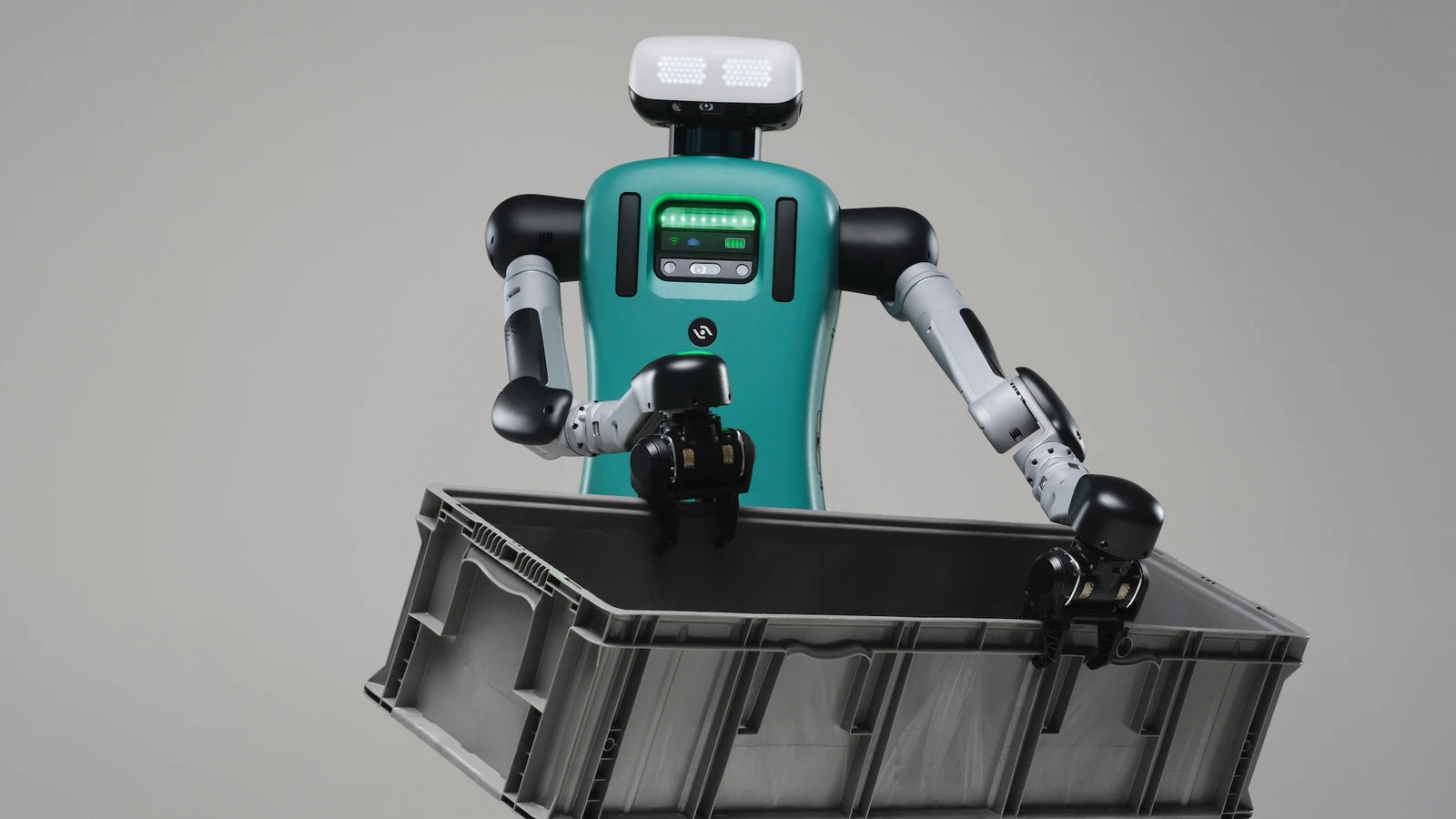
Agility's Digit holding a tote, in the company image Humanoids Daily ran with its report on the capital raise. Credit: Agility Robotics, via Humanoids Daily.
Churchill Capital Corp XI held its special meeting on November 2 and its shareholders approved the business combination with Agility Robotics, with more than 84% of votes cast in favor. The release from the two companies gives the rest of the calendar: closing expected November 4, subject to the usual conditions, and the combined company's common stock and warrants expected to begin trading on Nasdaq on November 5 as AGLT and AGLTW. Churchill XI moves its jurisdiction from the Cayman Islands to Delaware and takes the name Agility Robotics, Inc. Existing Agility holders roll their shares into the public company under a 180-day lock-up. Churchill called the result "overwhelming support." It is also the end of a three-week run of Agility announcements, from the AGCO pilot and the NVIDIA IGX Thor decision through GXO's two new sites, all timed ahead of this vote.
The money was set out on October 30, after the redemption deadline. Gross capital is about $465 million before transaction expenses: about $164 million from Churchill XI's trust account, about $201 million from a common-stock PIPE at $10 per share led by Foxconn with existing Agility stockholders and new institutional investors, and $100 million of equity Agility had already received after the deal was announced in June. The registration statement in October had projected more than $620 million, with about $424 million from the trust assuming no redemptions and $200 million from the PIPE. The companies did not publish a redemption figure. The arithmetic is simple: the trust came in about $260 million short of the no-redemption case, so roughly six in ten trust dollars were taken out as cash by SPAC holders who chose not to ride into AGLT. The $465 million headline also counts the $100 million already spent or banked, so new money at closing is about $365 million. The June announcement valued the merger at $2.5 billion. No updated pro forma equity value was published with the new numbers.
What the capital is for was spelled out on the October 26 investor call and the October 30 release. CFO Michael Beer put Digit 5's bill of materials at about $150,000 per robot at launch, at roughly 1,000 units a year, falling to about $75,000 and then about $30,000 at 10,000 units a year. Chief business officer Daniel Diez said Agility has commitments at nine customer sites and wants 25 by the end of 2027. The $300 million in committed Digit 5 orders carries the same caveat as before: potential multi-year value tied to milestones and specifications, not revenue. Early access to Digit 5 is still the first half of 2027, with general availability by the end of the year. The release describes Agility as "the only U.S. publicly listed pure-play humanoid robotics company with proven, active commercial deployments," and cites more than 65,000 hours of real-world Digit operation. The vote, the ticker and the dates are now checkable. Whether the stock holds the $10 PIPE price once AGLT opens is the next number to watch.
Section 232 finds imported robots a security threat and imposes no tariff, while the FCC lets a Unitree-based humanoid off its Covered List on a promise to build it in the U.S.
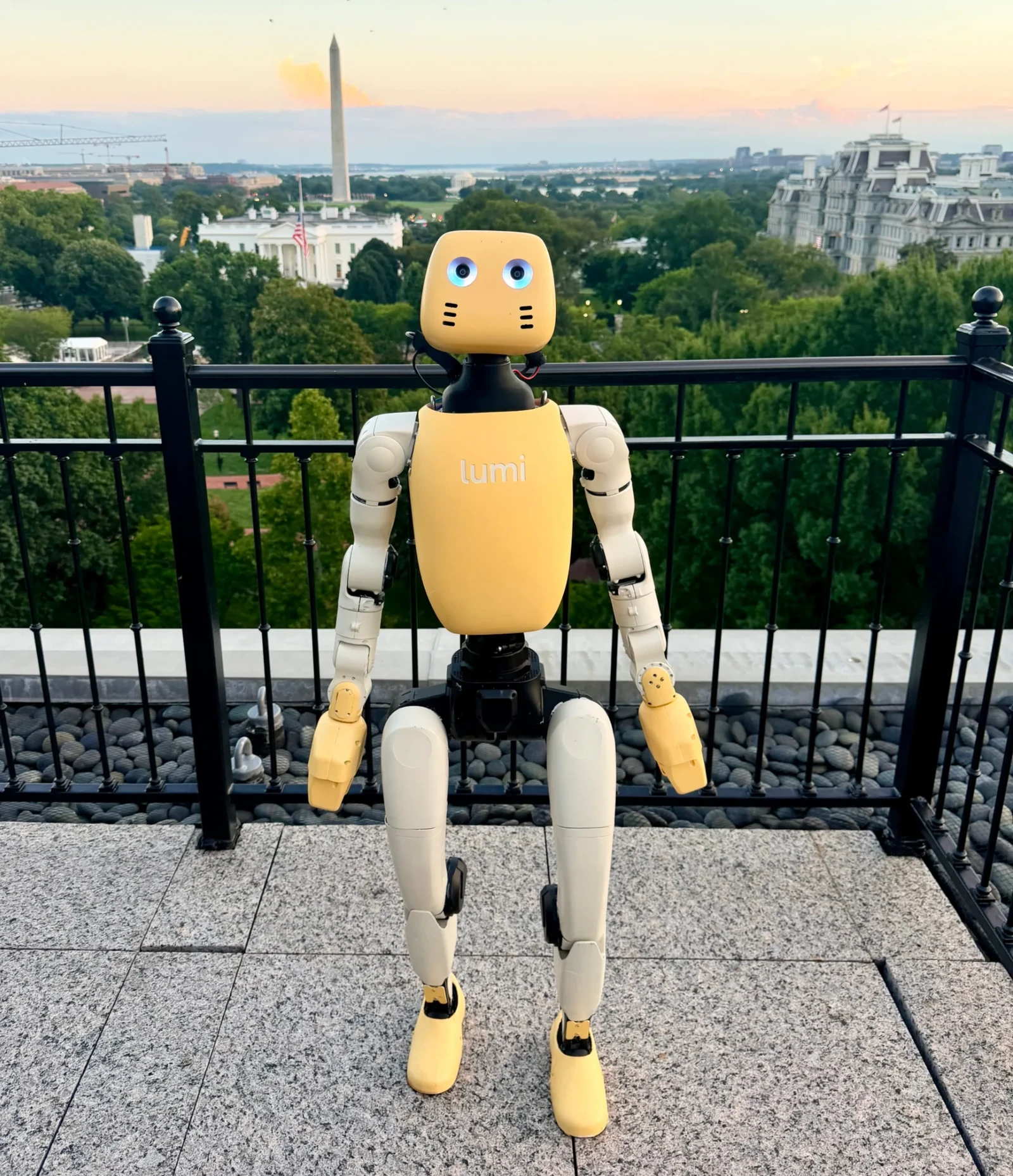
Lightberry's Lumi, a humanoid built on a Unitree G1 base, photographed in Washington, D.C. for the company's announcement of its Covered List exemption. Credit: Lightberry, via Humanoids Daily.
The proclamation is dated October 28. It says the Secretary of Commerce reported that robotics, industrial machinery and their parts and components are being imported "in such quantities and under such circumstances as to threaten to impair the national security of the United States," and that the President concurs. The findings say the U.S. relies on imports for most types of robotics and industrial machinery, that domestic capacity falls short of demand despite recent factory investment, and that equipment from certain foreign entities can carry cybersecurity vulnerabilities once it is wired into manufacturing and defense systems. Then comes the action, which is no action at the border. No tariff, duty, quota or fee is imposed. Commerce and the U.S. Trade Representative are directed to pursue or continue negotiations with trading partners and to report back within 180 days, which lands in late April 2027. If no agreement is reached, or one is not carried out, the President may take further steps. The document names tariffs, duties, quotas, fees, or an incentive program for new U.S. production as the options.
The scope is worth reading. The investigation, opened just over a year ago, covered programmable industrial systems, machine tools, stamping and pressing equipment, industrial ovens, autoclaves, and laser and water-jet cutting machinery. It separately flagged advanced robots with potential military use, including intelligence, surveillance and hazardous-material handling: autonomous mobile robots, humanoids, quadrupeds and autonomous ground vehicles. No HTS codes are listed, so nobody can yet say which line items would be hit if the negotiations fail. A3 had asked the administration in October 2025 not to impose tariffs and to write a national robotics strategy instead; Robotics 24/7 reports no new statement from A3 or any company on the proclamation. For an importer the practical reading is that nothing changes this week. What changed is the legal predicate. A Section 232 finding is now on the record for robots, and that finding is the step that preceded the tariffs on steel, aluminum and autos.
The second document came two days later. An FCC public notice dated October 30 (DA-26-1181A1) names Lightberry's Lumi among robotic devices granted Conditional Approval by the Department of War and therefore exempt from the Covered List, where the FCC placed foreign-produced advanced robotic devices on July 28. The same notice covers equipment from ARAPL, ATI Motors, SunScout, Swap Robotics and OMRON. Lumi is a Unitree G1 mechanically, with Lightberry's own sensors, onboard computer and software, sold as a conversation and entertainment robot with a $39,990 Founder Edition. The exemption rests on the onshoring plan in Lightberry's application, which starts with the body, head and hands made domestically and the rest to follow, plus updated product vetting; a false statement or a missed plan returns the device to the list. It is not a sales clearance. Lumi still needs independent FCC equipment certification before off-the-shelf sales, and CEO Ali Attar gave no shipping date beyond "very soon." The approval is specific to Lumi and to Lightberry's application. It does not clear the G1 itself, or anyone else's G1-based product, and Attar did not say whether a change of hardware or supplier would trigger a new review.
ANYbotics ships ANYmal X, a Zone 1 legged inspection robot with twelve flameproof actuators and a nitrogen-filled computer bay
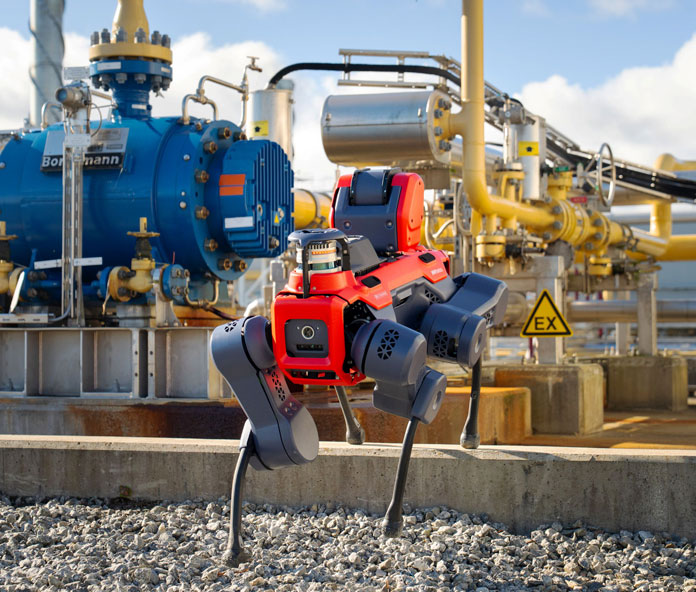
ANYmal X, the explosion-safe version of ANYbotics' quadruped, in the company image that ran with the launch. Credit: ANYbotics, via Robotics 24/7.
ANYbotics announced on October 27 that ANYmal X is shipping, with Equinor and DSM-Firmenich named as first customers. The company calls it the first legged inspection robot for explosive atmospheres. Its product page states the certification: ATEX and IECEx up to Zone 1, gas group IIB, plus IP67 and CE. Zone 1 means places where a flammable gas atmosphere is likely in normal operation, which is where the pumps, compressors, valves and piping are in a refinery or chemical plant, and where a human inspector today needs PPE, a handheld gas detector and an entry permit. Group IIB covers most hydrocarbon process gases; it does not cover hydrogen or acetylene, which are IIC, and Zone 0 is out. ANYbotics says the design took four years and more than ten patents, and that BP, Equinor, Shell, PETRONAS, Petrobras, BASF and SLB have run it in an early access program since 2023 across "hundreds" of onshore and offshore missions.
The engineering is a list of ignition sources and a countermeasure for each. CTO Andrea Corda described the method: "We asked one question over and over: which credible event in the life of a walking robot could create an ignition source." The AI computer and the inspection payload sit in sealed chambers filled with nitrogen, so there is no oxygen inside to support a spark. All twelve leg actuators and the battery are in flameproof casings, the Ex d approach, built to contain an internal explosion rather than prevent one. Non-metallic shells insulate the metal structure. The feet are conductive to bleed static to ground. Temperature monitors trigger automatic cutoffs. Charging and data transfer go through energy barriers so no live connector is ever exposed inside the hazardous area. The robot checks its own condition before, during and after each mission, and it was tested for shock, vibration, corrosion, solar radiation and salt mist. Twelve Ex d actuator housings on a walking machine is the hard part; the usual way to make a legged robot stiff and light is to put the motor electronics inside thin aluminum, which is the opposite of a flameproof enclosure.
The payload is the standard pan-tilt inspection unit: a 20x optical zoom camera, a thermal camera reading −10 °C to +400 °C, ±90° of tilt and ±165° of pan, a spotlight, a microphone for acoustic readings in the audible range, lidar for localization, and an optional combustible and toxic gas sensor. Findings are logged per asset in ANYbotics' Shift software, which connects to SAP, Yokogawa and SLB systems. What is not published: weight, battery runtime, price, the certifying body and certificate numbers, and the delivery count. The product page says the 2026 specifications are "coming soon." Chief revenue officer Thierry Obédé's figure of more than 50 customers running over 120,000 autonomous inspections a month refers to the company's whole fleet, not ANYmal X. The one customer quote with a name is from PETRONAS robotics manager Iskandar Al-Thani Mahmood: Zone 1 certification "will really enable us to bring the robot very close to our process area."
Meta built a 48 kg humanoid called Max with Fourier in three months, The Information reports, and says it has no plans to sell it
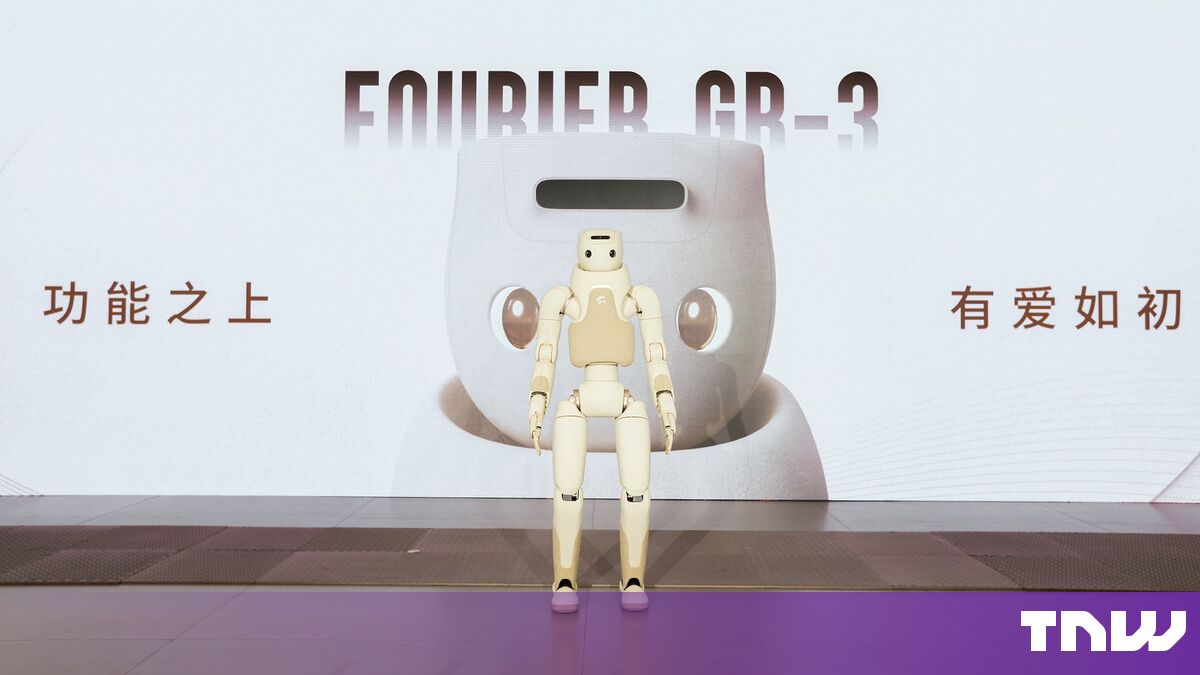
Fourier's GR-3 at its August 2025 launch. This is Fourier's own care robot, not Max; no image of the Meta prototype has been published. Credit: Fourier, via The Next Web.
Jyoti Mann reported the project in The Information on October 31, citing people familiar with it. Meta built a humanoid prototype called Max with Shanghai-based Fourier in about three months. The reported specifications: about 1.5 m tall, about 48 kg, an NVIDIA Jetson Thor onboard, five-fingered hands that can pick up small bottles and toys, chest-mounted speakers, and a face screen that displays expressions. It is a custom machine on Fourier hardware drawn from three robot generations, with the proportions, head, display and cameras changed. Li-Chen Miller, Meta's VP of product for robotics, spent almost two months at Fourier's Shanghai factory. Max was shown to some staff at an internal robotics summit in late August. Work on Max 2 began in September, with a redesigned torso, better hands, a projector and extra sensors for stairs. Meta is reported to be hiring robotics staff in Shanghai and Shenzhen. A Meta spokesperson told The Information: "this effort with Fourier is focused on internal research and experimentation, and we have no plans to sell these units."
The requirements list is the useful part for anyone building a character robot. Meta reportedly specified that the robot recognize a voice from 5 m, read a wave or gesture from 3 m, hold eye contact, and show whether it is listening, thinking, speaking or uncertain. CTO Andrew Bosworth is reported to have described humanoids as a physical embodiment of Muse, Meta's consumer AI agent. Those are social-presence specs, not manipulation specs, and the hands are described in terms of bottles and toys, not tools. For scale, Fourier's own GR-3 is 1.65 m, about 71 kg and up to 55 degrees of freedom, so Max is a smaller, lighter machine and not a rebadged GR-3. The background is Meta's purchase of Assured Robot Intelligence in May, whose team went into Meta Superintelligence Labs, and NVIDIA's agreement this week to invest $3 billion in Meta and expand work on Muse.
Everything here is one outlet's sourced report. No video, no photo of Max, no task data and no launch date have been published, and the GR-3 pictures that ran with the coverage are not the prototype. The timing sits against the week's other news: a U.S. company prototyping its humanoid on Chinese hardware, in China, in the same week the White House put a Section 232 finding on imported robots and the FCC's Covered List exemption for a Unitree-based robot turned on a plan to build it domestically. Meta's statement that it will not sell the units keeps it outside the Covered List for now. What Meta does with Max 2 when it is finished is the open question.
North American robot orders rose 24.8% in the third quarter to 10,989 units, and Unitree's revenue grew 70% while its profit fell 17%
The image A3 supplied with its third-quarter 2026 orders report. It is an illustration for the report, not a specific plant named in it. Credit: Association for Advancing Automation (A3), via Robotics 24/7.
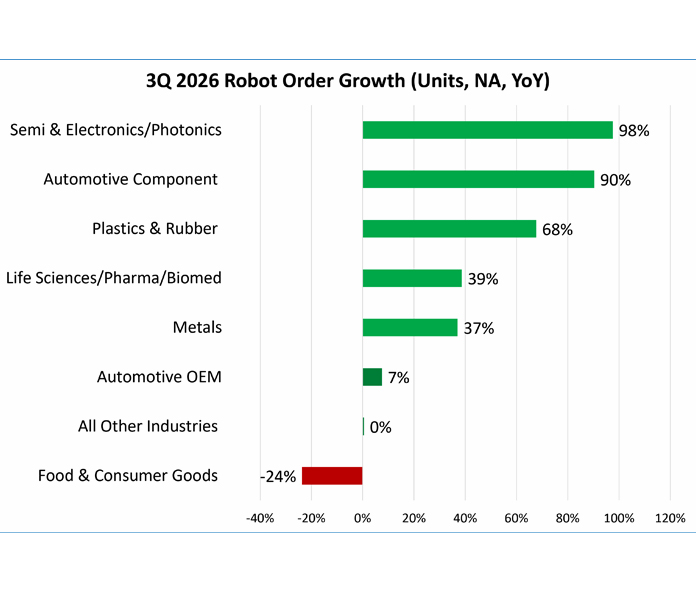
A3 released its third-quarter North American order figures on October 29. Companies ordered 10,989 robots worth $723.5 million, up 24.8% in units and 26.1% in value from the third quarter of 2025. That works out to about $65,800 per robot on average. The first nine months come to 28,984 robots and about $1.89 billion, up 9.6% and 13.3%. The growth is not in cars. Automotive OEM orders rose 7.5% in the quarter and are still 17% below last year over nine months. Automotive components rose 90.4%, semiconductors, electronics and photonics 97.6%, plastics and rubber 67.7%, life sciences and pharma 38.7%, metals 37.0%. Food and consumer goods fell 23.7%. Collaborative robots were 1,831 units and $63.8 million in the quarter, up about 56% in units, and 16.7% of all robots ordered; in life sciences, cobots are 43.8% of orders for the year. Alex Shikany, A3's executive vice president, said what mattered was "how broadly it was distributed across the market." A3 pairs the figures with a September ISM manufacturing PMI of 54.5, the ninth month of expansion. These are orders placed with A3's reporting members, not shipments or installations.
Unitree's first earnings release since its August 19 listing on Shanghai's STAR Market came on October 28. Third-quarter revenue was 665 million yuan, up about 70% from a year earlier. Net profit attributable to shareholders was 112.7 million yuan, down 17.4%, against an analyst forecast of 224 million yuan cited by Reuters. The reason is research spending: R&D was 127 million yuan, up 249.6%, or 19.1% of quarterly revenue, which Reuters attributes to embodied-intelligence models, computing capacity and the research team. Over nine months, revenue rose 55.7% to about 1.82 billion yuan and attributable net profit rose 270.5% to 386.7 million yuan, but Unitree itself attributes part of that increase to a large one-time share-based payment expense in the 2025 comparison period. The nine-month profit growth is a low base, not an acceleration. The revenue figure covers quadrupeds, humanoids and components together; Unitree does not break out humanoid sales.
Read together, the two reports describe different markets. The A3 number is installed industrial automation bought by factories that already use robots, and the quarter's growth came from electronics and components plants rather than the automakers that drove the last cycle. Unitree's number is a company selling research platforms and consumer quadrupeds that has chosen to spend a fifth of revenue on models and compute while its net margin falls from about 35% a year ago to about 17%. Neither report says anything about humanoid deployments at scale, which remain a story of pilots, commitments and preparation requests.