Robotics Briefing — compiled and curated by Chris Lee
Figure locks the Figure 04 design, says Figure 03 costs 90% less than Figure 02, and reports Helix 2.5 finishing 237 of 420 chores in homes it had never seen
Week of October 20 – October 27, 2026
A public recording of Figure's all-hands meeting went up on October 22. It put Figure 04 at design lock, Figure 03 at more than 90% below Figure 02's cost, and Helix 2.5 at 237 successes in 420 trials in homes the robot had never seen. Agility had a week of announcements of its own: an AGCO factory pilot, two more GXO sites, NVIDIA IGX Thor as the only onboard computer in Digit 5, and three paying manufacturing customers it will not name. ETH Zurich published a paper in which a Unitree G1 climbs ladders and vaults boxes by planning where its body will touch the world, trained from 13.2 minutes of human motion. Three rounds closed around the idea that robots need to feel force: Eka at $150 million, Bedrock Robotics at $600 million for autonomous excavators, and Enact at $30 million for motors that measure it. And AGIBOT put 110 production humanoids through a 5-minute-43-second dance in Jinan for a Guinness World Records certificate.
Humanoids
Figure 04 is at design lock, Figure 03 costs 90% less than Figure 02, and Helix 2.5 finished 237 of 420 trials in homes it had never seen
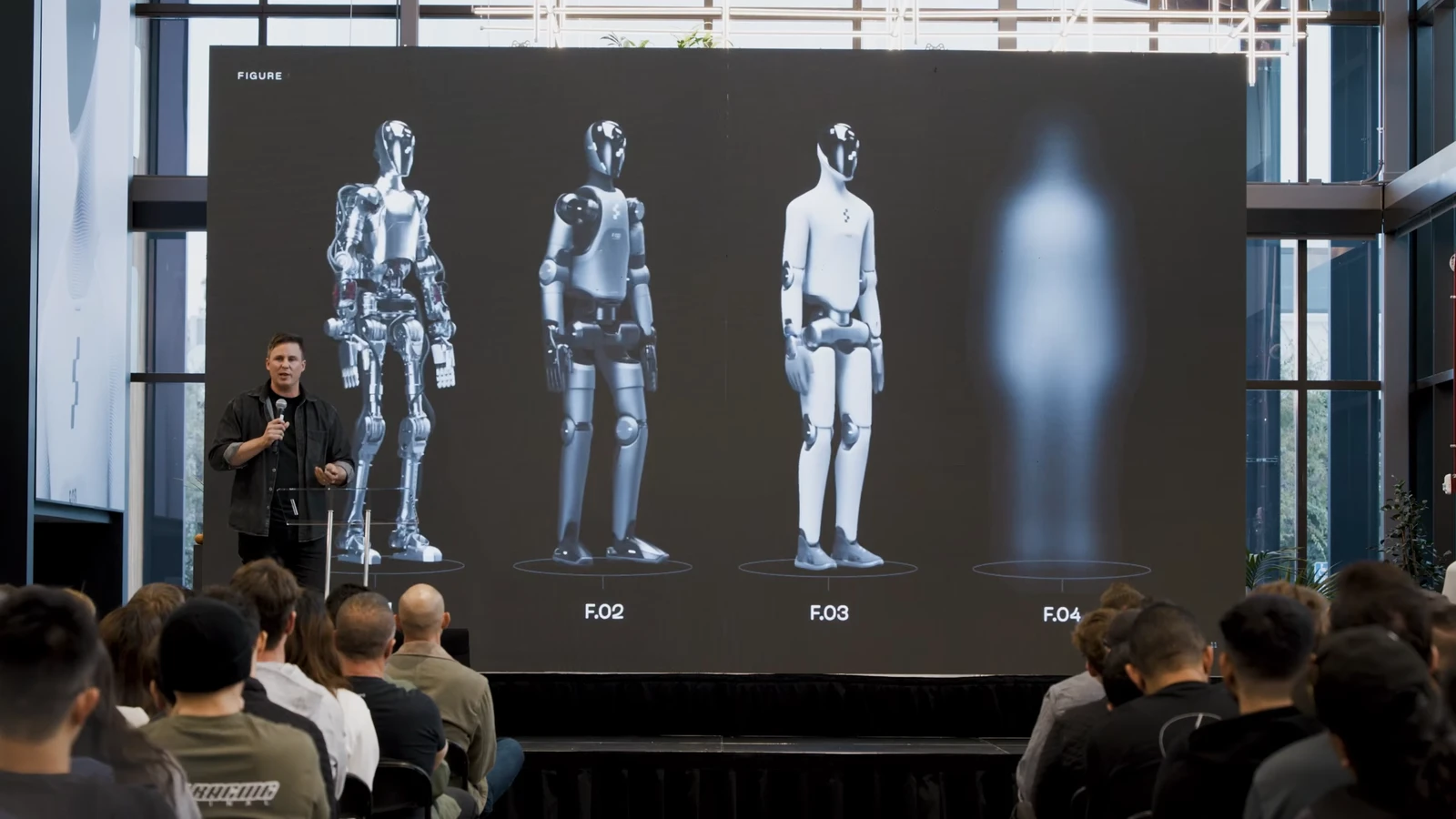
Brett Adcock presents Figure's robot generations at the all-hands meeting. Figure 04 is blurred on the right of the slide. A screenshot of Figure's video. Credit: Figure, via Humanoids Daily.
A public recording of Figure's internal all-hands meeting went up on October 22, and Humanoids Daily went through it the next day. The hardware news is that Figure 04 is in "design lock," in Brett Adcock's words. Parts are shipping. Ten full battery packs were brought up the week before the meeting, with load and thermal testing next. Actuators are running in the test lab. The hand is on its fourth iteration, and Adcock said the team spent months on fingertip tracking at millimeter precision against human references. He called it "approaching human parity." No dexterity benchmark was shown. Two cost numbers: Figure built its 1,000th Figure 03 over the summer, and unit cost fell more than 90% from Figure 02 to Figure 03. No absolute cost and no customer price were given. Figure 04 itself stayed blurred on the slide.
The data numbers are the ones to keep. Index, the creator app Figure launched in August after it could not buy the video data it wanted, is now at 37.5 million uploads from 112 countries, up from 16 million from 108 countries at launch. The app has 1.26 million downloads. In the week before the meeting, 210,000 people uploaded at least one video and Figure's estimated data spend was $8.1 million. Those are company figures, and an upload is not the same thing as a cleaned, annotated clip in a training set. Figure processes the footage to track hands and bodies for Helix pretraining. The evaluation that matters: Helix 2.5 was tested in 30 rented homes the robot had not seen, on three chores it had been trained on elsewhere. It succeeded in 237 of 420 trials, about 56%. That is evidence of transfer and a large reliability gap in the same number.
Compute and money were the rest of the meeting. The Nscale agreement started at $3.5 billion with an intent to scale to $6 billion, aimed at NVIDIA Vera Rubin infrastructure in West Texas due online in 2027. Figure planned to roughly double near-term compute within about a week and a half. Cash on hand was reported above $2 billion after additional capital; terms were not detailed, and the company did not call it a new round. Robots are working in three states, with customer names held pending approval. The 200-hour logistics run from earlier this year was continuous operation with robots swapping out to charge, not one robot on one charge. Adcock showed a teaser for Helix 3.0, said a larger model is weeks away, and called the internal result "baby AGI." The recording gives no evaluation detail that would let anyone check that.
Agility's week: an AGCO factory pilot, two more GXO sites, NVIDIA IGX Thor as Digit 5's only computer, and three paying customers it will not name
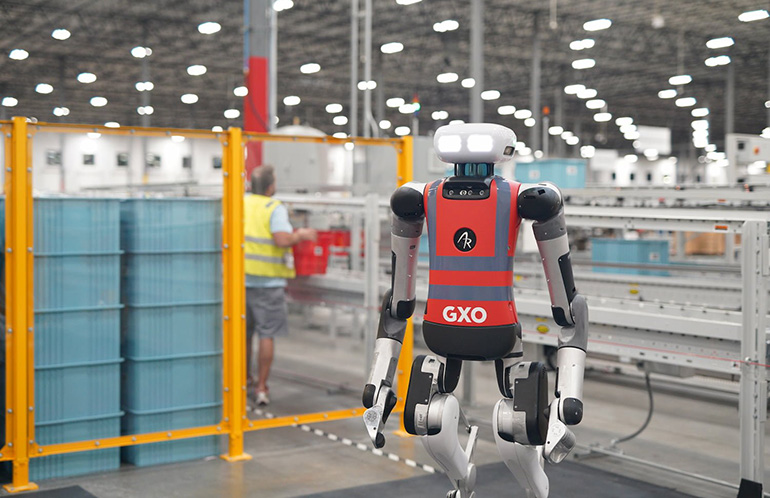
Digit at work in a GXO facility. Credit: Agility Robotics, via The Robot Report.
Agility Robotics put out five press releases in seven days, timed around an investor call on October 26 and a merger vote on November 2. The first, on October 20, is a commercial agreement with AGCO for a Digit pilot at its Hesston, Kansas plant, expected to start in 2027. The jobs named are parts sorting and stacking and placing totes for storage. AGCO's Thomas Enghof called the robots "teammates" and said the goal is resilient systems with "strict safety governance." No robot count, no contract value. On October 21 Agility announced a 50,000-square-foot Pittsburgh expansion for deployment and service work. On October 22 it said Digit 5 will standardize on NVIDIA IGX Thor modules, making NVIDIA the exclusive onboard compute supplier for the general-availability robot. Agility is folding IGX Thor and additional NVIDIA Halos models into its own safe-human-detection system, and will put Digit through the NVIDIA Halos AI Systems Inspection Lab before third-party certification. Early access to Digit 5 is still the first half of 2027; general availability by the end of 2027.
October 26 brought the customer news. GXO will deploy Digit at two more U.S. e-commerce sites, Statesville, North Carolina, and Lebanon, Tennessee, starting in early 2027 with Digit 4 and moving to Digit 5 when it is available. The relationship began with a pilot at Flowery Branch, Georgia in late 2023 and became a multi-year RaaS agreement in June 2024. The release repeats the figure that Digit has moved more than 100,000 totes there. GXO CEO Patrick Kelleher said the expansion "reflects our confidence in the technology's ability to create measurable value." On GXO's August earnings call he said the company had not yet achieved ROI on humanoids and that it was "a couple of years away," after 45 pilots. The Robot Report asked GXO to reconcile the two and had not heard back at publication. No robot count or contract value was given for the new sites either.
The same day Agility said it has three more paying manufacturing customers: a global automaker that sells more than three million vehicles a year, one of the largest automotive component developers, and a global consumer products maker. All three asked not to be named. Agility also counts more than 30 prospects in talks or in its Customer Acceleration Program, and two early-stage subcontractor leads tied to a branch of the U.S. Armed Services with no agreements signed. The $300 million in committed Digit 5 orders is restated with its caveat: potential multi-year value, subject to milestones and specifications, not revenue. The whole week reads as a pre-vote prospectus. The verifiable parts are the AGCO and GXO names, the Thor supplier decision and the dates. The three unnamed customers and the 30 prospects are not verifiable from outside.
ETH Zurich's G1 climbs ladders and vaults boxes by planning where its body will touch, from 13.2 minutes of human motion and no reference at runtime
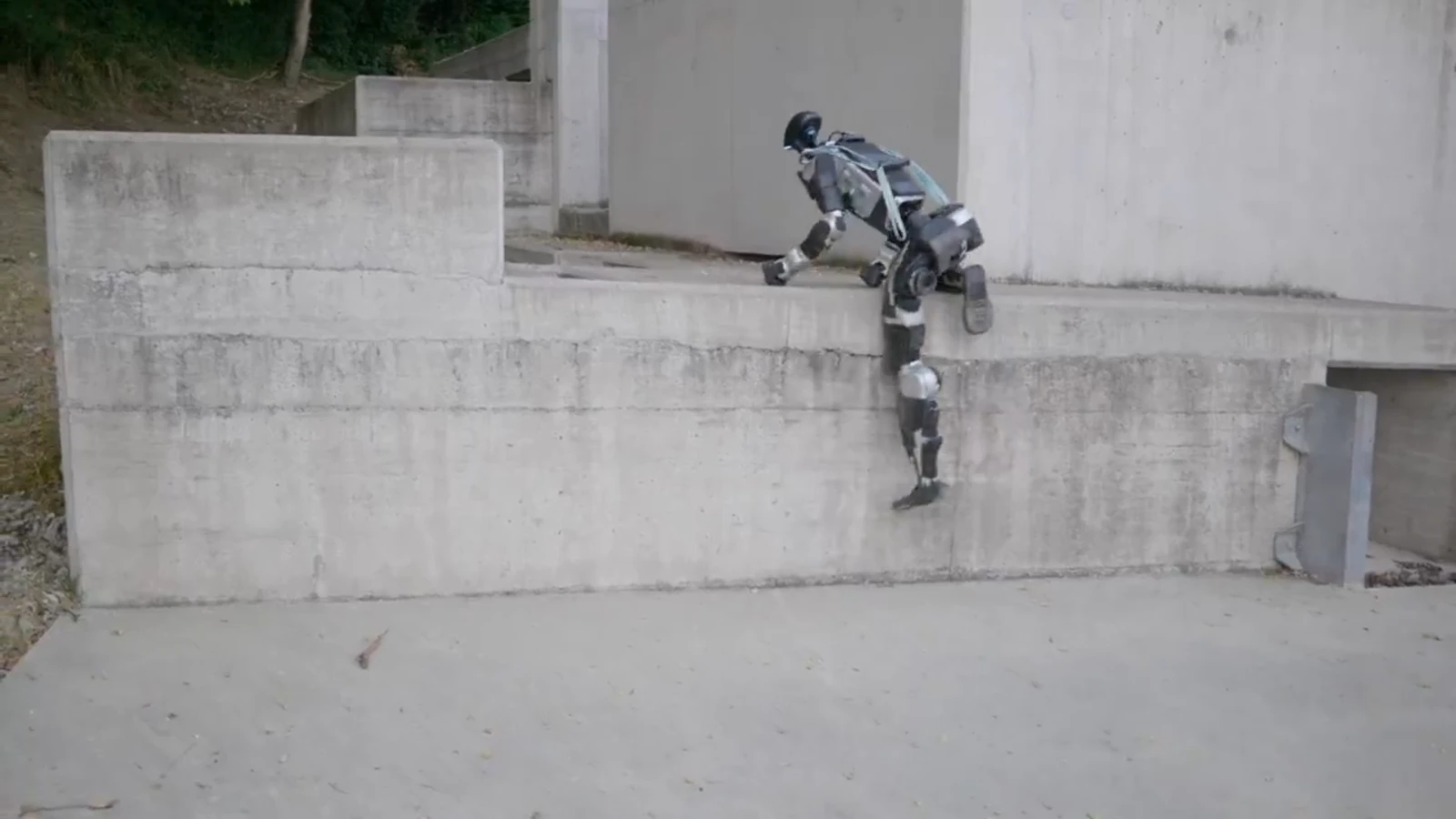
The Unitree G1 climbs onto a concrete platform using its hands and a knee. A screenshot from the ACP project page. Credit: Robotic Systems Lab, ETH Zurich, via Humanoids Daily.
The paper is "Humanoid Mobility via Attention-based Contacts," submitted to arXiv on October 22 by Junzhe He, Kehan Wen, Chong Zhang and seven others from ETH Zurich's Robotic Systems Lab, the ETH AI Center, NVIDIA and Apple, with Marco Hutter as senior author. Humanoids Daily covered it on October 25. The idea is to make contact the interface between perception and control. Reinforcement learning alone generalizes across terrain but struggles to produce coordinated whole-body motion. Motion-capture tracking produces natural motion but only for the trajectories in the data. ACP uses 13.2 minutes of human motion as a training prior only. A self-supervised, attention-based planner predicts where nine body parts (hands, elbows, knees, feet, pelvis) will touch the environment up to 1.5 seconds ahead, from a LiDAR height map, the robot's state and a goal. A second network turns that 9-by-3 contact plan into commands for 23 joints. Both run onboard at 50 Hz. At deployment there is no reference motion.
The hardware is a stock Unitree G1 with a head-mounted LiDAR. Mapping runs on the Jetson Orin NX's CPU, on a 3 cm grid, with each 10 Hz scan folded in under 30 ms. The project page shows nine skills from one policy: ladders, stage climbing, stairs, stepping stones, a balance beam, vaulting, jumping down, sitting and getting up. Composite courses chain them, ladder then jump down, vault then climb. The recovery clips are the useful ones for anyone who runs legged robots: a slip during a ladder climb, a failed jump down, and a fall caused by an artifact in the map, each followed by the robot getting up and continuing.
The number in the paper is from simulation. On eight composite courses, ACP averaged 92.5% success against 58.8% for MGMT, a motion-generation-and-tracking baseline from the same group. Sensor noise, physics randomization and action delay were turned off for that comparison to isolate terrain. There is no real-world success rate. Some of the unstructured routes used hand-placed intermediate waypoints; global navigation is out of scope. The authors say the contact representation does not handle overhead contacts, hanging or manipulation, and that a contact sequence cannot tell a vertical jump from a backflip. The paper is listed as under review, and the main video on the project page was still marked "TBD" when this issue was written.
Three rounds built on force: Eka's $150 million vision-force-action model, Bedrock's $600 million for autonomous excavators, and Enact's $30 million to measure force in the motor
An Eka Robotics arm and gripper, in the company image SiliconANGLE ran with its report. Credit: Eka Robotics, via SiliconANGLE.
Eka Robotics, in Cambridge, Massachusetts, announced a $150 million Series A on October 20, led by Andreessen Horowitz and F-Prime, at a reported $1.45 billion post-money valuation; Obvious Ventures and E14 Fund, who co-led the $11 million seed in May 2025, came back in. The founders are MIT's Pulkit Agrawal and Tuomas Haarnoja, who co-created Soft Actor-Critic and trained small soccer-playing humanoids at Google DeepMind. Eka calls its model vision-force-action. A custom gripper with more force sensors than a standard one tells the model how hard it is holding something, so the robot can tighten a slipping grasp mid-task or ease off when an insertion meets resistance. Training is reinforcement learning in physics simulation, then transfer to hardware. The company's numbers: about 1,500 picks an hour on objects outside the training data against a human baseline of about 600, objects up to 1 kg, success above 95%, a gripper under $1,000 rated for 5 million cycles with a 20 million target. Pilots with unnamed industrial customers cover pick-and-place and wire handling; the demos include screwing in light bulbs and packing strawberries. Kris Hauser at the University of Illinois told SiliconANGLE the demo was impressive and asked the two right questions: whether it runs a year on a line without failure, and whether it generalizes past pick-and-place.
Bedrock Robotics, in San Francisco, closed a $600 million Series C on October 26 at a $4.1 billion valuation, co-led by CapitalG and Emergence Capital, with USIT, Bessemer and Temasek new and NVIDIA among the returning investors. Total funding is close to $1 billion. Bedrock retrofits excavators for fully autonomous work on live commercial sites, which it began a few months ago, two years after leaving stealth. Its anchor contractor is Haydon in Texas, with regional partners in Minnesota, Florida, Georgia, Missouri and Virginia, on data-center, healthcare and heavy-civil jobs. CEO Boris Sofman told The Robot Report that "New customer demand is very high" and that 2027's goal is "triple-digit" machines operating autonomously nationwide. On installed base and unit economics he said, "It's a bit early to give concrete numbers." Bulldozers, articulated dump trucks and wheel loaders are next. The labor statistics in the release (20% of construction workers over 55, 87% of firms with open hourly craft jobs) are unsourced.
Enact Intelligence, in Zurich, came out of stealth on October 22 with a $30 million pre-seed, which Sifted called the largest in Switzerland. Redalpine and Notion Capital co-led, with firstminute capital, and Yann LeCun, Mistral's Arthur Mensch and Path Robotics' Andrew Lonsberry as angels. Founder Manuel Yves Galliker led the software team that taught 1X's NEO to walk and then worked at Physical Intelligence. The company was founded in March and has about a dozen people. The pitch is force sensing inside the actuator rather than tactile skin: motors that measure force more than 1,000 times a second, with the motor, controller and model developed together. Target jobs are the end of the assembly line, inserting cables, seating seals, handling screws, on short runs where per-task programming does not pay. Galliker predicts richer force feedback could cut training for a new task from months to days. Enact says its first motors exist and the approach is validated. No test results, insertion accuracies, cycle times or customers have been published.
110 production AGIBOT humanoids dance for 5 minutes 43 seconds in Jinan, on UWB positioning and a fleet controller that re-forms a group if one robot drops off
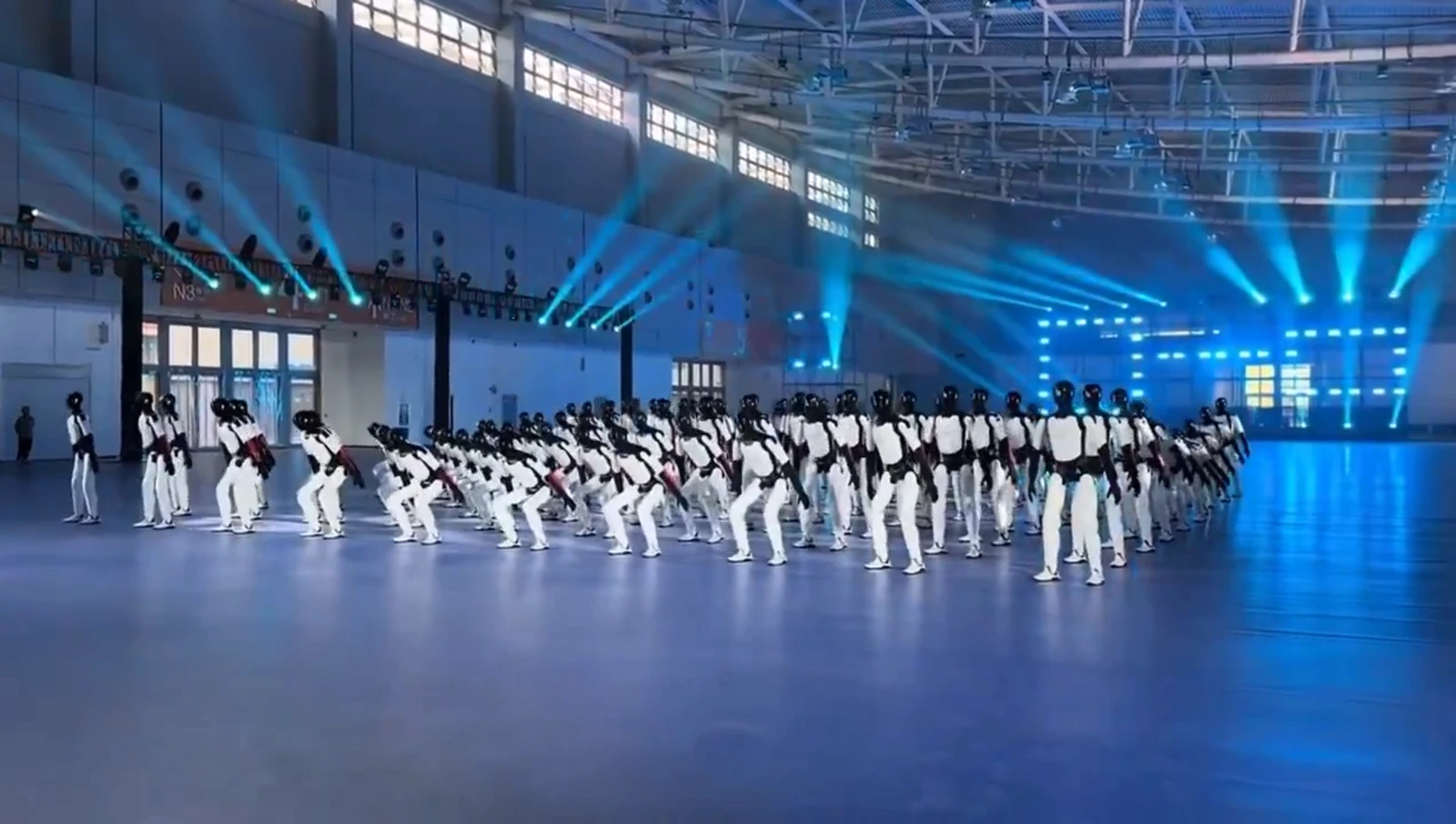
AGIBOT Expedition A3 humanoids in formation in Jinan. A screenshot from event footage. Credit: AGIBOT, via Humanoids Daily.
On October 24, at the Yellow River International Convention and Exhibition Center in Jinan, AGIBOT ran 110 full-size Expedition A3 humanoids through a synchronized routine that Pandaily, citing Chinese reports, clocks at 5 minutes and 43 seconds. A Guinness World Records judge was present and handed over a certificate for "most humanoid robots dancing simultaneously." Global Times reports the routine included repositioning, jumping, flips and formation changes; a Wen Wei Po reporter described wave patterns and countdown numerals drawn by the formation. AGIBOT's Wang Chuang said the robots were standard production units, not tuned show machines, and credited the result to "standardized joint calibration, torque settings and motion libraries." The fleet software is LinkBots. AGIBOT describes 5G and Wi-Fi links, ultra-wideband positioning it calls centimeter-level, "millisecond-level synchronization," and a behavior where a robot that loses its connection triggers a local re-forming of its group rather than a stop of the whole show.
For a show-control reader the interesting comparison is with Unitree's UniUni from last week's issue, which puts each robot on its own timeline track with an operator in the loop. AGIBOT has not published its authoring tool, its maximum fleet size, its latency or how a move is checked before execution. One hundred ten robots in one hall with no reported collision is a real number; the rest is marketing language until a spec sheet exists. The record category also needs a footnote. Guinness's existing "most robots dancing simultaneously" title stands at 1,372, set in Rome in 2018 with UBTECH Alpha 1S robots under 40 cm tall, which Guinness counted as humanoids. How the new "humanoid" category is drawn against that one has not been published. Humanoids Daily's own count of Unitree's Temple of Heaven show in February was about 46 to 49 G1s.
AGIBOT says the robots go on to tourism performances, public services, exhibitions, research and education. The policy backdrop is the same one that moved Unitree's share price last week: Global Times quotes an MIIT official at an October 19 press conference saying Chinese companies have developed more than 400 humanoid models and built more than 40,000 units in the first half of 2026, with annual output expected above 100,000. Those are government aggregates with no per-company breakdown. Separately, ROKAE said on October 26 that it has delivered its 10,000th force-controlled humanoid arm, a count of arms rather than robots, and named five Helios wheeled humanoids working on Schaeffler's Taicang assembly line. Schaeffler has published no output rate for that line.