Robotics Briefing — compiled and curated by Chris Lee
Agility's co-founder says he cannot love the 120 kg Digit 5, and explains why safety hardware and a 240 A charger made it that way
Week of October 13 – October 20, 2026
Jonathan Hurst, who co-founded Agility Robotics, published an essay in IEEE Spectrum on October 19 that says Digit 5 "feels more like a forklift" than the humanoid he wanted to build, and then explains each compromise. The same week Agility named Nyobolt as the battery supplier behind the robot's 9-minute charge, and the SEC declared its merger paperwork effective with a shareholder vote set for November 2. Boston Dynamics put out a shop-floor video that says an Atlas takes about a day to build. Figure's Brett Adcock reported a Figure 03 at 348 miles on a treadmill and still walking, and Elon Musk spent part of an interview on why Optimus hands are the hard part. Stryker invested $400 million in CMR Surgical and took an option on the rest of the company. Physical Intelligence opened a cloud API for fine-tuning its robot models, and X Square Robot published a benchmark that measures how well simulation scores predict hardware results. Phybot showed a 23-DoF direct-drive hand at the Canton Fair, and Rhoda ran a robot blindfolded on touch alone. Unitree shipped UniUni, a choreography and monitoring tool for robot stage shows, two days before its shares jumped 16% on a guidance document from Beijing.
Humanoids
"I cannot love Digit 5": Hurst explains the legs, the battery that fills 75% of the torso, and the robot that sits down
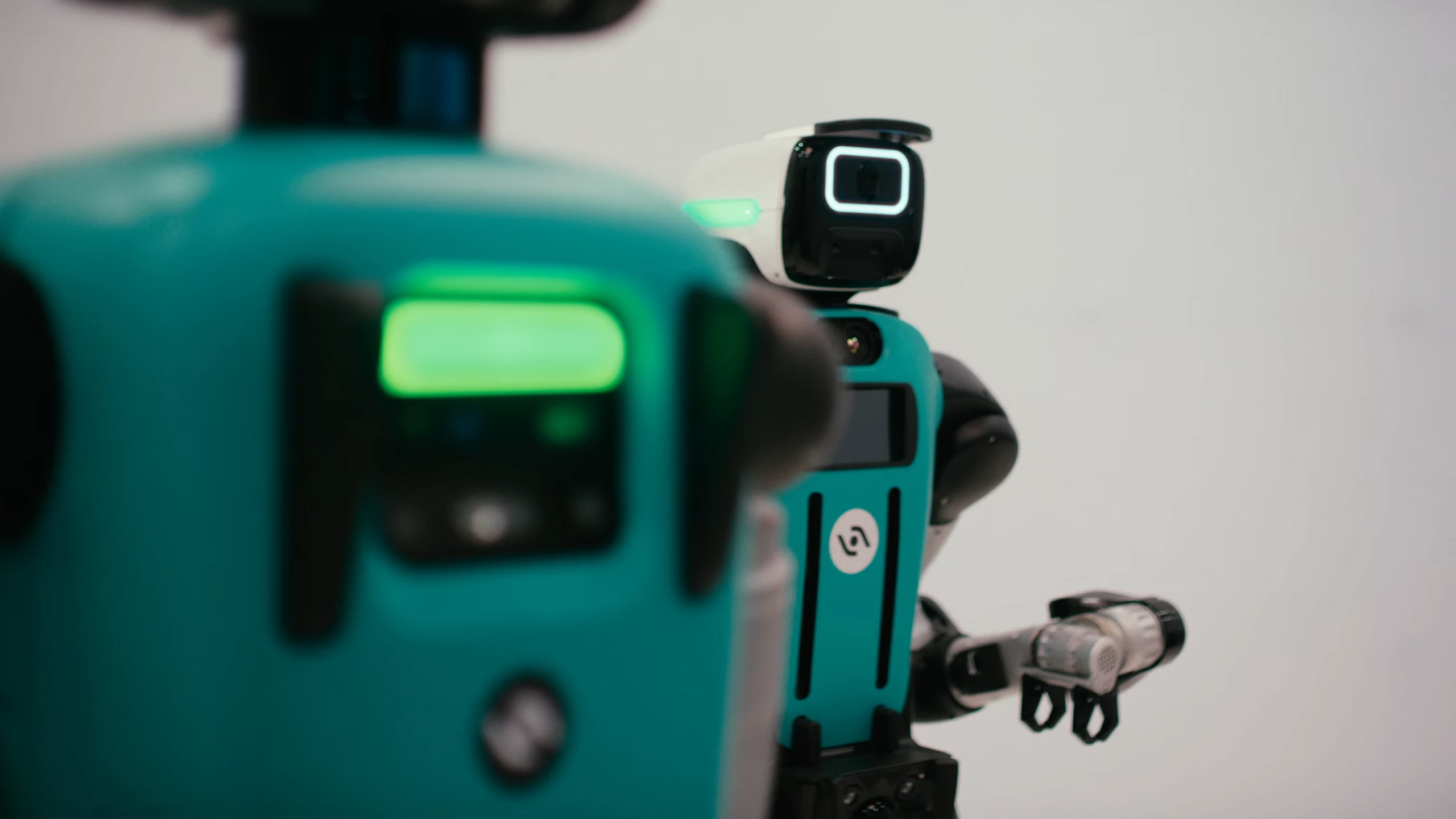
Digit 5, in a frame from Agility's introduction video. Credit: Agility Robotics, via Humanoids Daily.
Jonathan Hurst is Agility's co-founder and chief robot officer, and a robotics professor at Oregon State. His IEEE Spectrum essay, published October 19, is the most candid account of Digit 5 so far. The robot weighs more than 120 kg. It is built to lift 23 kg bins onto shelves 1.75 m high, over and over, within NIOSH lifting guidelines, and to work 20 hours a day. Hurst writes that it is the largest, heaviest and most expensive robot Agility will ever build. He also writes: "But I cannot love Digit 5." It is "exactly the robot it needs to be right now rather than the robot I dreamed of." It can no longer run or jump.
The mechanical reasons are specific. The backward, bird-like legs of earlier Digits were dropped because the ankle struck the ground in a deep squat. With humanlike legs, the knee and hip motors both contribute torque when the robot stands up under load. The battery and its cooling system fill about 75% of the torso. Fans push air through channels in the chest. The charging dock delivers 240 A at 48 V, enough that Hurst says the thick cables visibly move under magnetic force. The motors have to be strong enough for the lift and precise enough to control contact force. Safety added the rest of the mass. Safety-rated sensors sit in protective housings. Isolated computers handle the safety functions. When a person approaches, the robot stops, sets down its load, sits on the floor and cuts motor power before any contact. Agility spent two years on that behavior and calls it the only near-term way to verifiably reduce risk. CE marking, UL electrical safety and FCC emissions limits drove many of the other choices. Hurst says aesthetics and graceful motion were deferred every time they competed with function. The design came from ten mapped use cases, and the RoboFab plant in Salem, Oregon, is sized for more than 10,000 Digit 5s a year.
The battery supplier is now public. Agility announced on October 15 that Nyobolt, of Cambridge, England, will supply Digit 5's fast-charging pack. The numbers are the ones Agility gave at launch: 90 minutes of work, then a 9-minute charge, a 10:1 run-to-charge ratio against Digit 4's 2:1, and more than 20 working hours in a day. Nyobolt describes proprietary anode materials, its own cell design and integrated power electronics. Neither company gave a chemistry, a pack capacity, a C-rate or a cycle-life figure. Nyobolt's CEO Sai Shivareddy said the technology was chosen because "Digit 5 will need more power from a smaller, lighter pack." Agility's Daniel Diez: "For our customers, Digit's uptime is the business case." Nyobolt was founded in 2019 and reached a $1 billion valuation in May after a $60 million raise with Symbotic's backing. Early-access Digit 5 units are still expected in the first half of 2027, with wider availability over the following six to nine months.
The paperwork moved too. The SEC declared the Form S-4 for Agility's $2.5 billion merger with Churchill Capital Corp XI effective on October 13. Churchill shareholders vote on November 2, and the combined company expects to list on Nasdaq as AGLT in November. Humanoids Daily puts the gross proceeds at more than $620 million: about $424 million in the Churchill trust if no one redeems, plus a roughly $200 million PIPE led by Foxconn. The trust number only holds if shareholders stay in. Effectiveness is a filing milestone, not a sign-off on the business.
Boston Dynamics builds an Atlas in about a day, a Figure 03 has walked 348 miles without stopping, and Musk explains why the hands are late
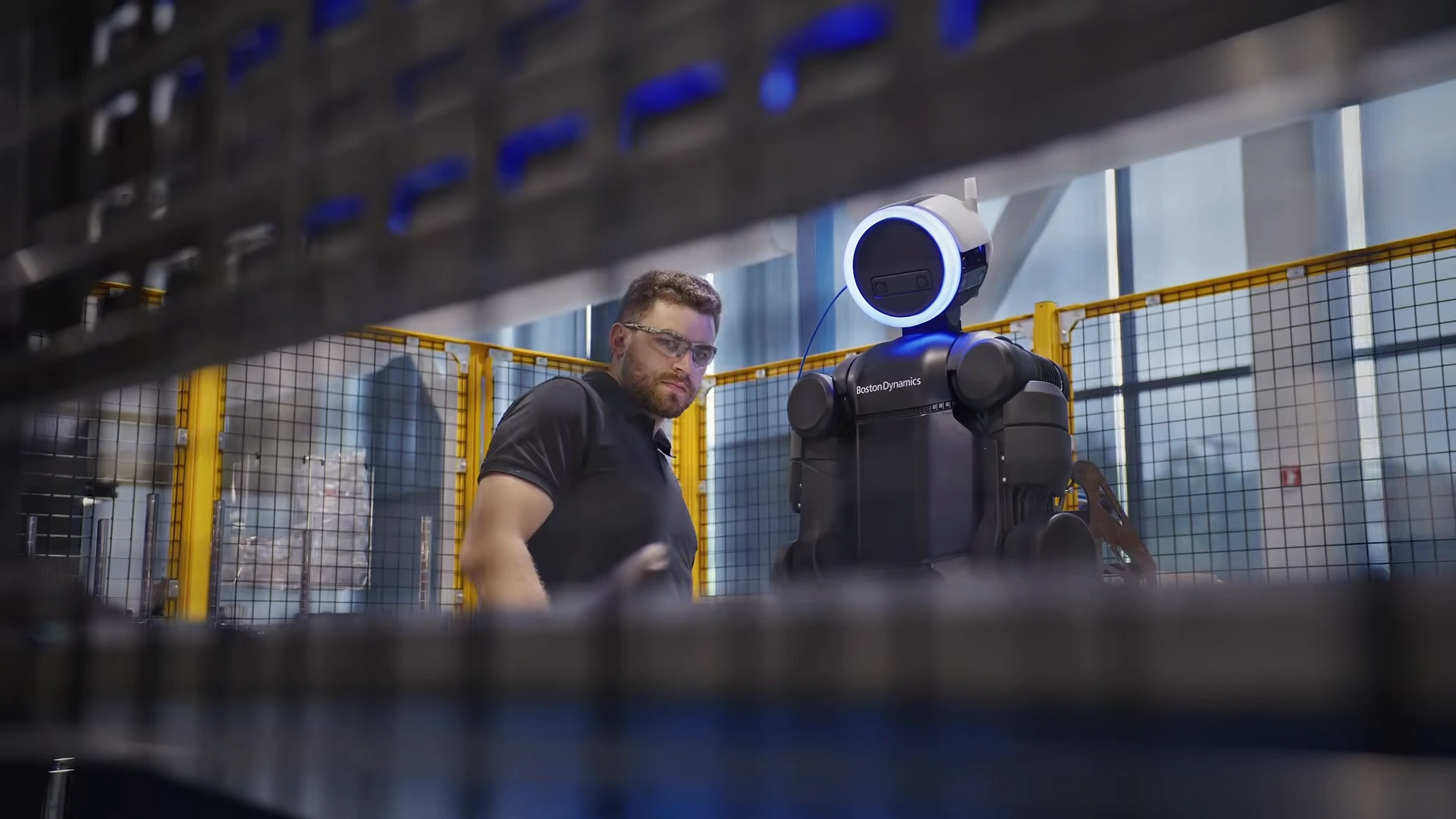
A technician beside Atlas in Boston Dynamics' prototype-operations video. A screenshot of the YouTube video. Credit: Boston Dynamics, via Humanoids Daily.
Boston Dynamics released a six-minute video, "Machine, Assemble, Repair: How We Build Atlas," and Humanoids Daily covered it on October 14. Katie Conner, a senior technical program manager, says building an Atlas now takes about a day. The goal for next year is about an hour, and she describes a path to minutes after that. The prototype operations group combines machining, assembly and repair on one floor laid out like a production line. The machinists say the gear cutting and the tolerances are why the work stays in-house. Engineers walk over, talk through a change and get parts the same day or the next. Staff describe an idea on Monday becoming hardware by Friday. Robot arms do some of the assembly. The video is also a recruiting piece and ends on the careers page. It gives no shipment rate. The one-hour figure is a target, not a result. For comparison, Figure claimed one robot an hour of line throughput at BotQ in April, and AGIBOT announced its 20,000th robot in September. Those are different measures: line rate and cumulative output, not time per robot.
Figure's test is about what happens after the robot is built. On October 19 Brett Adcock posted that a Figure 03 had walked nine straight days on a treadmill, 348 miles and 1.2 million steps, and was still going. "Started as a side project to stress the robot for any failures," he wrote. "Let's see how long it can go." It follows the 200-hour autonomous sorting run earlier this year that Figure said finished with no hardware failures, with robots rotating through charging. The post gives no protocol, no power setup and no maintenance log. Nine days of walking is a joint and actuator endurance number. It says nothing about the hands, the battery on a single charge or a shift of real work.
Elon Musk took the hands apart, verbally, in an X Takeover interview on October 10 that Humanoids Daily summarized on October 13. The requirements he listed: fingers that manipulate small objects while applying force, touch sensors that survive repeated deformation, and replaceable outer coverings that grip without slipping. His examples were signing a name, driving a small screw into wood, and opening a jar, where a rubber finger covering can rotate around the structure beneath it. He said China's export restrictions on motor magnets delayed the program by two or three months last year and left Tesla with robots "without arms," in Humanoids Daily's paraphrase. He repeated that volumes will eventually be very high and said the start of the ramp will be slow. None of this says the problems are solved. Last week's issue covered Tesla's application for thermoformed tactile sensors. The interview does not say whether that design is on the robot.
Stryker puts $400 million into CMR Surgical, becomes its U.S. sales agent, and takes an option to buy the whole company
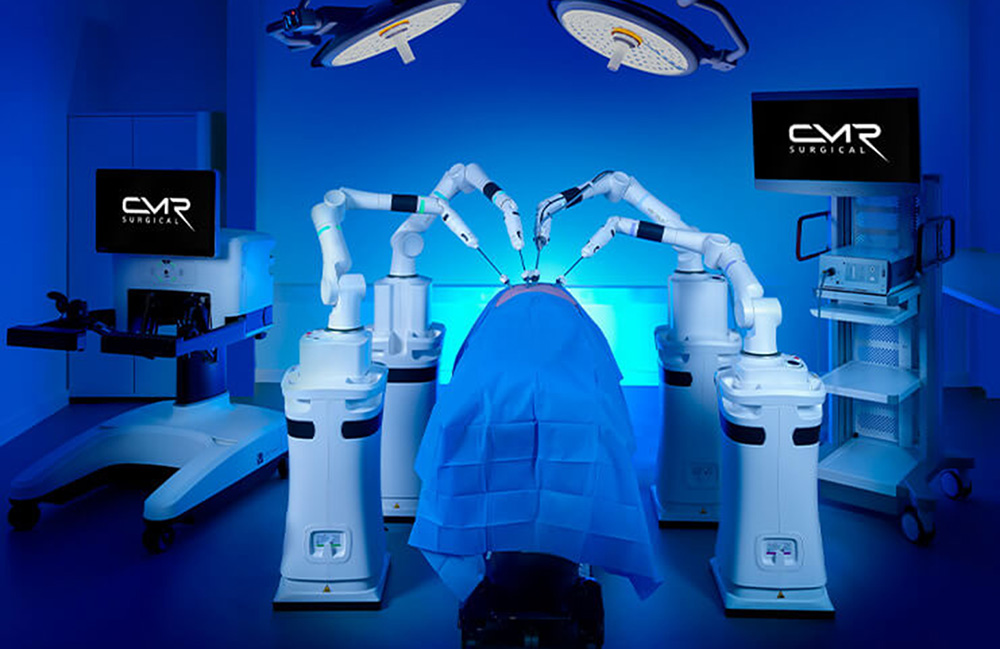
Versius in an operating room. CMR says the modular carts mean it does not need a dedicated OR. Credit: CMR Surgical, via The Robot Report.
Stryker and CMR Surgical announced the deal on October 12, and The Robot Report covered it on October 15. Stryker is making an approximately $400 million (£300 million) preferred equity investment in CMR, which is based in Cambridge, England. The investment comes with an exclusive option to acquire 100% of CMR's outstanding equity in the future, subject to the agreement's terms, and an exclusive agency agreement that makes Stryker the only U.S. sales agent for the Versius portfolio. CMR keeps development and sales outside the United States. Andy Pierce, Stryker's group president for medsurg and neurotechnology, joins CMR's board. The deal needs regulatory approvals and has no announced closing date. Neither company disclosed the stake Stryker gets for the money, the option price or when it can be exercised.
Versius is a soft-tissue system built as separate carts, one arm per cart, so it can be moved between rooms. CMR says it is used in hospitals in more than 30 countries and has done 45,000 cases. BTIG's Ryan Zimmerman, quoted by MD+DI, put the procedure count at more than 30,000, mostly outside the U.S. The two figures are not reconciled in either article. In the U.S., the second-generation Versius Plus has FDA 510(k) clearance for cholecystectomy, and CMR has filed a 510(k) for benign gynecological indications. That filing is pending, not cleared. Needham's Mike Matson told MD+DI that Versius Plus is the only U.S. soft-tissue robot with 5 mm instruments and that the addressable market is more than $12 billion.
Pierce's line in the release: "Soft-tissue robotics is a high-growth adjacency and a natural extension of Stryker's strengths in endoscopy." Stryker's robotics business until now has been orthopedic, with Mako. Zimmerman's read is that Stryker wanted into soft tissue for years and chose not to go "headfirst" against Intuitive, and that this structure puts it up against Medtronic and J&J first. The option is the part to watch. Stryker gets U.S. distribution and a look at the numbers before it decides whether to buy.
Physical Intelligence sells fine-tuning as a cloud service, and X Square publishes the number that says how much a simulation score is worth
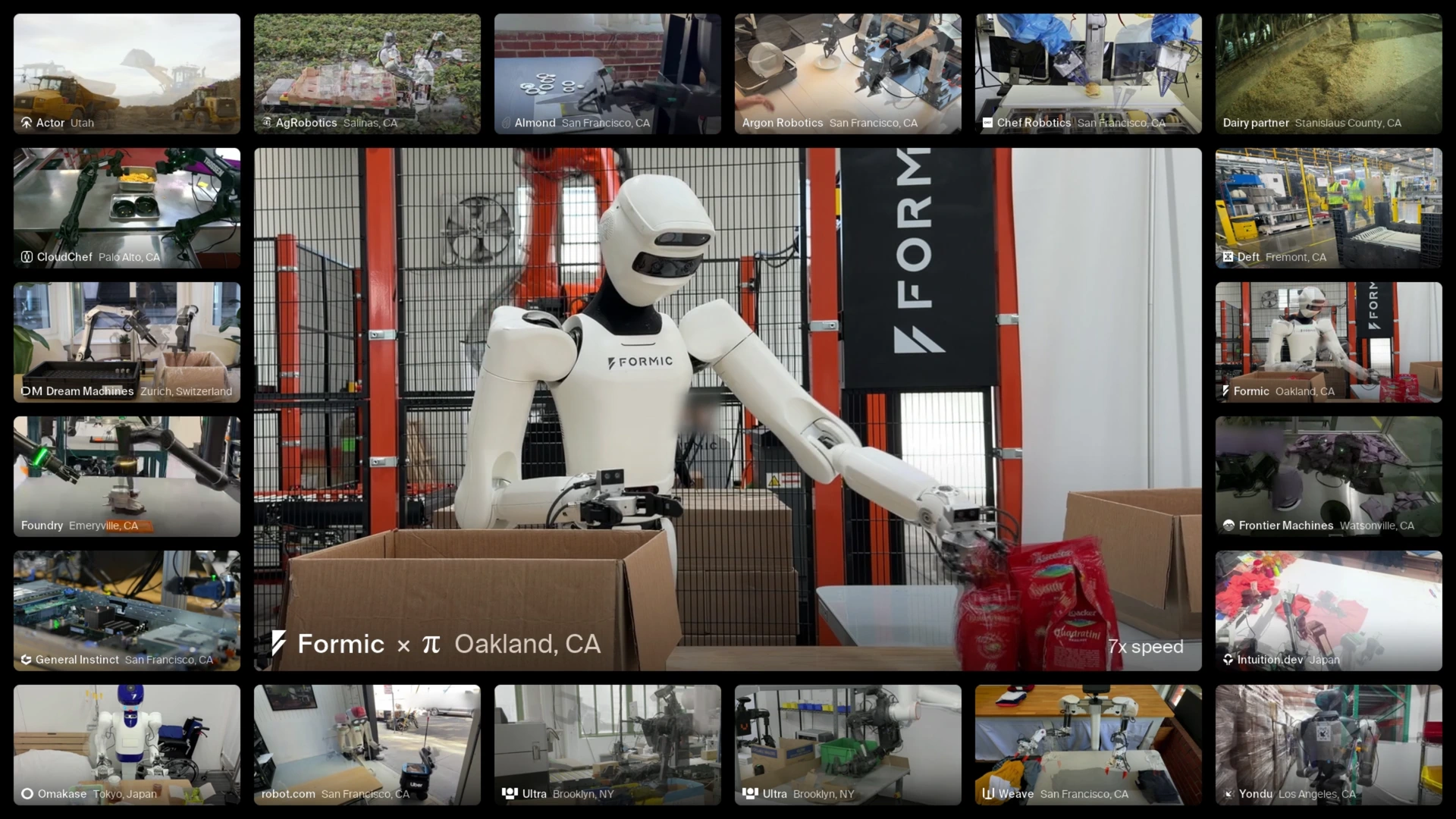
Robots from Formic and other teams in Physical Intelligence's API beta demonstration. The central clip is labeled 7x speed. A screenshot of the company's video. Credit: Physical Intelligence, via Humanoids Daily.
Physical Intelligence opened a beta of its Pi API on October 13. The pitch is that a robot company can adapt a general-purpose model without building any training infrastructure. The loop has four steps: upload demonstrations, launch fine-tuning on compute that PI manages, call the fine-tuned model through a hosted inference gateway, then look at the failures and collect more data around them. Inference runs in PI's cloud. The post says most of the showcased deployments used it that way and that some partners had network connectivity problems. The application form asks whether a team wants inference in the cloud, locally or both, which is a question and not a promise that local deployment exists. Access is by application, in small batches. No pricing was given. The models on the API are described as newer than the π0 and π0.5 weights PI publishes in its openpi repository, with "more data-efficient fine-tuning and improved capability." Users of openpi have to run data processing, training and policy serving themselves. The API is the managed version of that.
The examples are the interesting part. Almond, in San Francisco, used the API to get its dual-arm Axol robot deburring spacers for its own assembly line, and PI says the team got there in four days of iteration. Actor, in Utah, runs a wheel loader that scoops material and loads a dump truck with no operator aboard. Formic, Ultra, Weave, Chef Robotics, CloudChef, AgRobotics and others appear in the video. PI gives no success rates for any of them. The only hard number in the post is the four days.
X Square Robot released X2Real on October 19, a benchmark built on NVIDIA's Isaac Lab-Arena that asks how much a good simulation score tells you about a robot on real hardware. It has 44 tasks across 10 capability dimensions, from visual and language reasoning to tool use, and 73 runnable configurations across the ArtiXon Arm-6A, Quanta X1, ARX R5 and Franka platforms. The evaluation runtime is on GitHub. The assets and demonstration data ship separately, and the out-of-distribution task definitions, training tools and some data-generation tools are held back. The headline result: for its own WALL-OSS-0.5 model, trained without simulation data, the correlation between simulated and real performance across eight tasks was 0.84 for task progress and 0.74 for success rate. One task breaks the pattern. Placing glasses on a shelf succeeded in 70% of physical trials and in none of the simulated ones. The authors call the tool "a bounded evaluation tool, rather than a replacement for testing physical robots." Eight tasks and one model is a small sample. Deformable objects, fluids, dexterous hands and tactile sensing are all out of scope.
Phybot's 23-DoF direct-drive hand, Rhoda's blindfolded robot that finds things by feel, and Daimon's case for touch as infrastructure
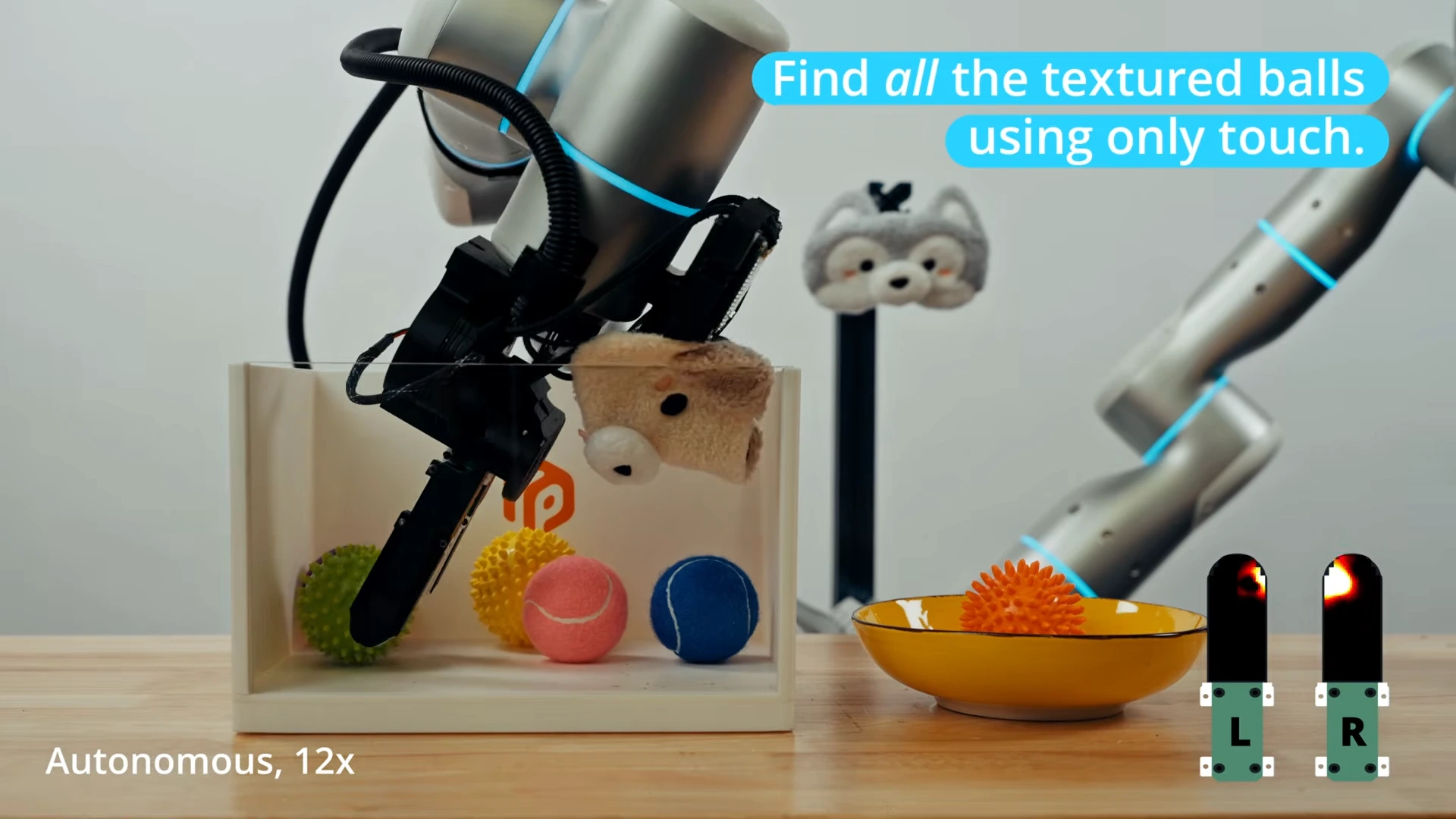
Rhoda's gripper searching a box of balls by touch, with sensor readings overlaid. A frame from the demo video, which runs at 12x speed in this section. Credit: Rhoda AI, via Humanoids Daily.
Phybot showed PhyHand at the 140th Canton Fair in Guangzhou, and Humanoids Daily wrote it up on October 19 from Jiemian, Pandaily and Yangcheng Evening News reports. The hand has 23 active degrees of freedom, counted as independently controlled axes rather than passive joints. Phybot calls it fully direct-drive. Pandaily puts the weight at 750 g and says each joint carries dual encoders. There are no force figures, no tactile specification, no price and no delivery date. The demo was rock-paper-scissors with fair visitors. Pandaily says lab validation and basic motion demos are done and testing on robot platforms is underway, with fine grasping still in development. For reference, Sharpa's 21-DoF hand from the September 29 issue came in under 750 g, and Unitree's 22-DoF hand from September 22 lists at $6,500. Twenty-three direct-driven axes in 750 g is a dense package. What it can hold is the open question.
Rhoda AI, in Palo Alto, published "Giving Robots a Sense of Touch" on October 13 and a video to go with it. The robot's head and wrist cameras were blocked. It searched a box of balls by touch, found the textured ones and pulled them out. Training used one smooth ball and one textured ball. Testing used seven, including two textured balls it had never seen that differed in diameter, firmness and surface pattern. Rhoda says it retrieved all three textured balls. The video shows wrong picks and a return to re-scan the box, and runs at up to 12x speed in places. The method extends Rhoda's video-action model to predict future tactile signals, and an inverse dynamics model turns those predictions into motion. The sensor is new and otherwise undescribed. Rhoda reports readings from a few millinewtons to more than 40 N, vibration sampled at about 500 Hz, and a feather-touch test after heavy loading that the optical and magnetic sensors it compared against did not register. The same sensors ride on a handheld UMI-style data collector. There is no trial count and no success rate. It is a demonstration.
Daimon Robotics made the business argument in an interview with The Robot Report's Steve Crowe, published October 19. Dr. Zhu, Daimon's partner and VP of technology, says the company is not building a foundation model. "By building tactile intelligence, we're actually playing the role as an infrastructure provider." Daimon's tactile feedback and control run at 30 Hz. It collects data through a handheld device it calls Umi and has talked about more than 10,000 hours gathered, with a program called Daimon-Infinity aimed at a million hours of tactile data. At IROS it showed robots applying heat-transfer designs to tote bags, threading bracelets and picking up and packaging broken glass. Lenovo Capital and Inovance are named partners. Customers are under NDA. On simulation for touch, Zhu was blunt: "Let's be frank; it's not good enough. It's kind of terrible." The article gives no sensor resolution, no price and no funding figure.
Unitree's UniUni puts a robot dance troupe on a timeline editor, and its shares jump 16% on a Beijing guidance document
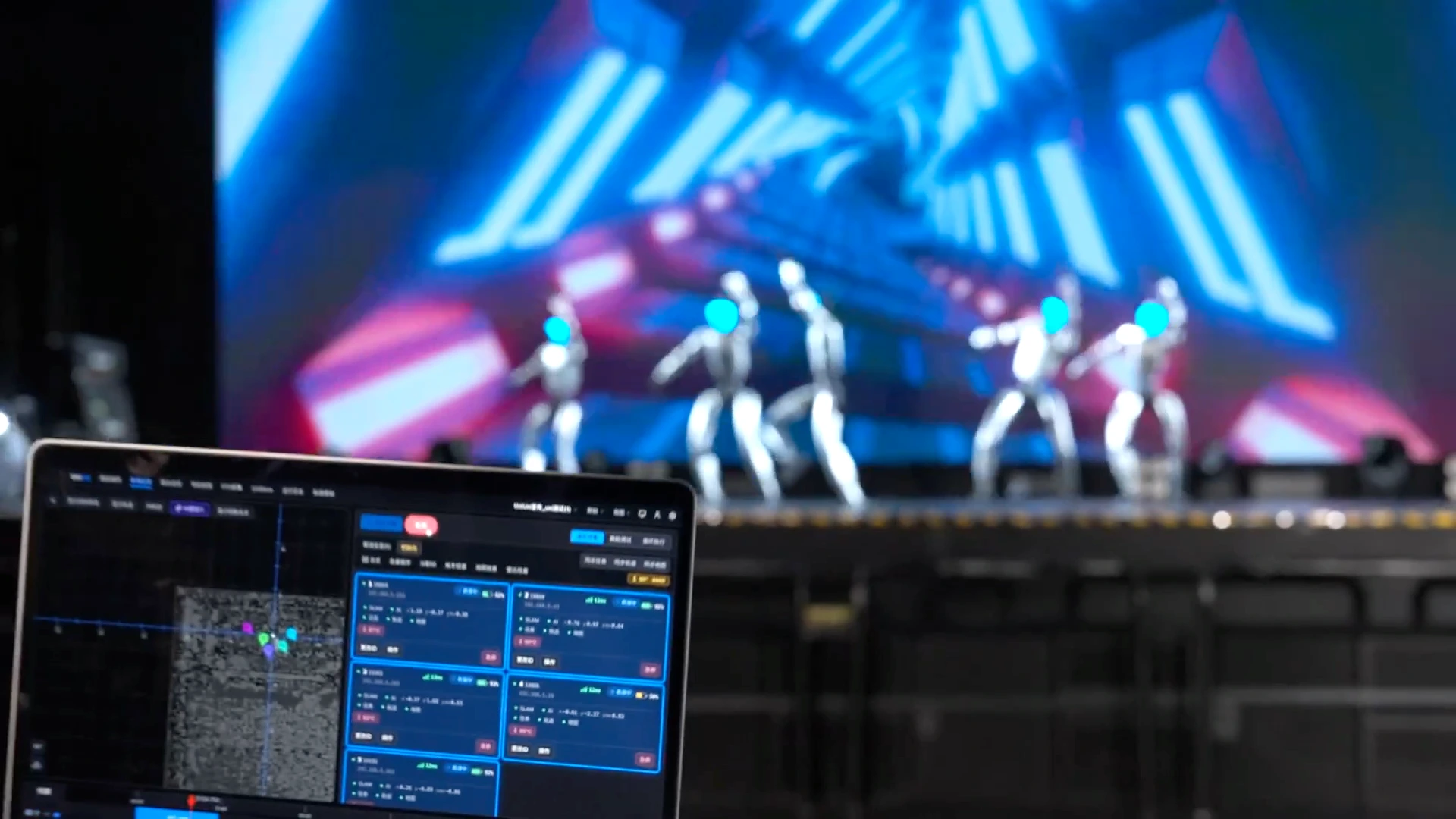
UniUni's control interface in front of a robot performance. A screenshot of Unitree's promotional video. Credit: Unitree Robotics, via Humanoids Daily.
Unitree announced UniUni on October 17. It is show-control software for fleets of its humanoids. A LiDAR scan builds a point cloud of the stage, which Unitree advertises as "centimeter-level scene construction." A choreography editor gives each robot its own timeline track and draws movements from an action library. A text box labeled "AI choreography" accepts natural-language changes next to a grid of robot positions. The monitoring view shows battery percentage and temperature per robot, low-battery warnings, and an emergency stop for each machine. The announcement also mentions "safety braking." In the demo skit an operator asks to expand the routine to five robots, and a later shot shows a larger formation. Unitree gives no maximum fleet size, no price, no availability date, no supported-model list, no latency figure, and no account of how a proposed movement is checked before a robot executes it. Humanoids Daily points out that the word "swarm" in the marketing is not backed by anything decentralized. What is shown is choreographed playback with an operator in the loop, which is exactly what a show needs. For anyone who has programmed a show-control cue list, the timeline-per-performer layout will look familiar.
Two days later, on October 19, Unitree closed at ¥495.92 on the Shanghai STAR Market, up 16.15% on the day after an intraday high of ¥508.99. The 21st Century Business Herald called the intraday move its biggest since the August 19 listing and reported limit-up moves at several unnamed suppliers. The trigger was a guidance document from China's Ministry of Commerce and eight other departments, published the same day, that names robots among the smart products whose supply should expand and calls for embodied intelligence in household services and commercial logistics, including warehousing and delivery equipment. It sets no numerical targets and commits no procurement. A share price is not an order book. Unitree hosts its World Physical AI Conference in Hangzhou on October 22.
Shanghai set a number of its own on October 12, at the opening of the China International Industry Fair: 8,000 humanoid robots working in the city's factories by 2028, inside a program that also calls for 500 advanced smart factories and more than 2,000 AI manufacturing scenarios. Economic Information Daily adds a 2028 target of 600 industrial robots per 10,000 workers, which counts all industrial robots and not humanoids alone. The reports name no suppliers, no budget and no baseline count of humanoids working today. It is a deployment goal, not a count of installations.