Robotics Briefing — compiled and curated by Chris Lee
Agility puts Digit 5's bill of materials at $150,000 and says its 1,000-robot order releases one use case at a time
Week of October 6 – October 13, 2026
Agility Robotics spent two and a half hours with analysts on October 6 and put numbers on Digit 5: a $150,000 bill of materials at launch, a $30,000 target at 10,000 units a year, and a 1,000-robot order that releases in tranches as the robot proves each use case. Boston Dynamics named Rohit Prasad, who ran Alexa and Amazon's Nova models, as its third CEO. Six days later its former CTO said Google DeepMind is building a robotics lab in the Cambridge area. ETH Zurich turned an off-the-shelf robot hand into an 818 g robot that walks on its fingertips, and a Tesla patent application describes thermoformed touch sensors for fingers and palms. SafeWorld left stealth with $12.2 million to test robots against simulated people. AWS published a robot-training toolchain built on NVIDIA's software, while Mecka and Ultra raised $60 million and $50 million. In Shenzhen, Lumos ran a 45-minute stage show it describes as autonomous. In San Francisco, REK bolted hardened steel blades to remotely piloted humanoids.
Business
Digit 5 costs about $150,000 to build at launch, and the $300 million order behind it ships one use case at a time
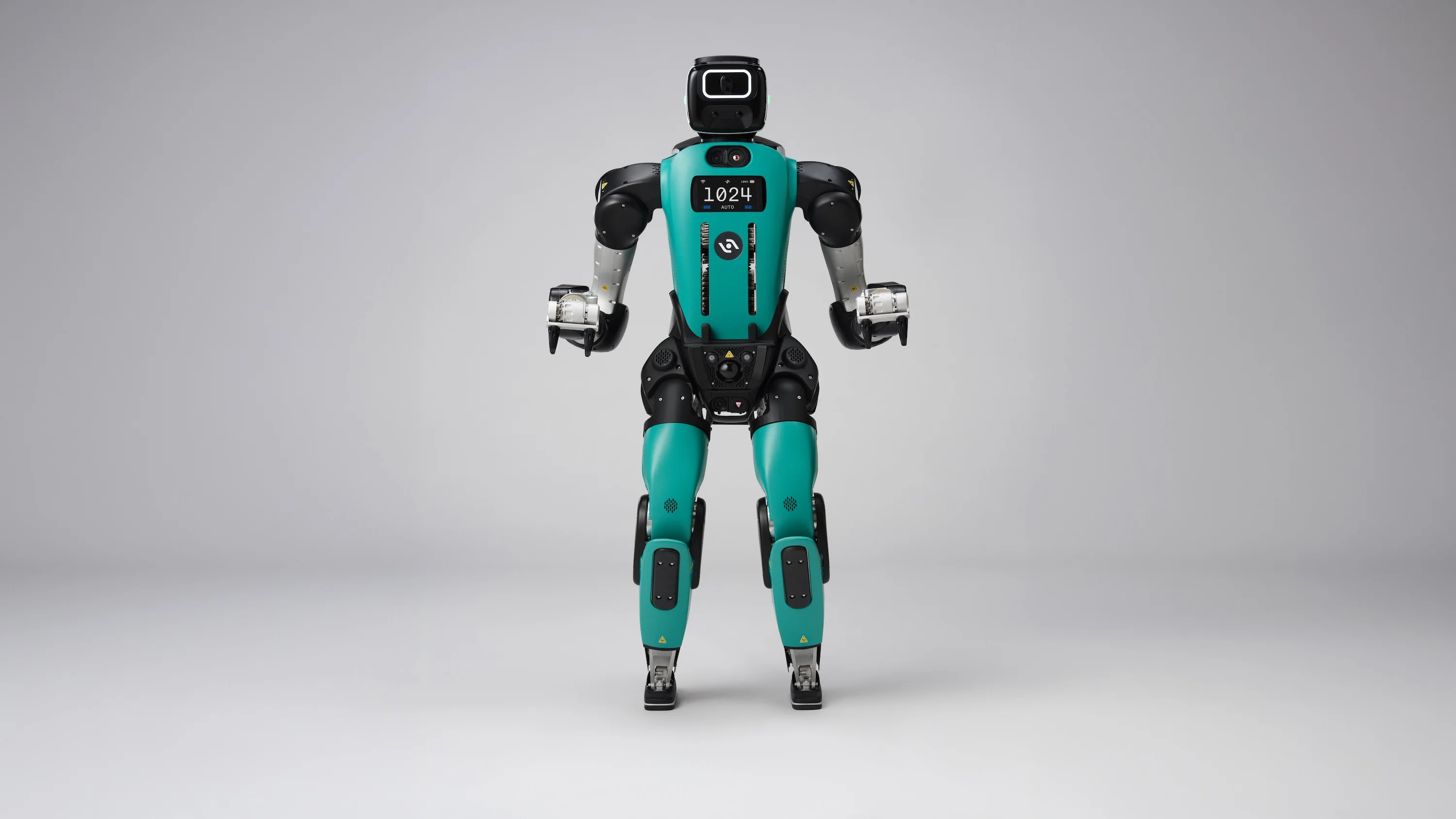
Digit 5, front view. Company image; Humanoids Daily prints no credit line with it. Credit: Agility Robotics, via Humanoids Daily.
Agility Robotics held its Analyst & Investor Day in New York on October 6, ahead of its proposed $2.5 billion merger with Churchill Capital Corp XI. Churchill filed the transcript with the SEC two days later. COO Jennifer Hunter put Digit 4's bill of materials at roughly $125,000 and Digit 5's at $150,000 at commercial launch. The target is about $30,000 per unit at 10,000 units a year. Actuators are roughly 25% of the cost today and the largest single line. Hunter named three levers: in-house redesigns, supply agreements with strategic partners, and volume tier discounts as production moves to 1,000 and then 10,000 units a year. Co-founder Jonathan Hurst explained why the new robot costs more than the old one. There is "a lot more robot in that robot," he said, meaning added sensors and safety systems.
Agility says it holds more than $300 million in multi-year Digit 5 orders, covering 1,000 robots under a three-year robots-as-a-service agreement. The customer is unnamed. Humanoids Daily notes that Agility's September S-4 identifies it as a related party that receives warrants as robots deploy. Chief business officer Daniel Diez called it one of the company's most experienced Digit 4 customers. In Humanoids Daily's transcription, he described how the order releases: "The robot is required to be able to perform certain use cases. And each use case unlocks new tranches of robots." CEO Peggy Johnson's wording in the transcript is that the orders are "subject to the satisfaction, obviously, of certain contractual milestones, product features, and specifications." No tranche sizes, use cases or dates were given.
Diez priced the service at a discount to a customer's fully burdened labor cost and used $100,000 per robot per year as his example, or roughly $0.5 million over five years. He said product margin "could exceed 70% as the business matures." In Humanoids Daily's account of CFO Michael Beer's model, margin starts near 50% at launch with hardware payback in about 1.5 years, and reaches about 70% at 1,000 units a year. The same report puts Agility's 2025 revenue at $1.78 million, from the S-4. Early-access customers get Digit 5 in the first half of 2027. Johnson gave general availability as "by the end of 2027." The merger would bring in about $620 million gross, Humanoids Daily reports: roughly $420 million from Churchill's trust and a $200 million PIPE that Foxconn led.
Schaeffler runs Digit 4 at its Cheraw, South Carolina plant, where Diez said the robot has moved more than a million pounds of material. Courtney Baines, a production engineer there, told the audience: "Right now, given the lack of ISO safety standards, it is necessary to put guarding around any humanoid deployment we have." Agility's pitch for Digit 5 is that it can work close to people. Johnson said its certification will come from a nationally recognized testing laboratory. She named no lab and gave no date. Schaeffler is a supplier as well as a customer. David Kerr, who leads its humanoid business, said the company sells about a billion euros of actuators a year and estimates its parts could cover half the bill of materials of a typical humanoid.
Boston Dynamics hires Amazon's Alexa and Nova chief as CEO, and its former CTO is building a DeepMind robotics lab nearby
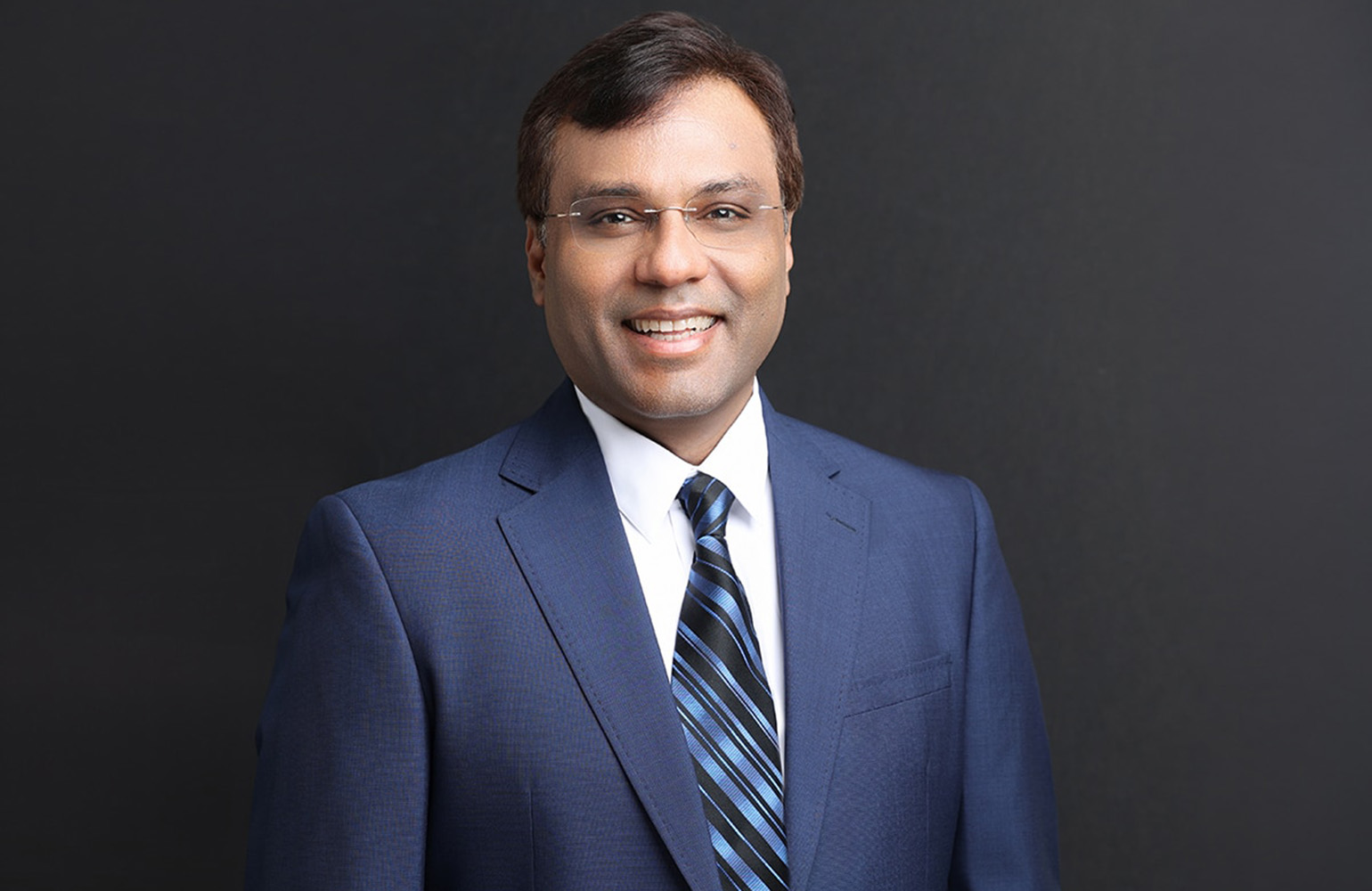
Rohit Prasad, CEO of Boston Dynamics as of October 7. Credit: Boston Dynamics, via The Robot Report.
Boston Dynamics announced on October 6 that Rohit Prasad would become CEO the next day. He is the third person to hold the job. Founder Marc Raibert ran the company from 1992 to 2020. Robert Playter followed him and left on February 27 after 32 years at the company. CFO Amanda McMaster had been interim CEO since then. Prasad is expected to join the board, subject to approval.
The release describes a career in machine learning. Prasad spent 12 years at Amazon, most recently as senior vice president and head scientist for Alexa and Artificial General Intelligence. He helped build Alexa and led development of the Nova family of foundation models. Before that he spent nearly 14 years at Raytheon BBN Technologies leading machine-learning research. He said Boston Dynamics "is uniquely positioned to advance Physical AI through its world-class robotics expertise." Jaehoon Chang, Hyundai Motor Group's vice chair and the chair of Boston Dynamics' board, said: "We are thrilled to welcome Rohit to lead the company into this exciting new era of real-world Physical AI." The release gives no Atlas shipment numbers, no product dates and no changes to the Spot or Stretch businesses.
On October 12, Aaron Saunders posted on LinkedIn: "We're building a new Google DeepMind robotics lab in the Cambridge area!" Saunders spent more than two decades at Boston Dynamics, across BigDog, Spot and Atlas, and was its CTO before DeepMind hired him in 2025 as vice president of hardware engineering. Humanoids Daily reports that the team is recruiting machinists, engineers and researchers, and that Saunders promised more news in 2027. He gave no size, budget, address or opening date. Boston Dynamics is headquartered in Waltham, in the same metro area. According to Humanoids Daily's company profile, Google DeepMind received some of the first production Atlas units this year. DeepMind is now staffing a hardware shop of its own.
A robot hand that walks on its fingertips, a Tesla filing for thermoformed touch sensors, and why Atlas's new hand is not on the fleet yet
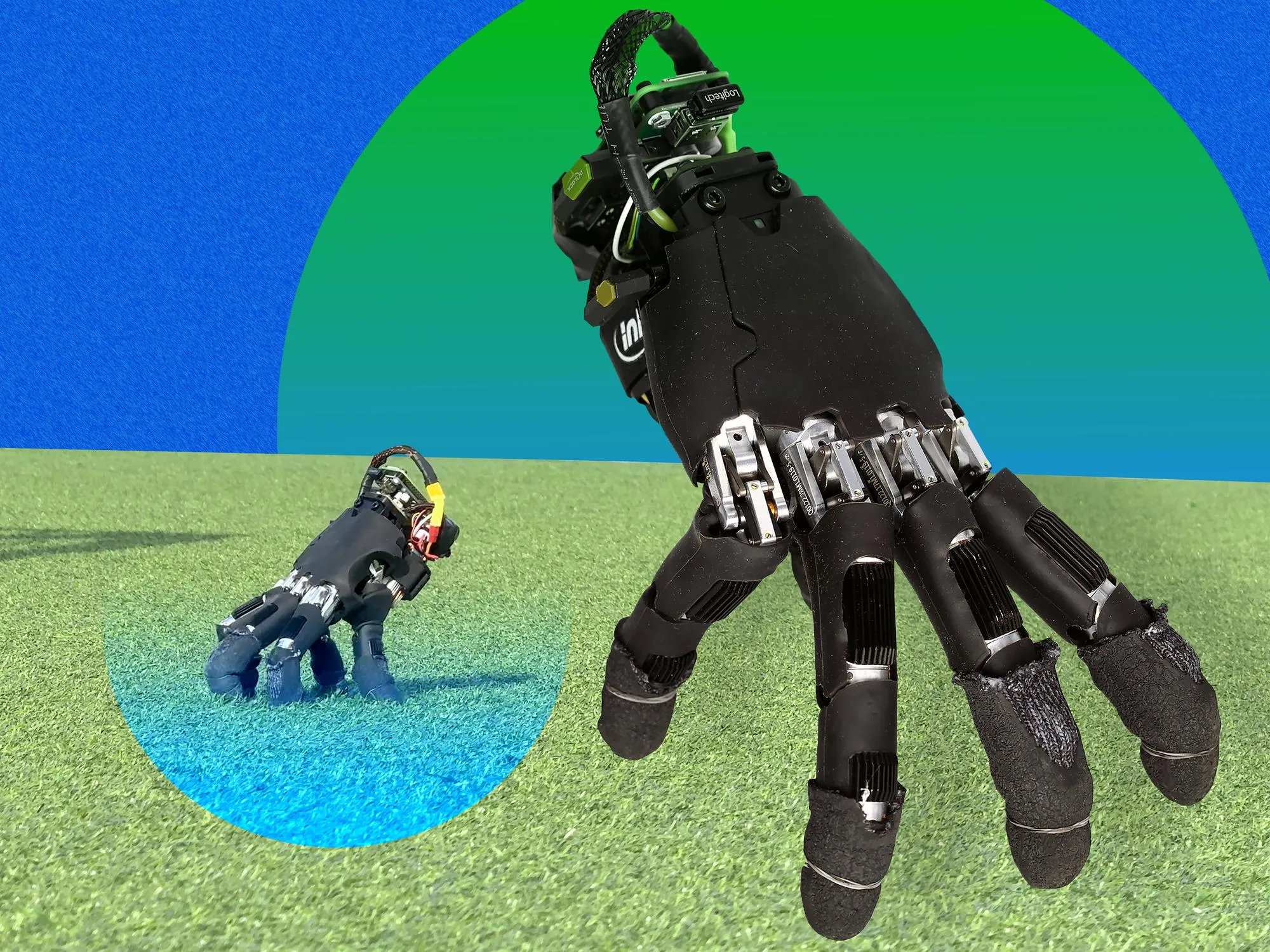
The ETH Zurich hand walking on its fingertips. IEEE Spectrum built the picture from the researchers' source images. Credit: Amirhossein Kazemipour, Hehui Zheng and Robert Katzschmann, via IEEE Spectrum.
Amirhossein Kazemipour, Hehui Zheng and Robert Katzschmann of ETH Zurich's Soft Robotics Lab took an off-the-shelf hand from Wuji Technology and turned it into a self-contained robot. IEEE Spectrum covered the work on October 8. The hand has 20 actuated joints, four per finger, and weighs 738 g. The team kept the stock fingers and the factory position controller. They added an 80 g module on the back of the hand with a four-cell lithium-polymer battery, a BNO085 inertial measurement unit and a Raspberry Pi Zero 2 W. The total is 818 g. The joints are not backdrivable.
Control is reinforcement learning. Policies were trained with PPO in NVIDIA Isaac Lab across 4,096 parallel environments, and they run on the Pi at 50 Hz. The reward gives each fingertip a target position relative to the palm. It penalizes sideways and vertical error four times more than fore-aft error. The authors report that in simulation it beats rewards tuned for quadrupeds, both in speed and in how many of the five fingers take part. The results on hardware: the hand crawled untethered on 14 surfaces, grass, gravel and metal grating among them, at an average of 9 cm/s. It righted itself in 21 of 25 falls. It entered 29 of 32 keyboard commands correctly without vision. With an overhead camera, it pushed a 41 g cube to targets up to 40 cm away 15 times in a row, with a mean final error of 17 mm. Each skill is a separate policy. The keyboard has to be aligned by hand, the pushing needs the external camera, and the code is not released. Hideki Shimobayashi, a Ph.D. student at the University of Tokyo, told Spectrum that walking loads a hand very differently from grasping, so durability may be a problem.
A Tesla patent application published on October 8, US20260310299A1, describes tactile sensor arrays shaped to fit fingers, thumbs and palms. Tesla filed it on September 11, 2025, with priority to a provisional dated April 4, 2025. The sensor is a sandwich: two flexible sheets carrying conductive patterns with a deformable layer between them. Each overlap of the patterns is an independently read region the filing calls a pixel. In the capacitive version, pressure narrows the gap and changes capacitance. In the resistive version, the middle layer changes resistance when squeezed. The filing gives two ways to get a flat sensor onto a curved finger. One screen-prints conductive ink on a flat sheet, then heats the sheet and forms it over a mold. The other shapes the base first and adds the conductors afterward by dispensing ink, pad printing, or laser-preparing areas for plating. Humanoids Daily points out that the filing does not name Optimus and gives no sensitivity, durability or cost figures. "Three-dimensional" in the filing refers to the sensor's shape. It does not mean three-axis force sensing.
Boston Dynamics answered a question last week's issue left open. Alberto Rodriguez, director of robot behavior for Atlas, told The Robot Report on October 9 that the GR3 hand is not on the Atlas fleet: "We have used the new hands extensively in our headquarters but have not deployed them yet." He added detail on the build. The hand "is built out of 13 identical actuators, all completely encapsulated, with no fragile cables crossing joints." Earlier Atlas hands could already lift more than 100 lb, so the team did not add strength. It considered giving some up for more transparent actuation. A two-thumb layout was rejected. It would have let one assembly line build left and right hands, at the price of more actuators, cost and volume.
SafeWorld raises $12.2 million to test robots against simulated people, and A3 puts the user's part of its mobile-robot standard on sale
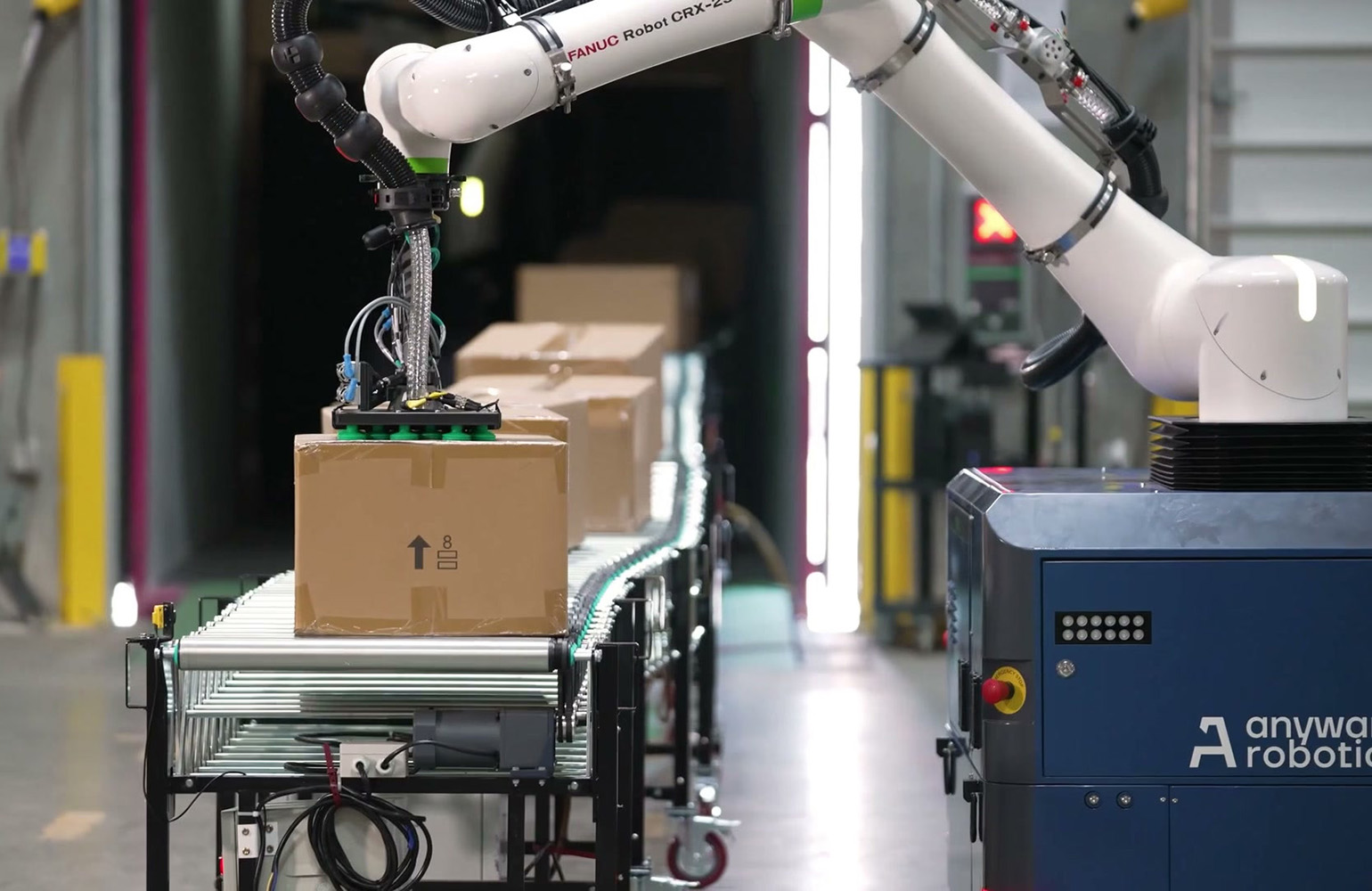
A robot arm picking a box from a conveyor, in an image SafeWorld supplied. Credit: SafeWorld, via The Robot Report.
SafeWorld, based in Oakland, California, left stealth on October 5 with $12.2 million in seed funding co-led by Shine Capital and a16z Speedrun. Its founders are CEO Kyle Wong, Ding Zhao, who directs the Safe AI Lab at Carnegie Mellon, and Simo Rachidi. The product is a test bench in simulation. A team builds scenarios in a browser from past incidents, safety standards and robot logs. The software runs the robot through thousands of variations of each one, with simulated people who move and react, and scores how the robot did. The tests can be rerun after every software update or change of site.
The company's case is that a robot running a learned policy has too many edge cases to cover with physical trials, so deployers fall back on cages and speed limits. Zhao told The Robot Report on October 8: "The robots, for the first time, were allowed to go out of the cage and share the same space with humans." Wong's rule for when to start: "if the timeline for your deployment is under one year, you probably need to start thinking about safety." He said about half a dozen companies use the platform and that two-thirds of them are publicly traded. Anyware Robotics is the only one named.
Neither article describes the human motion model, the scoring metrics, or any evidence that a pass in simulation predicts a pass on the floor. Neither names a standard that the scenarios map to. Wong told The Robot Report that existing safety standards are incomplete, and that safety simulation requires someone to define the test criteria. He and Zhao argue that a third party can build trust, because safety takes stakeholder sign-off as well as engineering. Neither article says a test lab or insurer has accepted SafeWorld's results.
On the standards side, A3 announced on October 4 that ANSI/A3 R15.08-3-2026 is available, which completes the three-part safety series for industrial mobile robots. Part 1 covers the robot and Part 2 covers systems and applications. Part 3 is written for the company that runs them: risk assessment, management of change, employee training, and periodic reviews and inspections. A3 developed it alongside Part 3 of R15.06 so that a site with both fixed arms and mobile robots gets consistent guidance. A3's store lists the document at 77 pages and $165, with a publication date of April 23, 2026.
AWS publishes a robot-training toolchain with the on-robot step still marked planned, while Mecka raises $60 million and Ultra $50 million
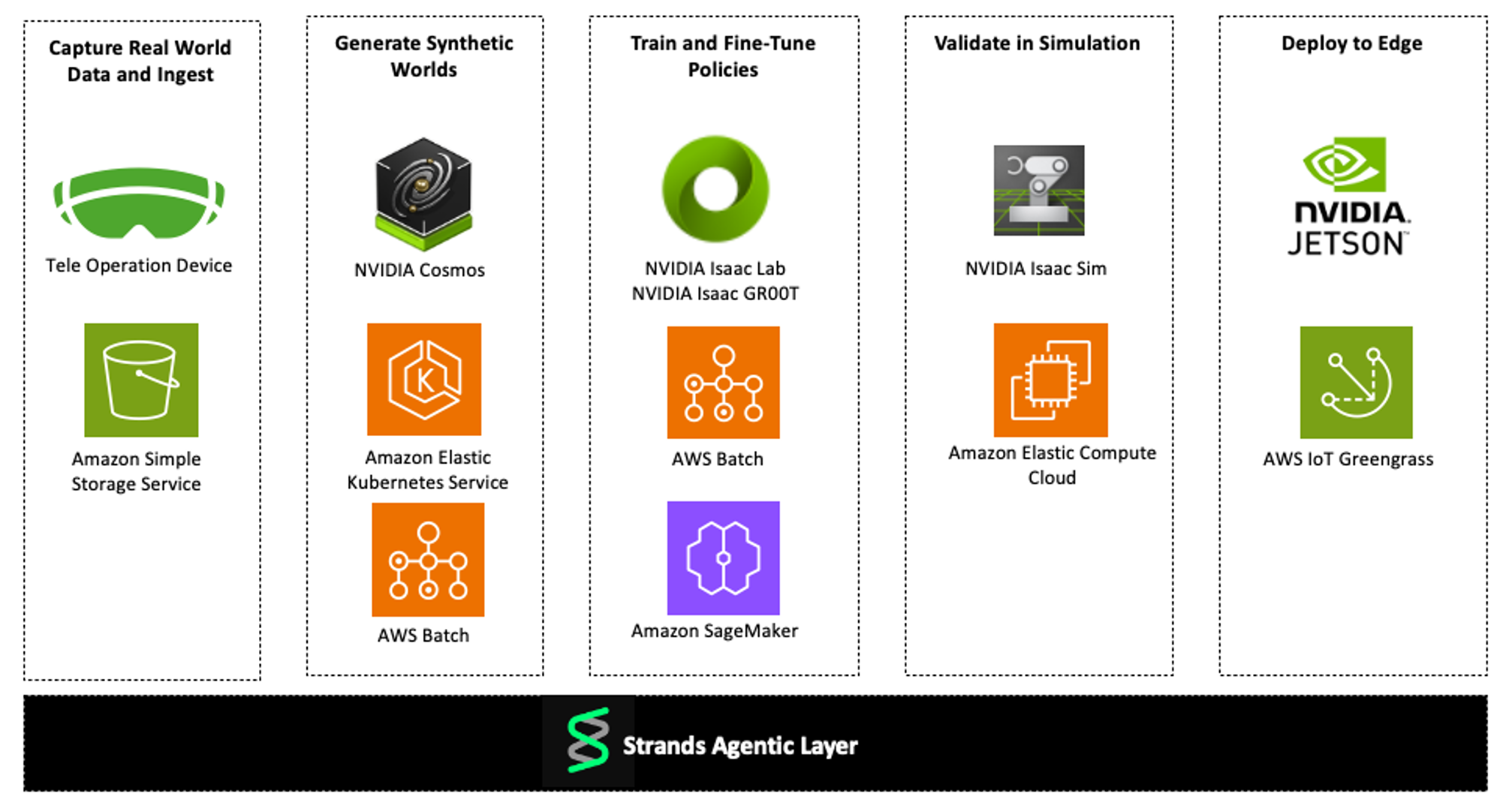
AWS's component diagram for the Physical AI Toolchain. It shows the intended workflow, and the edge-deployment step is still listed as planned. Credit: AWS, via the AWS Physical AI Blog.
AWS introduced its Physical AI Toolchain on October 7. It is a public set of reference architectures, Terraform modules and deployment automation that runs NVIDIA's robotics software on AWS. Teleoperation recordings land in S3. Cosmos generates synthetic variations on EKS and AWS Batch. Policies train with Isaac Lab and GR00T on Batch and SageMaker, and Isaac Sim validates them on EC2. The last step in the diagram sends the model to an NVIDIA Jetson through AWS IoT Greengrass. The modules deploy independently. The stack reads LeRobot and Zarr data, URDF robot descriptions, ONNX exports and ROS 2. The worked example fine-tunes GR00T on 27 teleoperated pick-and-place episodes from a UR3 arm. Humanoids Daily reports that the sample code is under Apache-2.0.
Humanoids Daily also read the repository's status table. GR00T, Isaac Lab, Isaac Sim, Cosmos and the OSMO workload orchestrator are marked available. Packaging a model to a Jetson through EKS Hybrid Nodes and Greengrass is marked planned, and the Isaac Lab Arena evaluation integration is in preview. So the path from the cloud to the robot is the part that has not shipped. Sri Elaprolu, AWS's director of Frontier AI Science and Engineering, told The Robot Report: "We're trying to make this easy button, if you will." The Robot Report notes that it is not a direct replacement for RoboMaker, the cloud simulation service AWS shut down in 2025. Running it takes an AWS account with GPU quota, an NVIDIA NGC key and a Hugging Face token. It is infrastructure. It includes no robot behavior beyond the example.
Mecka AI announced a $60 million Series B on October 7, led by Sequoia Capital with NVIDIA, Microsoft's M12, Qualcomm Ventures and Samsung. TechCrunch describes the business: Mecka pays people to record everyday tasks while wearing body sensors and using smartphones, then sells the processed motion data to robot developers. The company says it passed a $100 million revenue run rate in June and projects $300 million by the end of the year. Both figures are Mecka's own. A run rate annualizes a recent period. Mecka disclosed no valuation. TechCrunch reported in September that the round was nearing a $500 million valuation.
Ultra, a Brooklyn company that leases packing robots to third-party logistics warehouses, raised a $50 million Series A led by Framework Ventures, Fortune reported on October 9. With a $12 million seed, the total is $62 million. Its OP1 is a stationary dual-arm station on locking casters. It fits a five-by-five-foot footprint, lifts up to 10 lb per arm and plugs into a 120-volt outlet. Customers pay an integration fee and then a monthly fee. Ultra says its robots have packed more than 500,000 orders. The models come from Physical Intelligence. The one performance figure on record is from February: a full shift at 96.4% autonomy on the π0.6 model. Humanoids Daily notes that this describes one shift and says nothing about the fleet. People step in when the model stalls, and those interventions become training data. Ultra did not disclose revenue.
Humanoids for hire: a 45-minute stage show in Shenzhen, day rates under ¥1,000, and steel blades in San Francisco
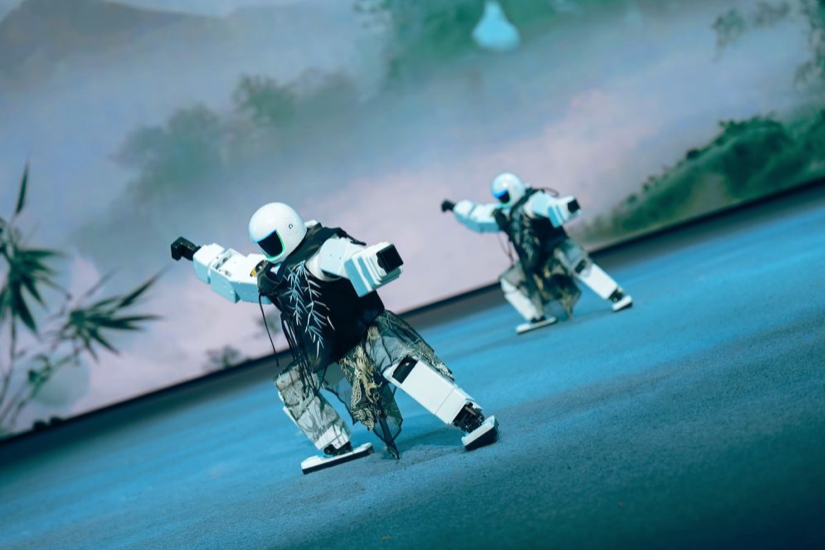
A scene from the Lumos Robotics stage show in Shenzhen. The source page prints no caption or credit with it. Credit: Lumos Robotics, via Robotics & Automation News.
Lumos Robotics staged a 45-minute show at the Dream Theater of the Shenzhen Bao'an District Youth Palace, Robotics & Automation News reported on October 8. Lumos calls it the first humanoid robot theater performance and says it was designed to run autonomously from opening to curtain call. A robot host introduced six formats: group dance, cross talk, sketch comedy, martial arts, a DJ set and magic. The robots handled their own entrances, positions, transitions and audience interaction. They shared the stage with human actors. Thomas Zhang, who leads R&D for Lumos's NIX robot: "The hardest part was not any individual movement, but making the entire performance fully autonomous." He also said, "Once you are on stage, it is one take." The article does not say what autonomous covers here. It gives no robot count, no detail on how the robots find their marks, and no mention of operators standing by. Shenzhen Tourism and Culture Industry Development Co. plans to run the theater regularly.
Shows like that are sold as rentals. The prices are falling. Humanoids Daily summarized an October 9 report from China's STAR Market Daily. Daily rates for a humanoid dropped from five-figure yuan sums in early 2025 to ¥2,000 to ¥3,000 in early 2026. Some listings are now under ¥1,000, and Unitree robots appear on the resale app Xianyu from ¥289 a day. Humanoids Daily cautions that ¥289 is an advertised starting price and the report does not say what it includes. Transport, setup, an operator, costumes and choreography can all sit outside the day rate. AGIBOT executive Xiong Yan told the paper that one operator currently handles about three robots. The company's target is ten, and twenty would be ideal. One rental operator cited platform data of roughly 10 bookings per robot per month at an average of ¥2,500. A TrendForce study cited by Robotics & Automation News gives similar numbers: about 10 paid performances a month and a payback of six to eight months in China.
The fight promoters are still putting a person in the control loop. At ARC's event in Singapore on October 7, martial artists in full-body motion-capture suits drove 35 kg Unitree G1 and 75 kg EngineAI T800 robots in real time, using a control system from Katena. ARC counted more than 380 people in the audience. In San Francisco on October 9, REK held the event it calls Deathmatch. The San Francisco Standard reports that REK's engineers fitted remotely piloted humanoids with blades 10 to 20 inches long, cut from AR500 hardened steel. The main event put Rektile, 6 ft 2 in and 180 lb with steel claws, against the 190 lb T-REK. Organizers moved photographers back from the cage beforehand, because the blades could reach through the viewing holes in its panels. A camera lens was pierced anyway. The panels came away gouged and cracked. More than 100 people attended, many on $69 tickets. REK's Cix Liv: "We're still a way out from autonomous fighting."
Last week's issue covered the California State Athletic Commission's cease-and-desist letter to REK over a bout between a person and a robot. The update is that REK kept its robot-against-robot schedule and added weapons. Liv told the Standard that what REK does is "not technically illegal," since the law covers fights between people. The commission did not respond to the paper's request for comment.