Robotics Briefing — compiled and curated by Chris Lee
Boston Dynamics gives Atlas a 13-DoF hand with four fingers, no cables across the joints, and no pinky
Week of September 29 – October 6, 2026
Boston Dynamics showed a new hand for Atlas on October 1. It has 13 degrees of freedom, four fingers, and one actuator type driving every joint directly. Dyna Robotics posted an hour of uncut video of its new Taku robot washing, drying, folding and shelving towels, alongside a technical report that does its own failure math. Runway, the video-generation company, announced a robot policy trained mostly on third-person video and promised open weights. Astribot brought an $18,000 cable-driven robot to IROS, Galbot priced a 1.25 m biped from 79,000 yuan, and RoboParty showed a humanoid it says it will open-source. Agility and FORT Robotics are adding an e-stop pendant and an off-robot safety interface to Digit 5. California's athletic commission told a fight promoter to stop putting a person in a cage with a teleoperated humanoid.
Components
Atlas's new hand has 13 directly driven joints and four fingers, and the fifth was cut on purpose
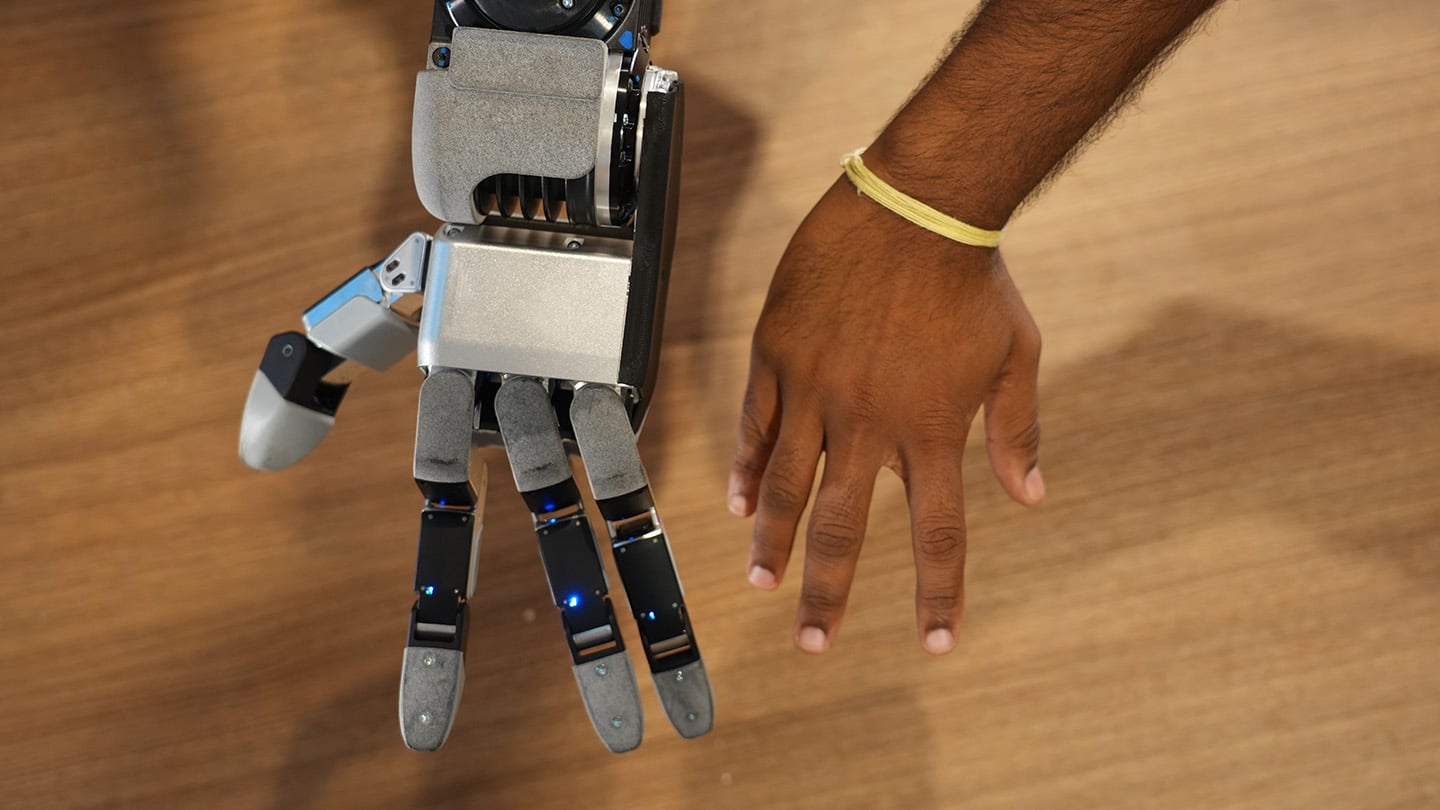
A human hand next to Atlas's new GR3 hand. The thumb has four degrees of freedom and each of the other three fingers has three. Credit: Boston Dynamics, via The Robot Report.
Boston Dynamics published the hand on October 1 in a blog post and a video. The company calls it GR3. It has 13 degrees of freedom, up from 7 on the GR2 hand it replaces: four in the thumb and three in each of the other three fingers. Every joint is directly actuated by a single actuator type. The actuators are enclosed in the hand, and no cables cross a joint. Dense pressure-sensing arrays cover the fingertips and the palm. Boston Dynamics describes the hand as a little larger than an average human hand and, on average, a bit stronger.
The company describes the drive as "rigid-drive actuation and backdrivable transmission," with control compensation for cogging and friction. A backdrivable joint lets force at the fingertip reach the motor, so motor current and position can stand in for a force sensor, and a finger that takes a hit moves instead of loading a gear train. The blog makes both points: backdrivability helps proprioception and is "really good in an impact." It is also why Boston Dynamics says the hand can be simulated "with high dynamic fidelity." Policies are trained by reinforcement learning in simulation, with domain randomization over motor torque profiles, surface friction, object geometry and disturbances. They then run on hardware "relying only on high rate actuator proprioception for feedback."
The missing pinky was tested on people first. Zachary Jackowski, the chief product and technology officer, had the team tape their ring and pinky fingers together for a day and report what they could no longer do. Dylan Thrush, a mechanical engineer on the Atlas team, quoted by The Robot Report: the team "determined that the additional dexterity and tasks you'd be able to accomplish is not worth the extra complexity." The blog puts a cost on it. An extra finger "means three more actuators, with the corresponding extra cost, volume, and probability of something breaking." The grasps Boston Dynamics lists are pinches between the thumb and any finger, tripod grasps, and holding a tool handle while one finger works the trigger. The named tools are drills, power torque drivers, grinders, nail guns and welding torches.
The post has no grip force, fingertip force, mass, sensor count, sample rate or gear ratio, and no cycle-life or impact-test numbers. Humanoids Daily points out that the video segment showing Atlas with the new hands is labeled teleoperated. The sim-to-real evidence is one sentence, "initial results showing promising sim2real transfer in dynamic tasks," with no success rate. Boston Dynamics calls the hand "a long-term bet" on manufacturing "reliable hardware at large scale and low cost." It gives no date for the hand to reach the Atlas units training at Hyundai's Georgia plant.
Dyna's Taku ran a towel laundry for an hour uncut, and Dyna's own report shows what 95% per step would cost
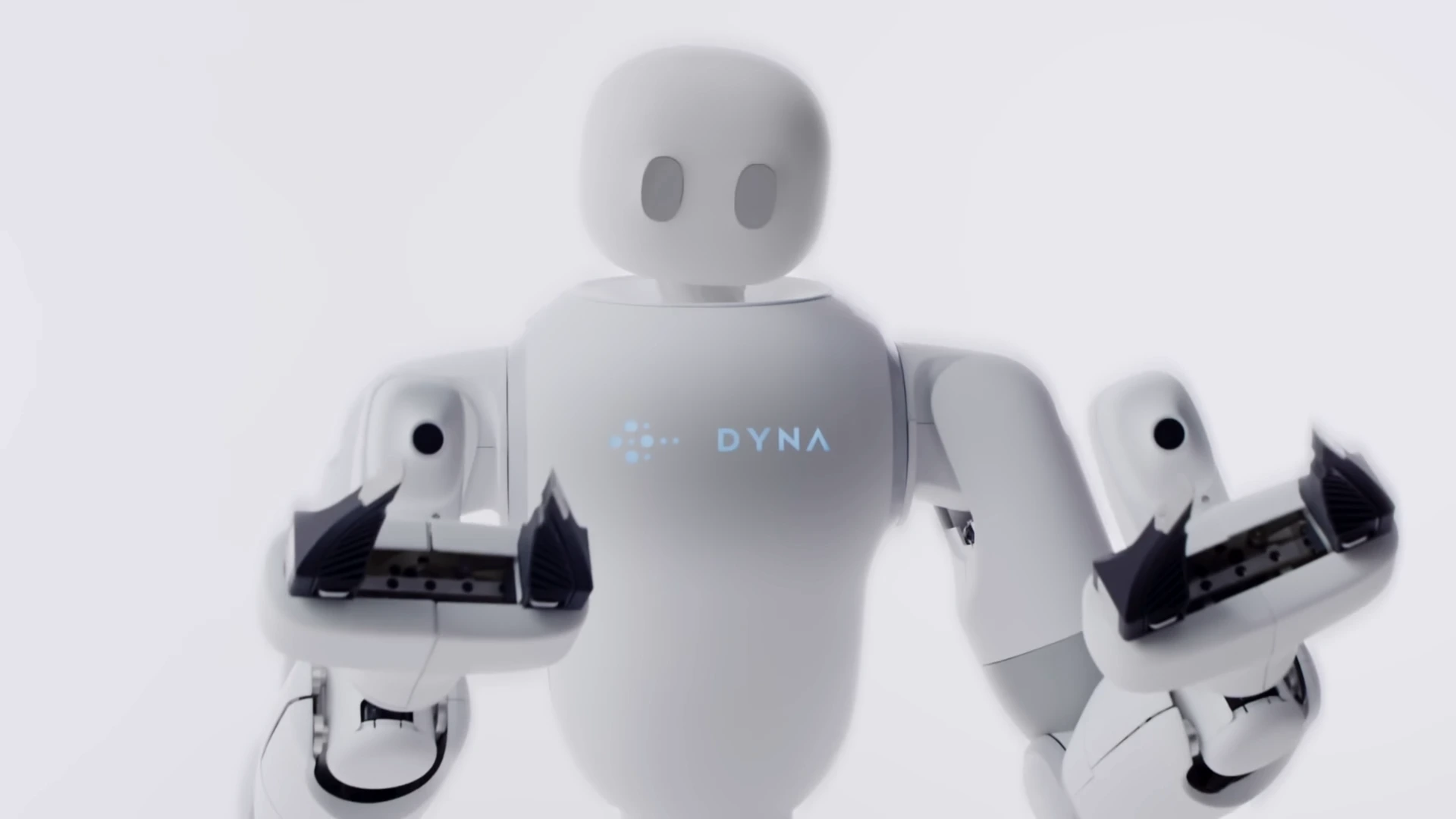
Dyna's Taku, a wheeled semi-humanoid with two 7-DoF arms. Still from Dyna's video. Credit: Dyna Robotics, via Humanoids Daily.
Dyna Robotics published Dyna-2.1 and a new robot called Taku on September 29. Taku is a wheeled semi-humanoid with a 21-DoF upper body, two 7-DoF arms, a lower body that folds to reach low and high, and four steerable wheels. The arms use low-ratio planetary actuators, which Dyna chose over harmonic drives for speed and acceleration. The demonstration is a one-hour uncut video of Taku running a towel laundry: loading and unloading washers and dryers, folding, stacking, and moving the stacks to a shelf. Humanoids Daily notes that it also recovers a towel it drops.
The software is three layers at three rates. A whole-body controller, trained by reinforcement learning in NVIDIA Isaac Lab, runs at 100 Hz. The Dyna-2 policy, a world-action model trained on one million hours of human video mixed with robot fleet data, sets motion targets at about 5 Hz. Above both sits a vision-language orchestrator that picks the next step and keeps a text memory of the job: which steps are done, whether each washer and dryer door is open, how many towels are folded, which machine is running. Human video and robot data share one format, which Dyna calls the Unified Robot Representation. It describes a body by wrist, elbow, chest and footprint poses.
The report then does arithmetic that demo videos usually leave out. One laundry cycle is about 79 subtasks with 13 decision points, including roughly 52 towel picks and 8 door operations. At 95% success per step, the chance of finishing a cycle with no failure is 0.95 to the 79th power, or 1.7%. At 48 half-hour cycles a day, that is about 190 interventions. Dyna marks the 95% figure as illustrative and not measured. It does not publish the per-step rate Taku actually achieves or how often a full hour runs clean. The video is one run. Two measured numbers come from the company's older stationary folding robots. A new site reaches its production bar "in as little as three days." Dyna-2 pretrained on human video alone passed 87% of customer acceptance tests zero-shot, against 46% for Dyna-1. No customer is named, and Taku has no price.
Nucleus posted a longer video with a blunter label. On October 1, Nucleus founder and CEO Melvin Schwarz shared nearly two hours of uncut factory work by the company's wheeled dual-arm Nucleus II and said the run was "60% autonomous and 40% teleoperated." Humanoids Daily reports that he did not say whether that is a share of time or of tasks. Nucleus says it regularly runs four- to six-hour shifts. It names no customer.
Runway's Praxis-1 is a robot policy pretrained on third-person video, with open weights promised and not yet released
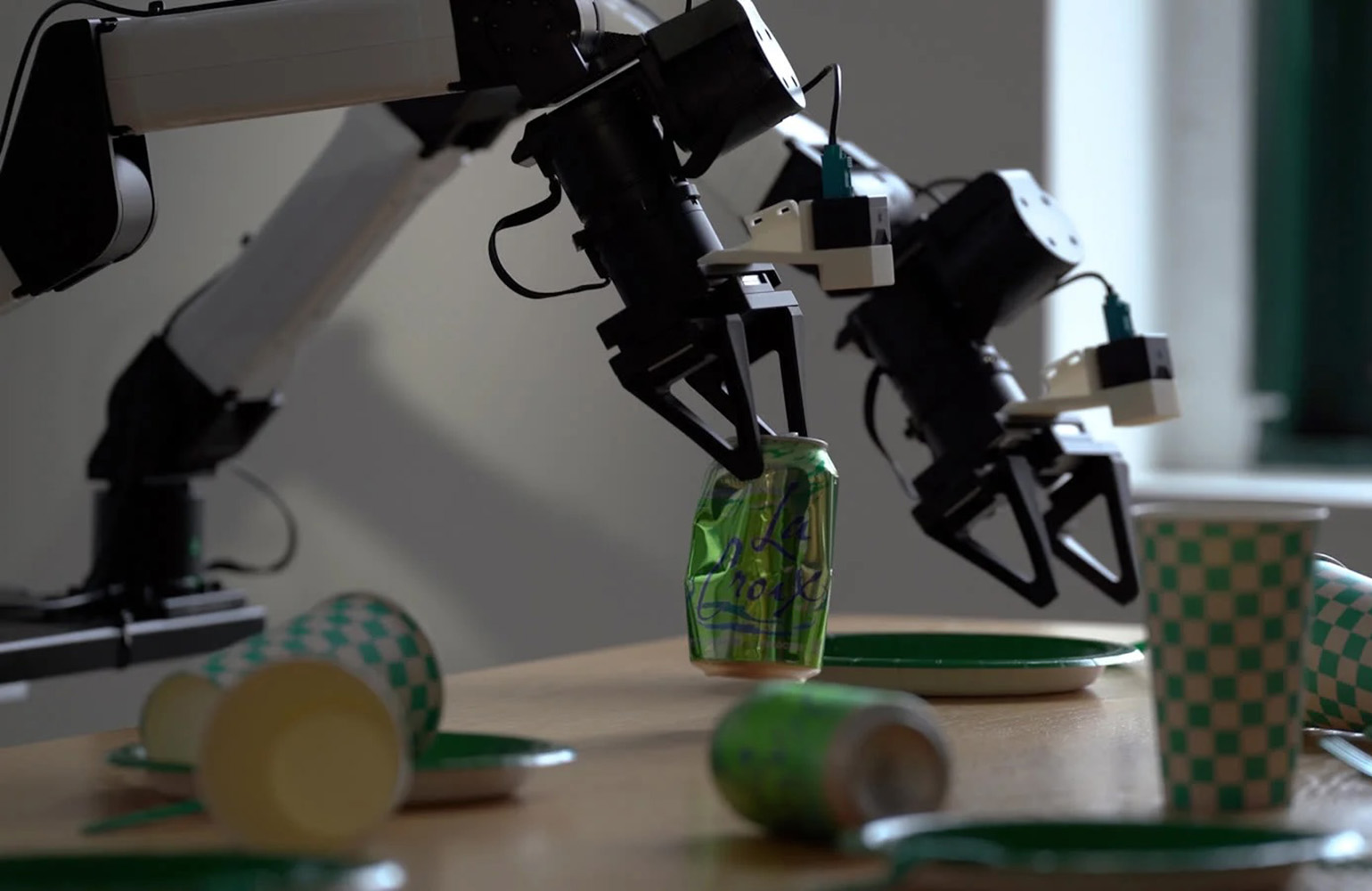
Two robot arms clearing a table in Runway's Praxis-1 demonstration. Credit: Runway, via The Robot Report.
Runway, the New York company known for video-generation models, introduced Praxis-1 last week. It is what the company calls a world action model: a policy pretrained on large amounts of video, primarily third-person footage, and then fine-tuned to output robot actions. Kamil Sindi, Runway's CTO, told The Robot Report: "Most robot policies are bottlenecked by robot data, which is scarce and expensive to collect." Three early partners are running the model on their own hardware: Noble Machines on a bimanual system, Standard Bots on its six-axis RO1 arm, and Ultra on a mobile platform. Sindi says one model adapts "from bimanual arms to humanoids, with light fine-tuning."
Runway's research post gives two numbers. In a scaling experiment that pretrains from scratch on 10 to 1,000 hours of video, the model pretrained on web video reached a final placement error of 16.1 cm. The model pretrained on teleoperated robot video reached 16.0 cm. Error bars are one standard error over 93 evaluation pairs, and Robotics & Automation News notes that the gap is not statistically significant. That is Runway's argument for the approach. Hour for hour, web video did as well as robot video, and far more of it exists. The second number is an evaluation shortcut. Runway says that running a policy inside its world model predicts the policy's real-world results with a correlation of 0.95.
The post does not give an architecture, a parameter count, a control rate, an action format, a license, or a task success rate for Praxis-1 itself. Release is "in the coming months." Runway does show failure clips, sorted by rigid, cluttered, transparent and deformable objects. Sindi also made a policy pitch: "We believe U.S. leadership in physical AI is critical to regaining our manufacturing lead, and that requires open American models." Until the weights ship, the three partners are the only outside parties who can check the claims.
Two prices and an open-source promise from IROS week: Astribot's $18,000 T1, Galbot's 79,000-yuan ET1, and RoboParty's RP1
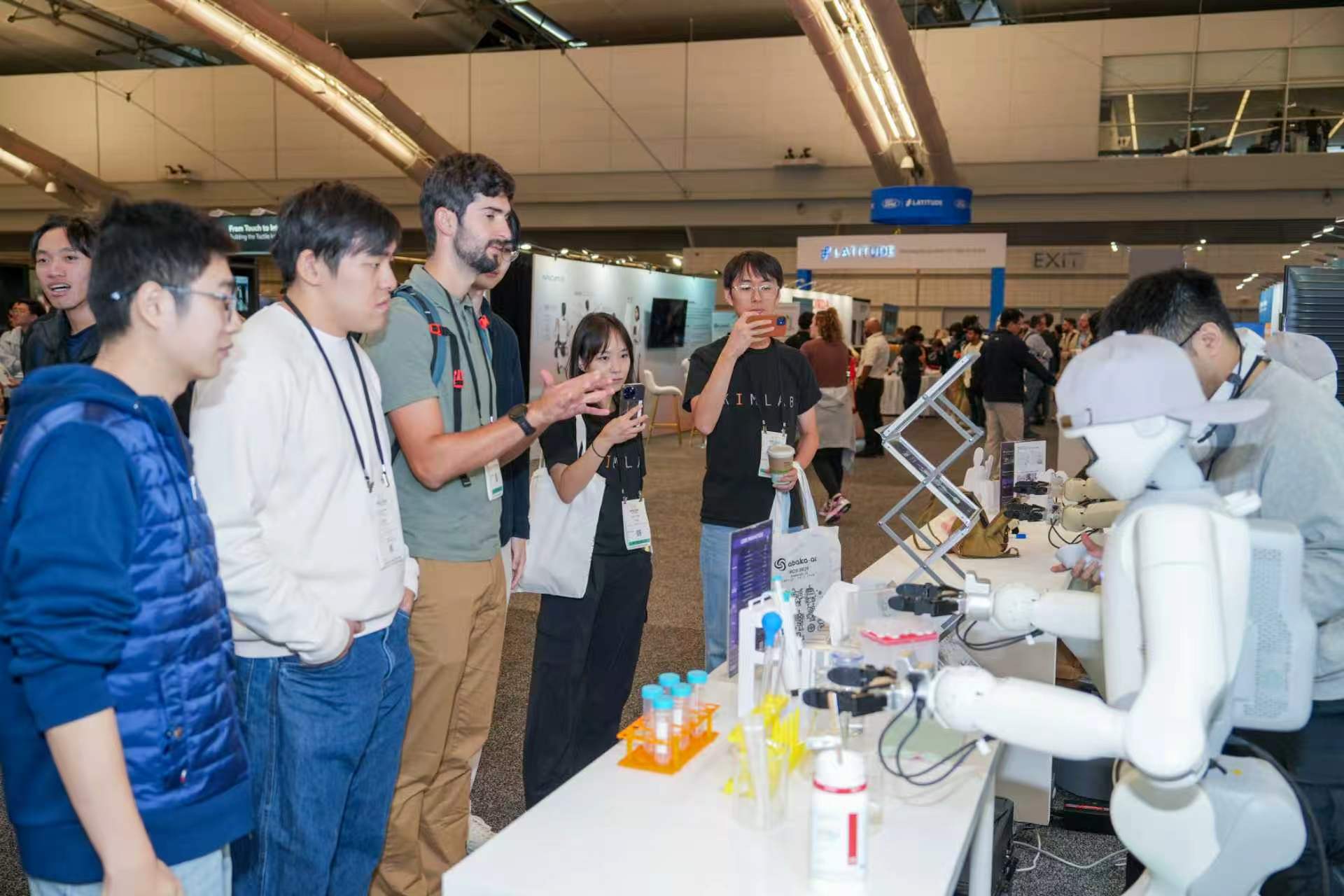
Astribot's T1 at IROS 2026 in Pittsburgh. Credit: Astribot, via EIN Presswire.
Astribot announced on September 29 that its T1 is on sale in North America, and showed it at IROS in Pittsburgh. The U.S. price starts at $18,000. The robot stands about 1.55 m, weighs about 66 kg, and has 23 degrees of freedom before end effectors, with up to 5 kg of payload per arm. The architecture is cable-driven, which Astribot says supports dexterous manipulation and compliant contact. T1 charges itself and takes a quick battery swap. The SDK exposes joint control, Cartesian motion, whole-body coordination and sensor data. Astribot says U.S. orders are open with immediate delivery. Its headline demo is T1 tidying loose items into a backpack on the company's Lumo-2 model. Humanoids Daily notes that no success rate is attached, and Astribot says harder household tasks need more training.
Galbot has priced its ET1 biped in three tiers, Humanoids Daily reported on October 2, citing Chinese outlet QbitAI and Pandaily: 79,000 yuan for Standard, 139,000 for Pro and 179,000 for Flagship. The base price is about $11,000. ET1 is 1.25 m tall and weighs 32 kg with its battery. It has 26 degrees of freedom, plus 12 more with the optional dexterous hands, which are offered only on Pro and Flagship. The robot carries RK3588 and RDK X5 processors. Pro adds an Orin Nano rated at 40 TOPS and Flagship an NX at 100 TOPS. The Standard robot is sold for dancing, performance and conversation. Interactive learning and action planning are upper-tier features. Humanoids Daily's caution is that the price list says what Galbot is asking and says nothing about how reliably the robot learns a new task.
RoboParty showed its RP1 biped at IROS on September 28 and issued a press release on October 3. The release gives one hardware number, a peak joint torque of up to 160 N·m from the company's own Romomo actuator modules. It gives no degrees of freedom, height, weight, battery or price. RoboParty says it will release motion control, simulation environments, SDKs, training tools and its PartyOS framework in the fourth quarter. What is public today is the predecessor, ROBOTO ORIGIN: mechanical and electronics designs, a ROS 2 deployment framework, reinforcement-learning training code and firmware, with the aggregation layer under GPLv3. Humanoids Daily flags the gap between that repository and the RP1 files, which have not been posted.
Agility and FORT add an e-stop pendant and an off-robot safety interface to Digit 5, and name no standard or rating
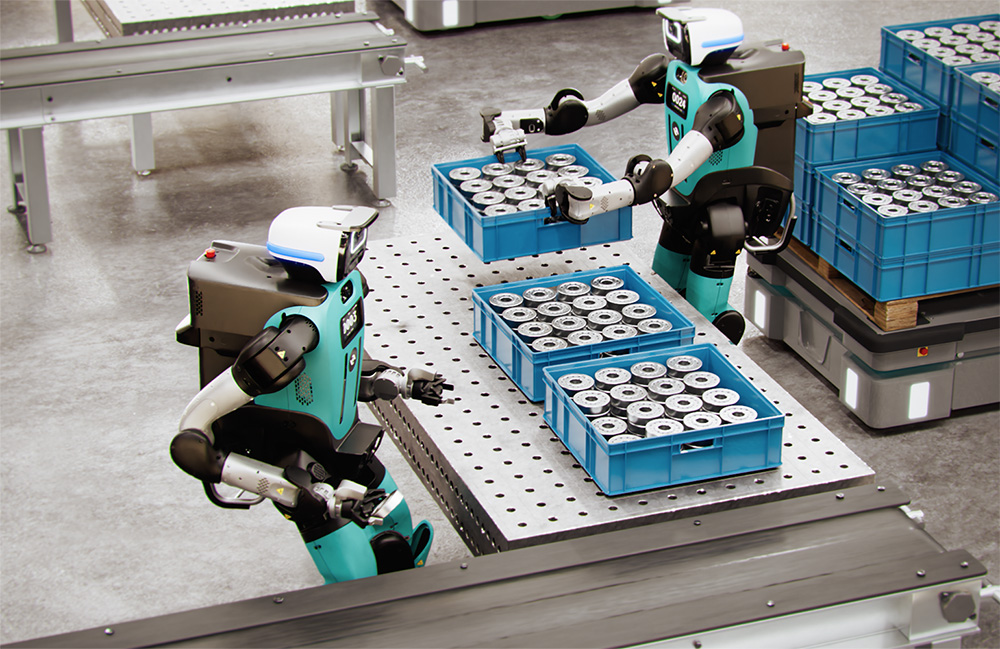
Two Digit 5 units in a facility setting, from the September 15 launch. The pendant and the bridge are not shown. Credit: Agility Robotics, via The Robot Report.
Agility Robotics and FORT Robotics announced a partnership on October 1. A memorandum of understanding covers joint hardware development, solutions engineering, regulatory compliance and deployment support. Two pieces of hardware are named. The Pendant Sled is a holder for Digit's tablet with an emergency stop and an enabling device built in. FORT has delivered it to Agility. The Offboard Safety Bridge is an off-robot interface that connects Digit to external safety systems. It is still in development.
Digit 5's own safety chain is on the robot. Agility lists safe human detection, safety cues and safe motion control. At the September launch it described an independent safety controller that can slow the robot, stop it, or sit it down. The pendant puts a manual stop in a person's hand. The release describes it as a redundant manual override for setup, maintenance or unexpected situations. An enabling device is a hold-to-run switch: motion is allowed only while the operator holds it. The bridge runs the other way. It gives safety equipment outside the robot a path to Digit, and the release does not list which equipment.
The release names no standard, no performance level or SIL, no certification and no delivery date for the bridge. Humanoids Daily makes the same observation. Pras Velagapudi, Agility's CTO: "Every layer we've added with FORT has made Digit's safety system more resilient, not just more redundant." The timing is commercial. Digit 5 early access is planned for the first half of 2027. Earlier Digits have logged more than 65,000 hours at Schaeffler, GXO and Toyota Motor Manufacturing Canada. Agility scheduled an analyst and investor day for October 6, ahead of its proposed merger with Churchill Capital Corp XI.
California's athletic commission orders REK to stop putting a human in the cage with a teleoperated humanoid
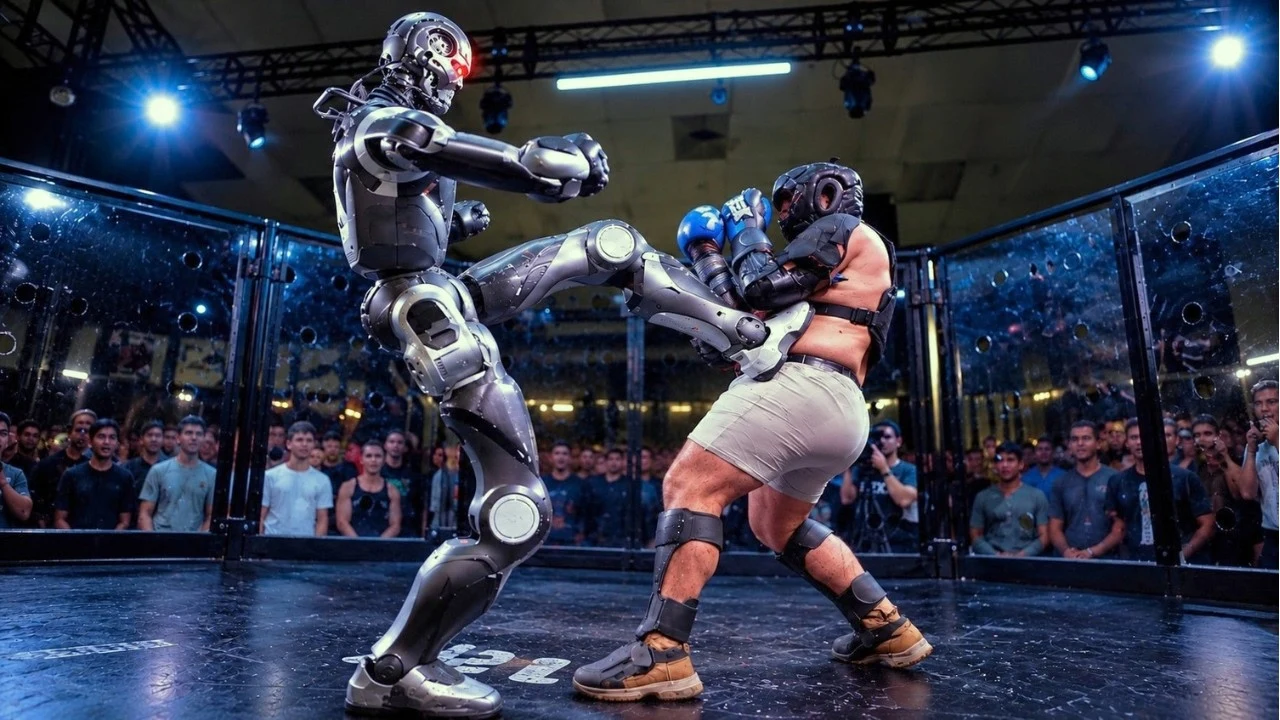
Frankie LaPenna, in protective gear, facing an EngineAI T800 inside REK's cage. Credit: Frankie LaPenna / REK, via Humanoids Daily.
REK promotes cage fights between humanoid robots. On September 18 in San Francisco it staged its first bout between a robot and a person. Internet personality Frankie LaPenna, in protective gear, fought an EngineAI T800 that a human operator drove remotely. Cybernews describes the robot landing a high kick to his face and a kick to his stomach, and counts about 1.5 million views of the video on X. EssentiallySports reports no serious injury.
The California State Athletic Commission answered with a cease-and-desist letter dated September 23 and signed by executive officer Andy Foster. It calls the event an "UNSANCTIONED HUMAN VERSUS HUMANOID ROBOT CAGE FIGHT." It orders REK and CEO Cix Liv to stop holding, promoting or advertising boxing or mixed-martial-arts contests involving a human in California without the commission's approval. Cybernews reports that the letter cites Business and Professions Code sections 18870 and 18878, with misdemeanor charges for violations. Liv posted the letter on X with the comment "We made it, boys," and said California is "gonna have to change the law." Humanoids Daily notes what the letter leaves alone: it does not prohibit robot-versus-robot fights.
The commission's authority comes from the person in the cage. It regulates combat sports, and the letter as reported cites no robot safety standard. EngineAI lists the T800 at 173 cm, 75 to 85 kg depending on configuration, and a peak joint torque of 450 N·m. None of the coverage describes a torque or speed limit on the robot for the bout, who held an emergency stop, or what the operator could see.