Robotics Briefing — compiled and curated by Chris Lee
Qualcomm buys the company behind MoveIt and puts the planner on a $299 Arduino board with an STM32 for the motors
Week of September 22 – September 29, 2026
Qualcomm agreed on September 23 to buy PickNik, the Boulder company that maintains the MoveIt manipulation framework, and showed MoveIt Pro running on Arduino's new VENTUNO Q board at ROSCon. The IFR's World Robotics 2026 report puts 5 million industrial robots in service and 600,000 installed in 2025, 354,000 of them in China. Skild AI post-trained its S1 model on 140 years of simulated soccer and put the result on a Unitree G1. Sharpa launched a 66-DoF manipulation robot, a 21-DoF tactile hand and a haptic exoskeleton glove at IROS in Pittsburgh. Feather started selling a 105 kg wheeled dual-arm humanoid for $29,990 the same week Agility's CEO said the Digit maker is looking at wheels. AGIBOT says it has built 20,000 robots, and The Information reports Tesla is building several hundred Optimus units a week, with hands that take more than 100 screws each.
Software
Qualcomm now owns Arduino and MoveIt, and the VENTUNO Q is where it wants them to meet
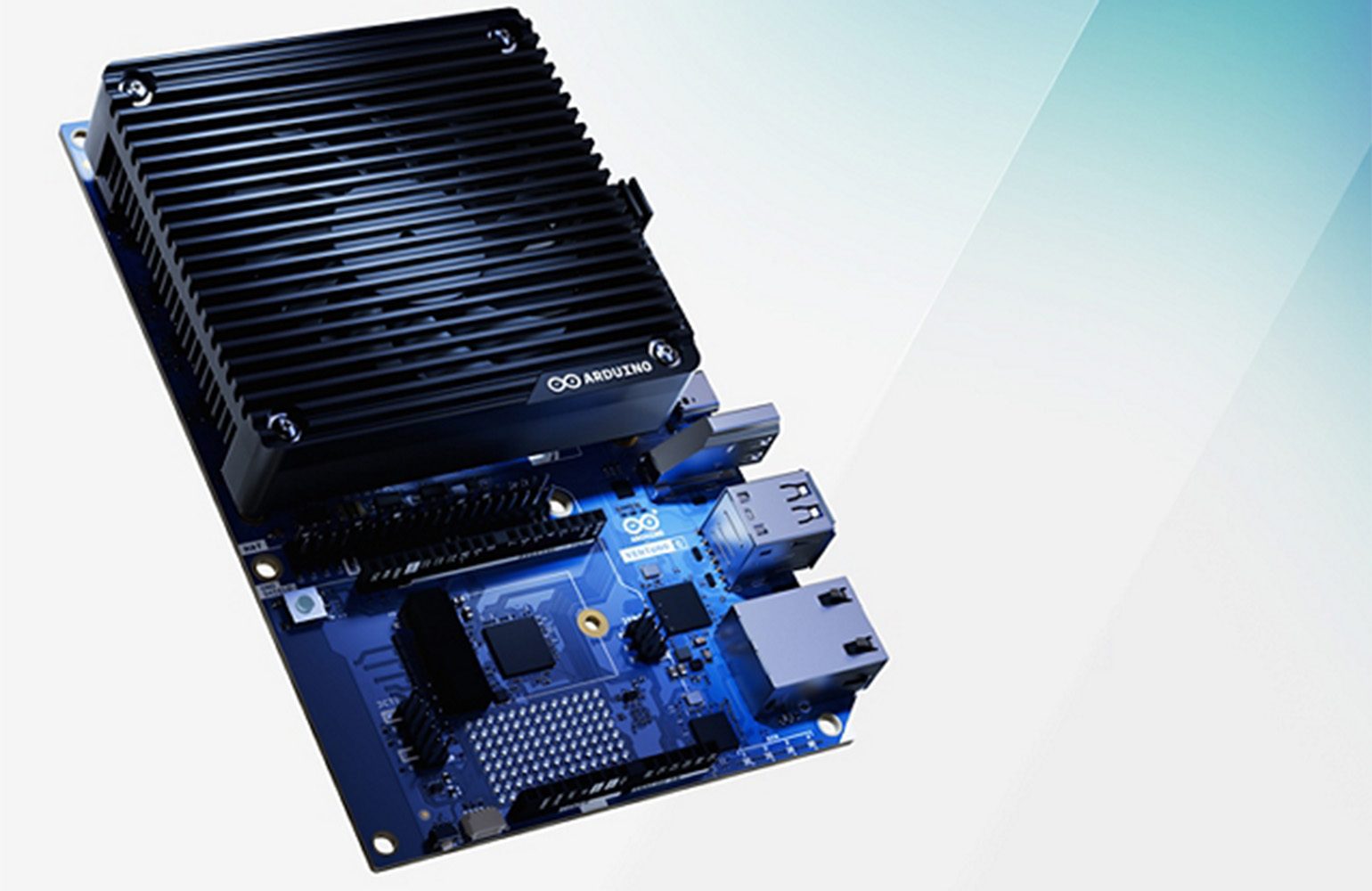
The Arduino VENTUNO Q. A Qualcomm Dragonwing IQ-8275 runs Linux and the AI models; an STM32H5 handles the real-time I/O. Credit: Qualcomm, via The Robot Report.
Qualcomm Technologies announced on September 23 that it will acquire PickNik Inc., the Boulder, Colorado company founded in 2015 that maintains MoveIt, the open-source ROS manipulation framework, and sells MoveIt Pro on top of it. Price and closing date were not disclosed. Qualcomm says MoveIt 1 and MoveIt 2 stay open source under their existing license, keep their community roadmaps, and keep working on other vendors' hardware. Nakul Duggal, Qualcomm's group general manager for automotive, industrial and robotics: "Software is the connective tissue that turns great hardware into great robots." PickNik founder Dave Coleman said joining Qualcomm lets the company accelerate its mission while "preserving the openness, community collaboration" of the project.
The hardware side is the VENTUNO Q, Arduino's second UNO-branded single-board computer. Arduino has been a Qualcomm subsidiary since October 2025. The board pairs a Dragonwing IQ-8275 (octa-core Kryo CPU, Adreno 623 GPU, Hexagon NPU rated at 40 dense TOPS) with an STM32H5F5 Cortex-M33 microcontroller for real-time control. It carries 16 GB of LPDDR5, 64 GB of eMMC, an M.2 NVMe slot, three MIPI-CSI camera connectors, Wi-Fi 6, Bluetooth 5.3 and 2.5 Gb Ethernet. The Linux side ships Ubuntu 24.04. The microcontroller runs the Arduino core on Zephyr and exposes CAN-FD and PWM, so a servo bus or a motor driver talks to the M33 while the Dragonwing runs vision and planning. Arduino's Marcello Majonchi called it "the first intentional step for a product meant to be used as a single point of control of a modern robotics platform."
Pre-orders opened in late August at $299. They sold out on the Arduino store in the first week, per OMG! Ubuntu on September 2, and The Robot Report's September 23 piece says pre-orders are open again with no ship date named. Qualcomm demonstrated MoveIt Pro on the VENTUNO Q and on Dragonwing platforms at ROSCon in Toronto this week. What no one has published is the number that matters for a builder: how many joints MoveIt Pro can plan for in real time on this board, or what a MoveIt Pro license costs on it. MoveIt Pro is the commercial product, and the release does not say whether its pricing changes under Qualcomm.
5 million industrial robots are in service; China installed 354,000 last year and the U.S. passed Japan for second place
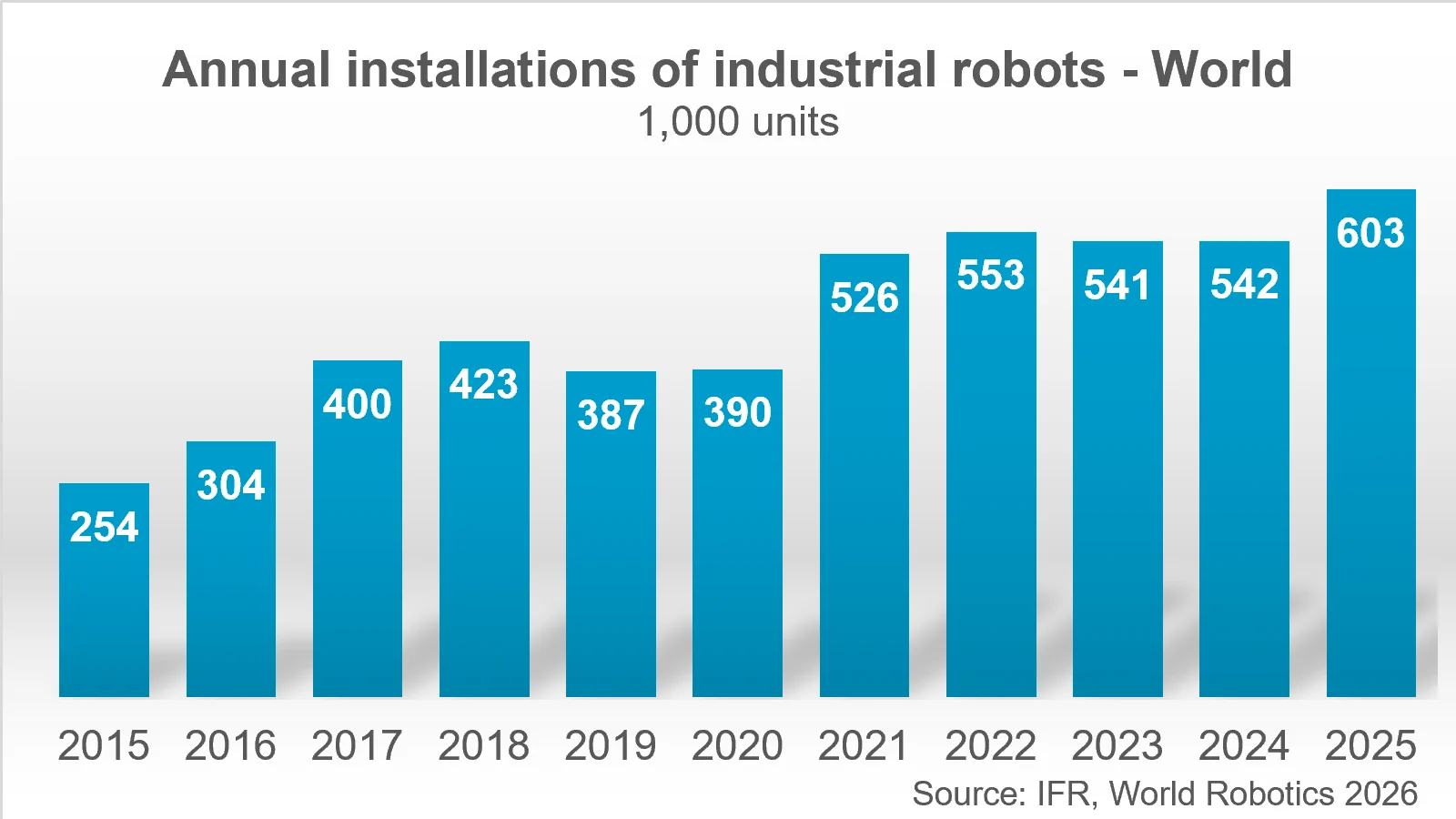
The IFR's World Robotics 2026 headline graphic. Credit: International Federation of Robotics.
The International Federation of Robotics published its World Robotics 2026 numbers on September 24. The operational stock of industrial robots reached 5 million units, up 9% in a year and more than double the count of seven years ago. New installations in 2025 came to more than 600,000, an 11% increase. The IFR forecasts 655,000 installations in 2026 and 806,000 by 2029. Jane Heffner, the IFR's president: "Industrial automation is progressing at high speed."
The regional split is the story. China installed 354,000 robots in 2025, up 20%, which is 59% of everything installed on the planet. Chinese manufacturers supplied 195,000 of those, a 55% share of their home market. The United States installed 38,500 units, up 12%, and moved into second place. Japan fell to third at 36,219 units, down 19%. South Korea was flat at about 30,000. India installed 10,500, up 15%, on a 27% compound growth rate since 2020. Europe went the other way: Germany down 8% to about 25,000, Italy down 11%, France down 8%, Spain down 15%. Brazil was the outlier in the Americas at 4,300 units, up 38%, with automotive installations there up 212%.
Two things the headline hides. The 5 million figure counts installed robots the IFR estimates are still in service, not robots it has verified are running. And the forecast growth is 9% for 2026, which is slower than 2025's 11%. Jon Quick of Launchpad Build AI, quoted by The Robot Report, put the U.S. side in labor terms: hundreds of thousands of open manufacturing and assembly jobs now, projected at 2 million by 2030. The full report is a paid publication; the press release carries the country tables.
Skild's S1 learned to play soccer against itself for 140 simulated years, then played on a real G1
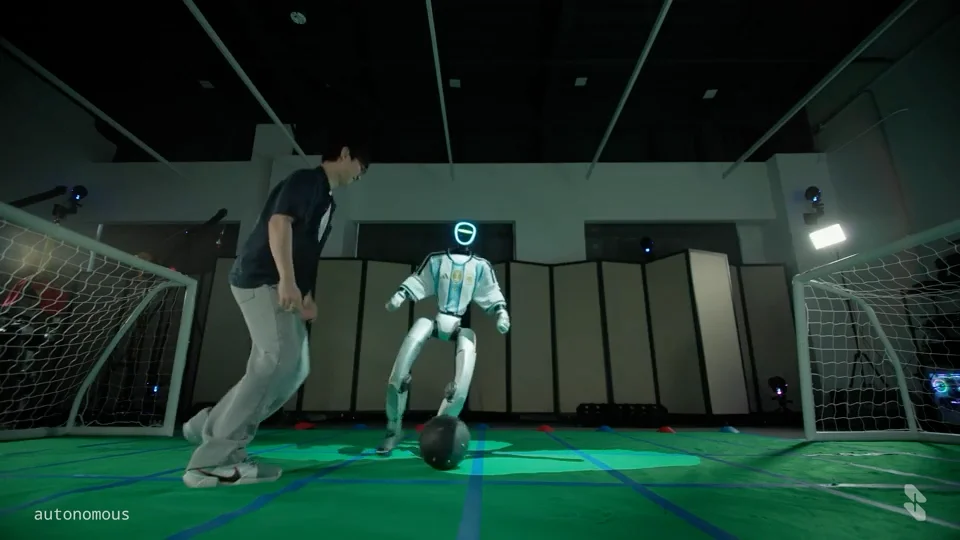
A Unitree G1 running Skild's self-play soccer policy against a human. Still from Skild's video. Credit: Skild AI, via Humanoids Daily.
Skild AI published "Physical Self-Play" on September 23. The company took its S1 base model, which is pretrained on human data, and post-trained it with reinforcement learning in NVIDIA Isaac Sim against recent copies of itself. The objective was one line: score goals. Training ran in two stages. First, skill drills for dribbling at several speeds and directions and for kicking, each with its own reward and human reference motions. Then open self-play, where the policy emitted 50 joint commands per second per joint and accumulated more than 140 years of simulated match time. Skild says dribbling past defenders, shielding the ball, tackling and getting up after a fall emerged from the self-play stage rather than from explicit rewards, and that four-agent games showed early passing.
The hardware result is a Unitree G1 in a jersey playing against people and against other robots. Skild's own framing of the ceiling is the useful part: because S1-class models are pretrained on human demonstrations, "they are capped at human capability," and self-play is the company's route past that cap. CEO Deepak Pathak on X: "This method scales, and we will scale it."
What is missing is everything a reviewer would ask for. No wall-clock training time, no compute budget, no count of parallel matches, no success metric for the real-world games, and no sim-to-real transfer method; Skild says that comes in a later post. The videos show the robot walking, recovering from falls and dribbling. They do not show a scoreline. And Skild's separate claim of $100 million in annual recurring revenue, ten months after first deployment, is a company statement with no customer list behind it.
Sharpa's IROS launch: a 66-DoF manipulation robot, a 21-DoF hand under 750 g, and a glove with 22 encoders
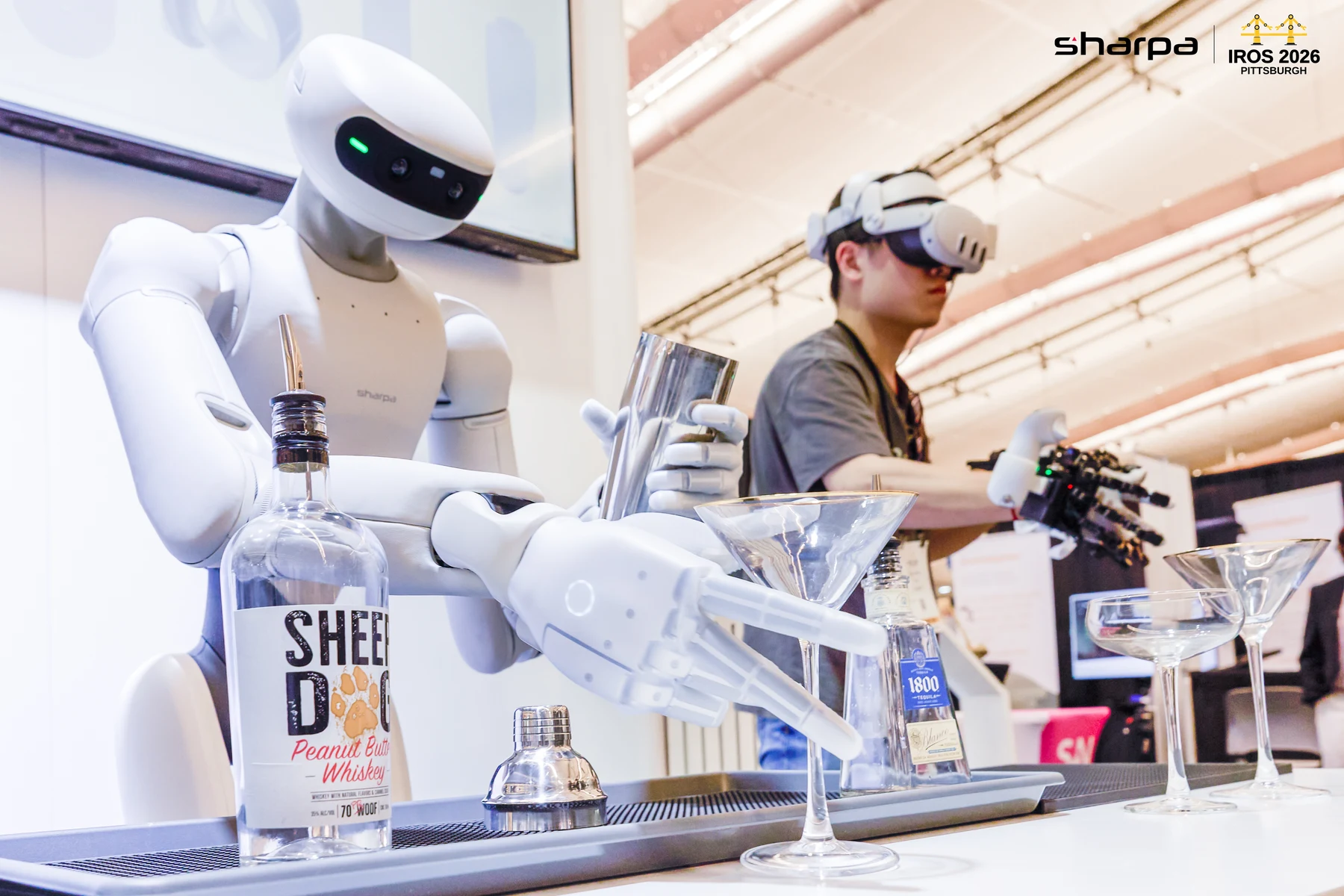
The Dexa D01 during a teleoperation demo at IROS 2026 in Pittsburgh. The operator wears a headset and a pair of AE01 gloves. Credit: Sharpa, via Humanoids Daily.
Sharpa launched three products at IROS 2026 on September 28. The Dexa D01 is a dual-arm manipulation platform with 66 degrees of freedom including the hands, 7-DoF arms with a spherical wrist at human scale, a 5 kg payload per arm on roughly 40 kg of upper body, an end-effector speed above 10.5 m/s, and ±0.2 mm repeatability. It runs on an NVIDIA Jetson Thor with a 1,000 Hz control loop. The whole body is covered in electronic skin sampled at 100 Hz, with 10 mm spatial resolution, 0.2 N force resolution and a 0.1 to 20 N range per element.
The Wave W02 hand is the part most likely to show up in other people's robots. It has 21 active degrees of freedom, weighs under 750 g, and measures 188 by 87.5 by 40 mm, which is 20 mm shorter and 2.5 mm narrower than last year's 1.3 kg W01. Fingertip arrays sense from 5 mN to 30 N at 1 mm resolution; the palm and finger skin sense 0.1 to 20 N at 5 mm. Sharpa rates it IP54 bare and IP67 in its glove, and says it closes to a zero gap, so it can pinch a cord or a chopstick. The Avatar AE01 is the data-collection glove: 22 encoders, one vibration motor per fingertip with 256 feedback levels, 500 Hz wired at 5 ms latency or 150 Hz wireless at 10 ms, three hours on a battery, no calibration step.
Every number above is from Sharpa's spec sheets. No prices, no delivery dates, and no customer results were published; the company is taking sales inquiries from booth 514 through September 30. The demo on the floor was a teleoperation challenge, visitors in a headset and gloves driving the D01, which shows the glove-to-hand loop works and shows nothing about autonomous performance. A hand that senses 5 mN at the fingertip is a real advance if it survives a shift. Durability is the spec no one publishes.
Feather sells a 105 kg wheeled humanoid for $29,990, and Agility says it is looking at wheels too
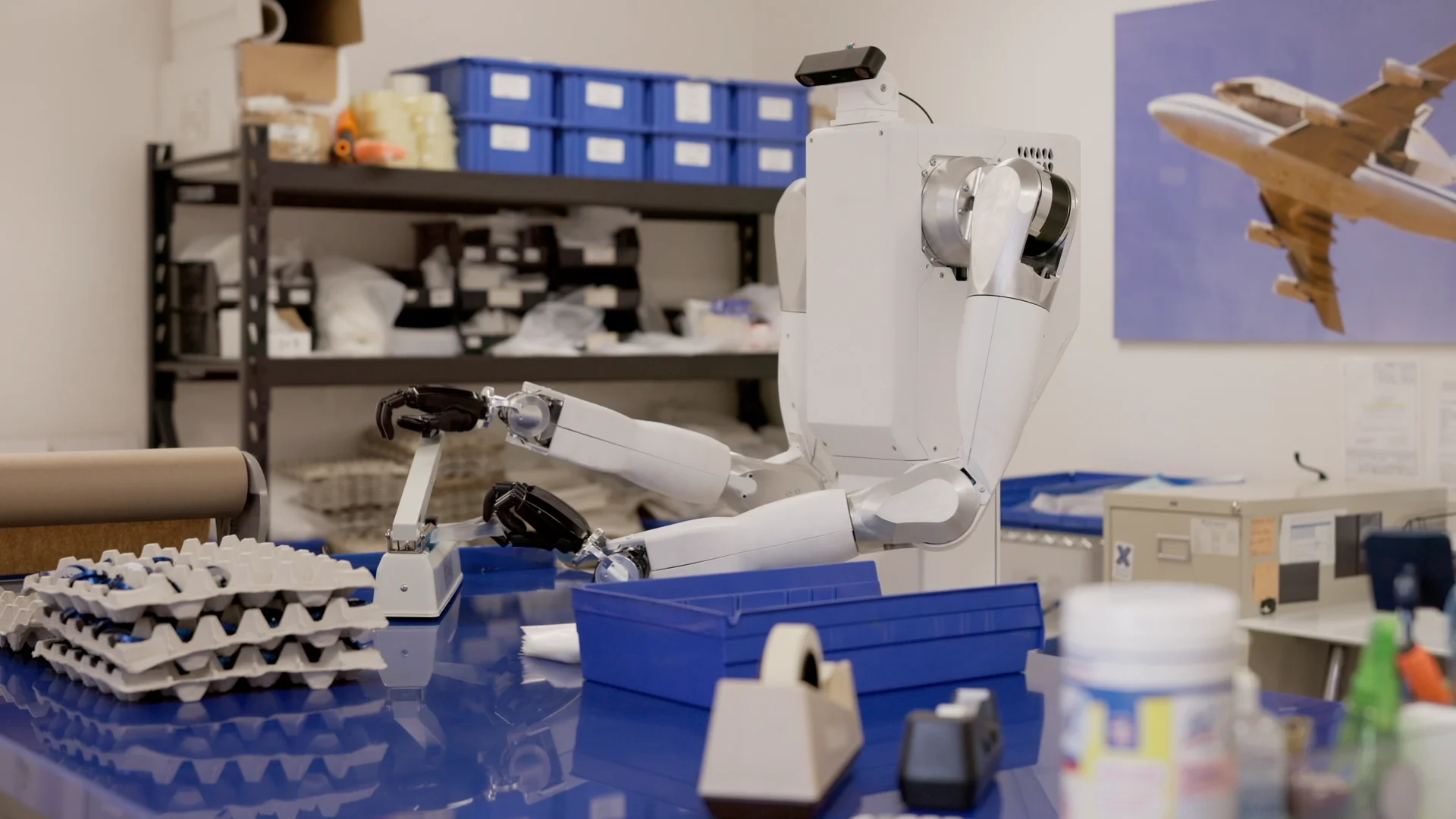
Feather's wheeled dual-arm robot at a bench. Credit: Feather Robotics, via Humanoids Daily.
Feather Robotics launched on September 24 with a $7.6 million pre-seed round led by Gradient Ventures and a robot you can order from its website for $29,990, discounted from a $32,990 list. The machine is a wheeled dual-arm platform, 23 degrees of freedom total, two 7-DoF arms 1 m long, a 600 mm telescoping torso that takes it from 1,200 to 1,800 mm tall, and a holonomic base on a 500 by 510 mm footprint that moves sideways without turning. Total weight is 105 kg. Each arm is rated for 1.8 kg with a 6.8 kg peak. Two hot-swappable 48 V, 50 Ah packs give a claimed 10 hours. The compute bay takes a Jetson Nano, Orin AGX or Thor; the head takes a Zed 2i, Zed X or Zed X Mini; wrist cameras are optional. Python 3.9-plus SDK, ROS 2, Vision Pro and Quest teleoperation, one-year warranty, and an e-stop that cuts motor power.
Co-founder Hoa Mai built humanoids in his garage from 2018 and co-founded Kind Humanoid, which 1X bought in January 2025. Co-founder Parsa Bakhtiari came from Tesla's Model 3 ramp. TechCrunch reports revenue above $1 million with robots cooking in restaurants and cleaning labs, no customer named. Bay Area production is 30 units a month with a plan for 200. Mai's pitch is that the hardware is the commodity and the customer picks the brain: "You can't buy a Tesla robot today and develop on top of it." Feather says the robot has had a year of field testing and publishes no uptime, task success or fleet numbers from it.
The same day, Agility Robotics CEO Jonathan Hurst confirmed to The Robot Report that the company is "exploring a range of robot designs and form factors, including wheels." A wheeled rendering appeared briefly in the Digit 5 launch video. Asked what form it would take: "Too early to say! I have guesses and inclinations, but really we're just starting." Two weeks after launching a biped built around cycloidal-actuator legs, that is a notable thing for Agility to say out loud. For a flat warehouse floor, a $30,000 wheeled base with two arms is competing on the same tasks as a $150,000 humanoid.
AGIBOT says it has built 20,000 robots; Tesla is reported at several hundred Optimus units a week, with 100-screw hands
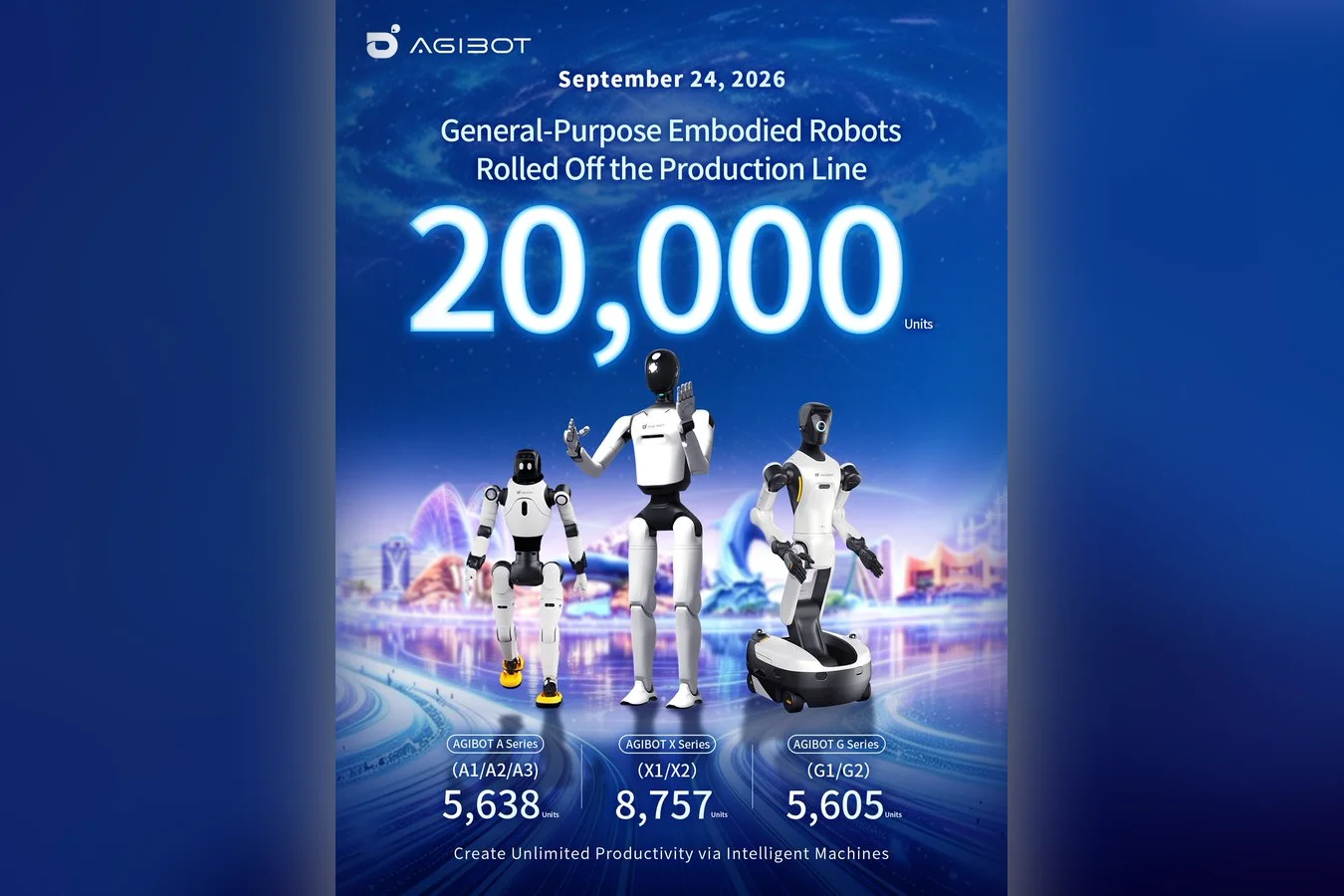
AGIBOT's 20,000-unit milestone graphic. Company artwork, not a photo of the line. Credit: AGIBOT, via Humanoids Daily.
AGIBOT posted on September 24 that cumulative production has reached 20,000 robots. The company's own milestones run 5,000 in December 2025, 10,000 in March, 15,000 in June, 20,000 now, which is a steady 5,000 a quarter, not an acceleration. The mix is 8,757 wheeled X-series, 5,638 A-series and 5,605 G-series, so under half are bipedal humanoids. Humanoids Daily's caveat is the right one: this is a production count from the company, not sales, commissioning or robots in service. AGIBOT reported 1.05 billion yuan of 2025 revenue and began a Hong Kong IPO process on July 24.
Tesla's number comes from The Information on September 25, sourced to unnamed people on the program. Optimus output rose from a few dozen a week in the second quarter to several hundred a week in August, with a stated capacity goal of more than 1,000 a week by year end. Tesla declined to comment. The engineering detail is the hand: each hand-and-forearm assembly takes more than 100 screws and small parts, put in by hand, and the touch sensors have durability problems, with a replaceable sensing glove planned for 2027. Suppliers that pass on prototypes are reported to struggle at volume, and Tesla is qualifying new ones outside China. Three sources told the outlet the robot "cannot yet reliably handle a broad range of tasks." The units are V3 development builds, not the customer version, and the plan is to lease to a few companies whose factories look like Tesla's.
Put the two together and the count that matters is still zero: neither company has published a number of robots doing paid work for a third party. Humanoids Daily also found nine "gen3" Optimus renders in Tesla's Android app, first appearing August 27, showing a more enclosed lower body than the earlier gold prototype. They sit in an assets/mock directory, which is where placeholder art goes.