Robotics Briefing — compiled and curated by Chris Lee
Agility's Digit 5 trades bird legs for cycloidal-actuator human legs, charges in 9 minutes, and sits down when a person walks up
Week of September 15 – September 22, 2026
Agility Robotics unveiled Digit 5 on September 15: human-style legs on proprietary cycloidal actuators, a 50 lb lift, a 90-minute runtime against a 9-minute charge, and a safety architecture that has the robot slow, stop, or sit down before a person can reach it. Boston Dynamics opened an Atlas training center inside Hyundai's Georgia Metaplant, a Czech Hyundai plant said it wants Atlas too, and The Robot Report reported that SoftBank has agreed to buy the RAI Institute from Hyundai. Figure ran Helix 2.5 through 420 trials in 30 rented homes and finished 56% of them. The IFR put 2025 humanoid sales at 7,000 units, most of them bought for research, in the same week The Robot Report tallied $4.87 billion of August robotics funding. The FDA cleared Neptune Medical's Triton 1 robotic colonoscope on a 50-patient trial. Unitree listed a 22-degree-of-freedom hand at $6,500 and published almost nothing else about it.
Humanoids
Digit 5 is built to lift 50 lb all day and to never fall on anyone
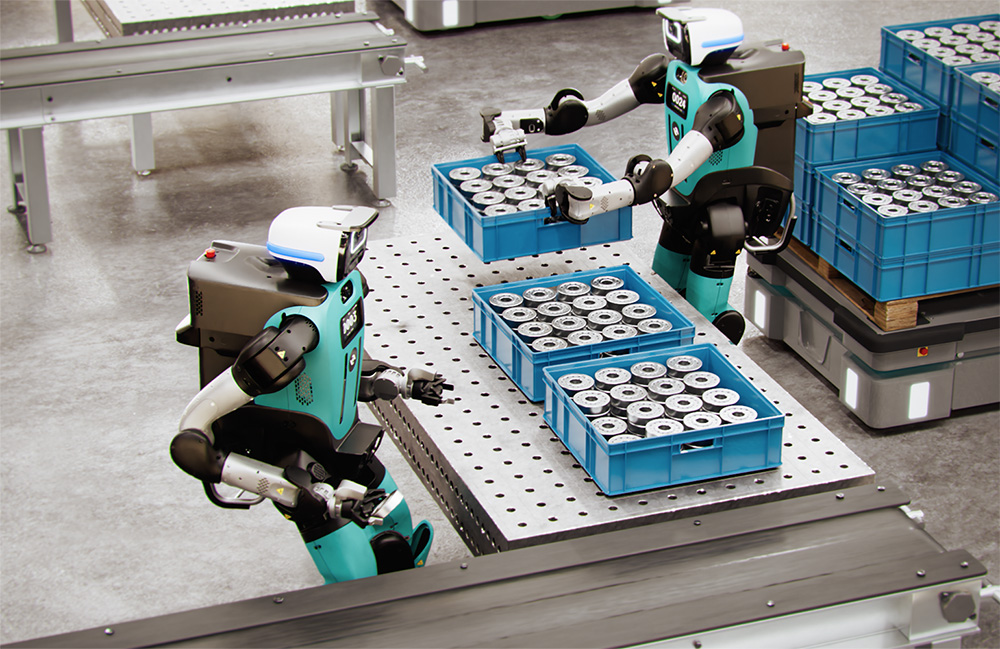
Two Digit 5 units in a facility setting. Agility says the hardware is real but not yet deployed at customer sites. Credit: Agility Robotics, via The Robot Report.
Agility Robotics unveiled Digit 5 on September 15. It stands 5 ft 11 in (1.81 m), weighs 284 lb (129 kg), reaches 7.2 ft (2.2 m), and lifts 50 lb (22.7 kg), a 40% payload increase over Digit 4 and enough to meet OSHA's single-person lift guidance. The legs are the visible change. Cassie and every Digit before this one used backward-bending, bird-style legs tuned for walking. Digit 5 has human-style legs on proprietary cycloidal actuators, padded knees for kneeling, and a squat that puts it in a stable position on the ground. Jonathan Hurst, co-founder and chief robot officer: "The previous leg configuration was really optimized for very good walking and running. The new configuration is optimized for lifting heavy things and getting up and down off the ground a lot."
The battery numbers matter more than the leg shape for a warehouse buyer. Runtime is 90 minutes and a full charge takes 9 minutes, a 10:1 run-to-charge ratio against 2:1 on Digit 4, which is how Agility gets to "20-plus hours in a 24-hour day." The end effector is a two-finger parallel-jaw gripper on an ISO-standard mounting flange, swappable, and rated to move 25 kg bins. Hurst on why there is no five-finger hand: "General-purpose hands don't exist. There are none on the market. No hand that exists on the market can pick up 25-kg bins and do complex manipulation."
The safety architecture is the part Agility is selling. The robot runs 360-degree person detection on visual and auditory sensors, with no fixed safety zones. An independent safety controller watches the detection output and can slow the robot, stop it, or have it put down its load and sit, with motors off, before contact. Agility says it contributed to ANSI/A3 TR R15.108 and to ISO 25785-1, the first international humanoid safety standard, and that it is pursuing a CE mark for EU and UK deployment. What it does not say is which parts of that chain are certified to a performance level today. Hurst's own framing: "There's a difference between safety as a personal opinion and safety as the industrial standard and regulatory process."
The money is in the SEC filing for Agility's SPAC merger with Churchill Capital Corp. XI, which values the company at $2.5 billion on $1.8 million of 2025 net sales. IEEE Spectrum's Evan Ackerman pulled the numbers: a bill of materials of $150,000 to $200,000 at launch, projected to fall under $50,000 at 10,000 units a year, and a service price of about $8,500 a month, which Agility sets against $100,000 a year of labor at $30.50 an hour. Agility reports more than $300 million in multi-year orders as of May, for what Ackerman estimates is under 1,000 robots. Early access starts in the first half of 2027, general availability by the end of 2027, from the RoboFab plant in Oregon. Digit 4 has logged 65,000-plus hours at GXO, Schaeffler, Amazon and Toyota Motor Manufacturing Canada. No customer has a Digit 5 yet.
Boston Dynamics opens an Atlas training floor in Georgia while the ownership chart around it keeps moving
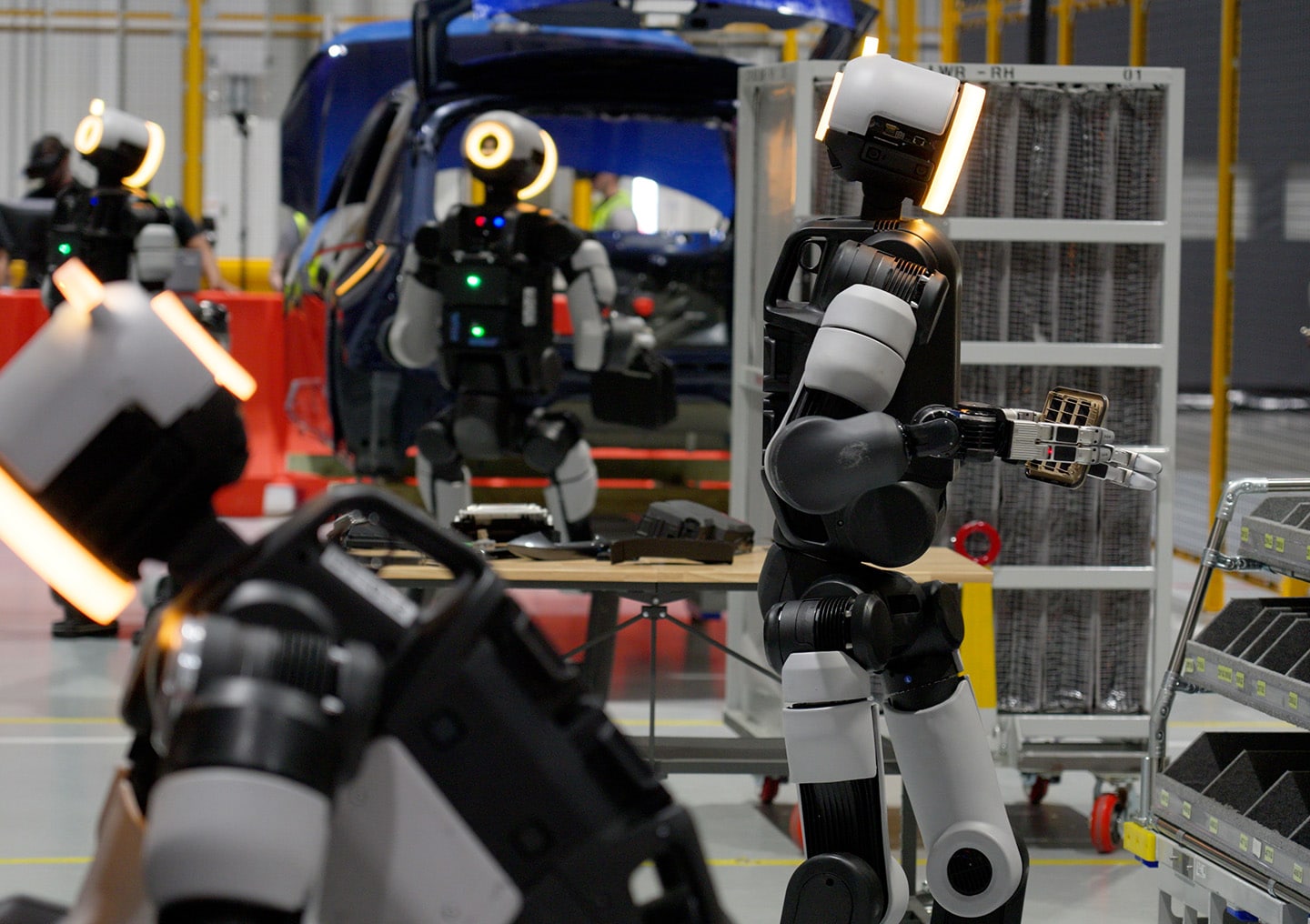
Atlas robots at the Robotics Metaplant Application Center near Savannah, Georgia. Credit: Boston Dynamics.
Boston Dynamics opened the Robotics Metaplant Application Center on September 21 inside Hyundai Motor Group Metaplant America near Savannah, Georgia. The company calls it a "Robot Behavior Factory." Atlas units there are trained on automotive parts logistics and sequencing through teleoperation, reinforcement learning in simulation, and handheld Universal Manipulation Interface devices. The tasks listed are specific: pulling parts out of shipping packaging, placing them in transport cubbies, two-handed carries of large or off-balance items, and grasps that respect cosmetic and fragile surfaces. The current floor is described as initial capacity, with a facility roughly ten times larger planned for 2027.
The numbers around it are Hyundai's July roadmap. Parts sequencing on the line starts in 2028, component assembly by 2030, 25,000 Atlas units across Hyundai and Kia plants over the coming years, and a U.S. factory sized for 30,000 robots a year. Zack Jackowski, chief product and technology officer, said "the design assumptions we made for the production version of Atlas have been very close to right on." Boston Dynamics' own release adds that the deployment plans remain subject to technical validation, operational readiness and business requirements. The Korea Herald reported on September 21 that Hyundai's Nošovice plant in the Czech Republic is in early talks about Atlas as well, with no date, count, or task named; that plant runs 566 robots today.
Two ownership moves landed the same week. The Robot Report reported on September 18 that SoftBank has agreed to acquire the Robotics and AI Institute from Hyundai Motor Group, with terms undisclosed and the deal under CFIUS review. RAI is Marc Raibert's Cambridge research lab, spun out with more than $400 million in initial funding when Hyundai bought Boston Dynamics. RAI told The Robot Report it had nothing to share, and SoftBank did not respond. Hyundai said in July it would buy SoftBank's remaining 9.65% of Boston Dynamics, and SoftBank is still working through its $5.375 billion purchase of ABB's robotics business. If the RAI deal closes, the people who designed Atlas's control stack and the company that builds it will sit under different owners.
Figure's Helix 2.5 finished 56% of chores in 30 homes it had never seen
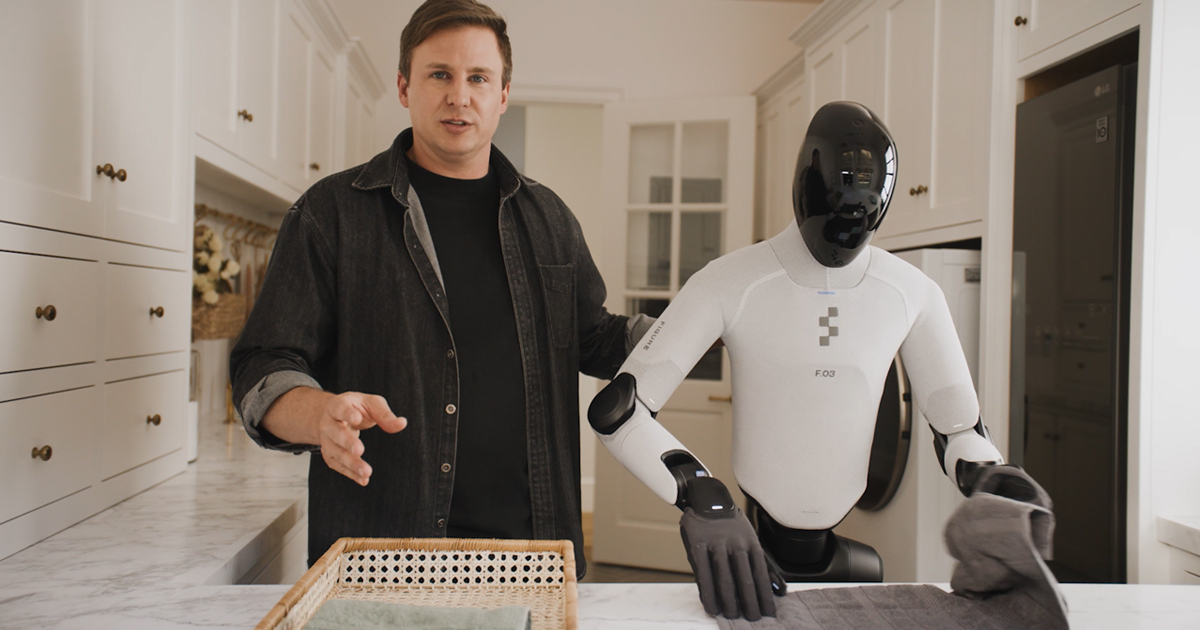
Figure's announcement image for Helix 2.5. Credit: Figure AI.
Figure published its Helix 2.5 results on September 17. The company rented 30 homes in the Bay Area, collected no data in any of them, and ran a single fixed policy checkpoint through three tasks: tidying 13 to 15 toys into a basket, folding towels into a basket, and making a bed with pillows placed and the comforter smoothed. Each task had a per-item timeout of one to three minutes. Across 420 trials the robot succeeded 237 times, or 56%. By task: bed making 67% (94 of 140), towel folding 62% (87 of 140), tidying 40% (56 of 140).
The comparison Figure wants you to make is against the same architecture trained from scratch, which managed 9%. The difference is pretraining on Index, Figure's dataset of first-person human video, which the company says grows by 35 minutes of new experience every second from more than 90,000 weekly contributors. Figure also says it matched Helix 02's earlier performance with half the adaptation data, and that no single evaluation task made up more than 1.9% of the pretraining set. "Zero-shot" here means unseen homes and objects. The three behaviors were trained beforehand, elsewhere.
A 44% failure rate is the other half of the result. Figure's line that the robot "recorded successes in every one of the 30 homes" is a statement about geographic coverage, not reliability. The trial counts, timeouts, and success definitions are more than most humanoid demos publish, and they come from the company running the test. The $3.5 billion compute commitment for Helix training is in the same post.
7,000 humanoids sold in 2025, most of them for research; $4.87 billion of robotics funding in August, half of it Chinese
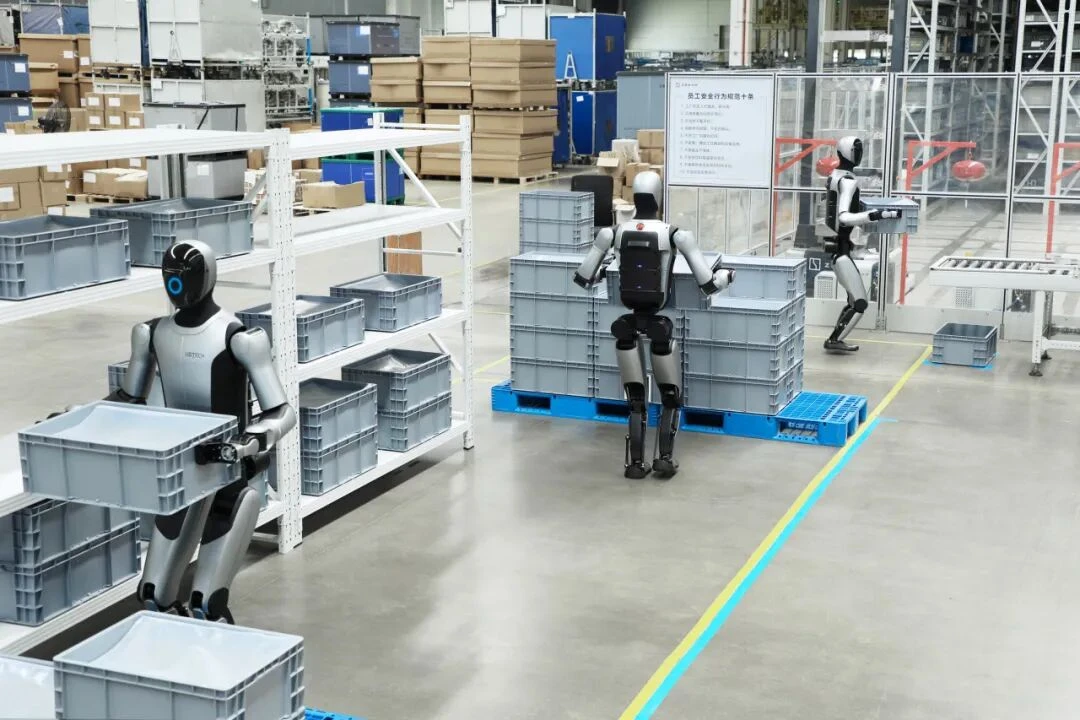
UBTECH humanoids handling totes in a factory. Illustrative; not a photo tied to the IFR count. Credit: UBTECH, via Humanoids Daily.
The International Federation of Robotics told Reuters on September 21 that about 7,000 humanoid robots were sold worldwide in 2025 for industrial and professional service use. The IFR definition requires a human-like appearance and autonomous operation in environments built for people; legs are optional, and consumer, military and medical robots are excluded. Secretary general Susanne Bieller said the units were "often used for research and data collection rather than productive work," and that automaker pilots run to single-digit or sometimes double-digit robot counts. For scale, the IFR counted 542,000 industrial robot installations in 2024 and 199,000 professional service robots.
Two numbers to hold against that. Unitree alone reported more than 5,500 humanoids shipped in 2025 in its IPO filing, which suggests either that most of the IFR's 7,000 are Unitree G1s bought by labs, or that the two counts use different definitions. Bank of America Global Research, quoted in the same Reuters story, forecasts 90,000 humanoid shipments in 2026 and 1.2 million by 2030. That is a 13x jump in one year from a base the IFR describes as mostly research purchases.
The money is not waiting for the count. The Robot Report's August tally, published September 17, is $4.87 billion across 162 disclosed transactions. China accounted for about $2.44 billion, the United States $1.27 billion. The top five deals were more than $3.3 billion of the total, led by Unitree's $905 million IPO and XPENG Robotics' $900 million Series A. Humanoid companies took about $943.8 million, 19.4% of the month, most of it the XPENG round. The report notes that undisclosed rounds put the real figure higher.
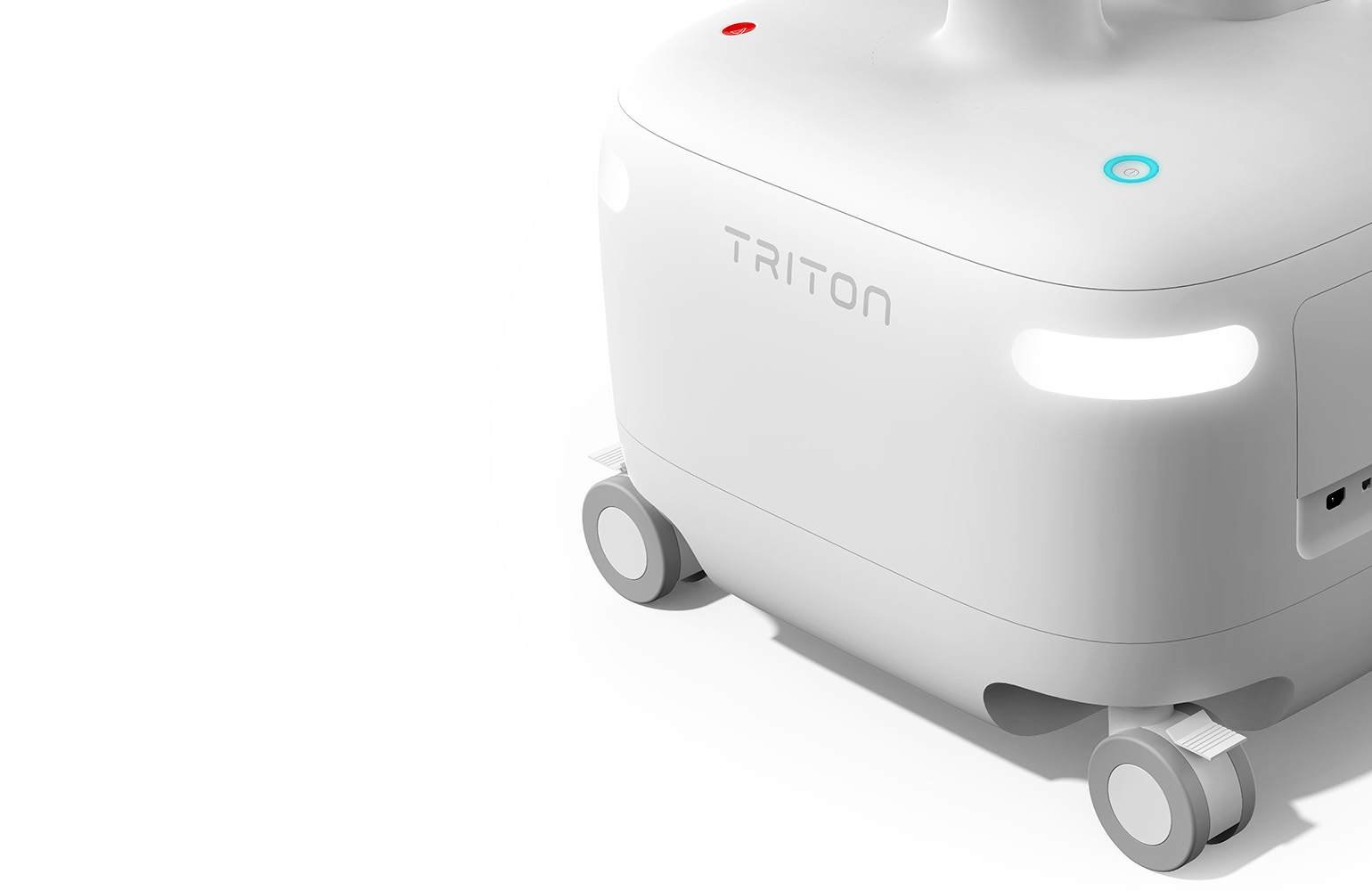
FDA clears Neptune's Triton 1, a rigidizing robotic colonoscope that reached the cecum in all 50 first-in-human patients
The Triton 1 robotic endoscopy system. Product image from the company's announcement. Credit: Neptune Medical, via The Robot Report.
Neptune Medical announced on September 16 that the FDA granted 510(k) clearance to its Triton 1 robotic endoscopy system for diagnostic and therapeutic procedures throughout the colon, including screening and surveillance colonoscopy, endoscopic mucosal resection and endoscopic submucosal dissection. The device is built on the Burlingame, California company's Dynamic Rigidization platform, the same principle behind its earlier overtubes: a flexible tube that can be stiffened on command so the scope stops looping and the tip goes where the operator points it. The announcement gives no arm, console, or scope-compatibility details beyond "robotic precision, stability, and control."
The clearance rests on CARE 1, a 50-patient first-in-human study reported in May. Cecal intubation was 100%, with no patient repositioning, no abdominal pressure, and no conversion to manual colonoscopy. The adenoma detection rate was 54.2% against the 35% benchmark. No adverse events were reported. Clinicians scored their workload 67% lower than manual colonoscopy on the NASA-TLX scale. Jason Samarasena of UC Irvine, a study investigator: "Triton showed us the possibility of one system that can screen and treat anywhere in the colon, efficiently, thoroughly, and with minimal burden."
Fifty patients is a feasibility study, not a comparison trial, and the ADR figure has no randomized control arm behind it. Neptune raised a $97 million Series D in 2024 with Olympus and Sonder Capital, whose co-founder Fred Moll chairs the company. It gave no commercial launch date and says it will use this generation to build evidence and inform the next platform.
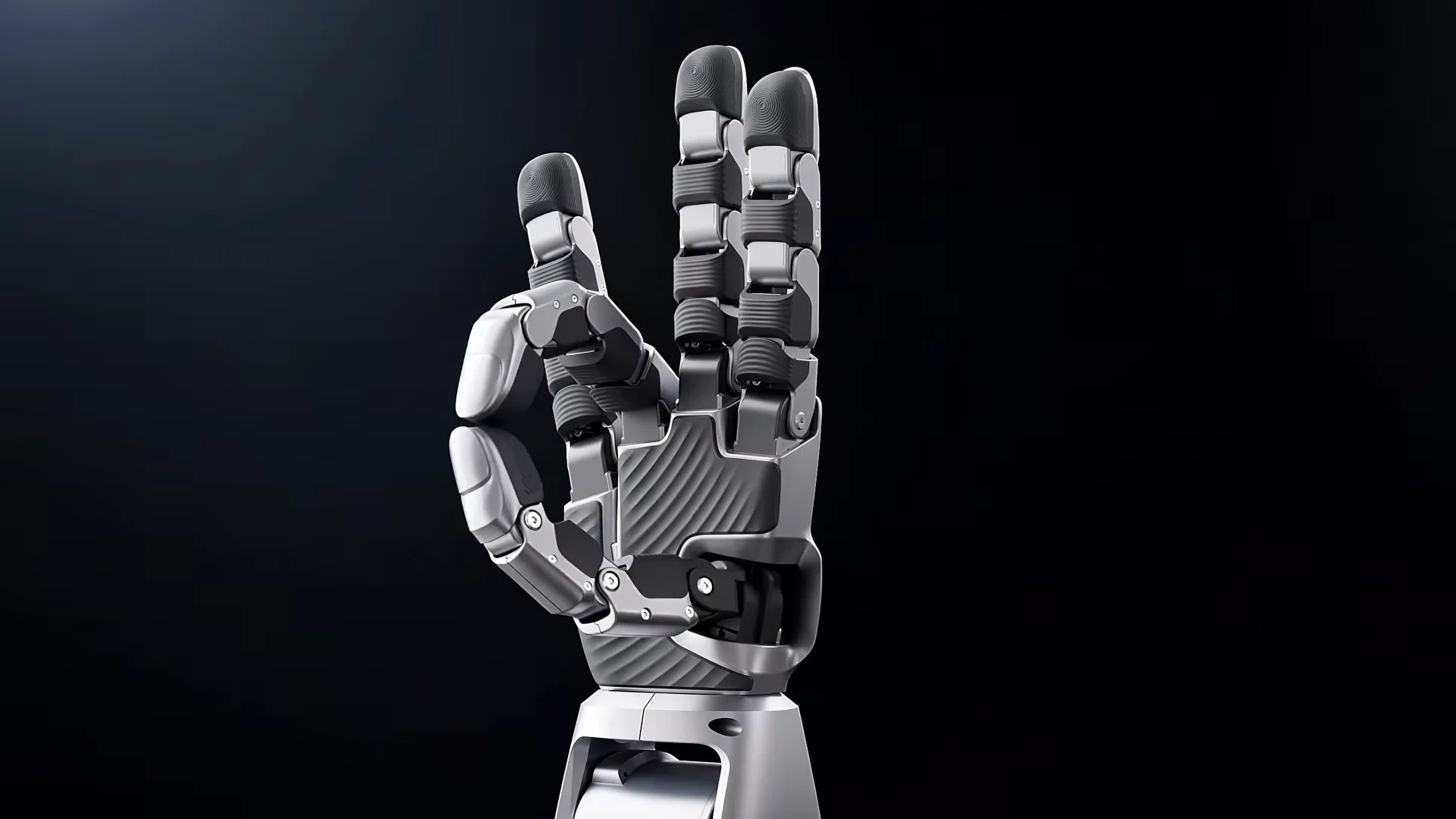
Unitree lists a 22-DoF hand at $6,500 and leaves the spec sheet blank
The Dex5-S, a still from Unitree's launch video. Credit: Unitree, via Humanoids Daily.
Unitree announced the Dex5-S on September 21: a human-sized hand with 22 degrees of freedom, every joint described as backdrivable with impact-torque protection, starting at $6,500 before tax and shipping, or 39,900 yuan in China. That is about the price of a mid-range cobot gripper for a hand with more joints than the Shadow Dexterous Hand has actuated axes. The previous Dex5-1 had 20 degrees of freedom, 16 driven and 4 passive, weighed about 1 kg, and offered an optional 94-point tactile array.
That is everything Unitree has published. No weight, no fingertip or grip force, no joint torque, no tactile option, no interface, no ship date, and no statement of whether all 22 axes are independently driven or some are coupled. Hurst's line from the Digit 5 launch, that no hand on the market can pick up a 25 kg bin and do fine manipulation, is the right frame. A 22-DoF hand at this price is a research tool until the force and durability numbers exist. If a datasheet appears, this briefing will come back to it.