Robotics Briefing — compiled and curated by Chris Lee
Universal Robots puts 40% more compute in a 30% smaller controller and a camera-ready flange on three new cobot arms
Week of September 8 – September 15, 2026
Universal Robots used IMTS in Chicago to launch Gen 7: three new arms, a CB7 controller with 40% more compute in a 30% smaller box, and a tool flange built to carry a wrist camera without a separate cable run. Unitree listed the G1+ at $15,000 with a two-axis neck and motors it says deliver 110% more shoulder and waist torque, three weeks after its stock peaked. UBTECH commissioned a Liuzhou plant sized for one industrial humanoid every 10 minutes. Four research groups published tactile datasets that roughly double manipulation success rates. Two logistics startups picked wheels over legs, one of them a month after shipping a biped. Teradyne's patent case against JAKA now has a public docket at the Unified Patent Court, and the three patents are worth reading for the brake and joint designs alone.
Industrial
Gen 7 rebuilds the UR cobot from controller to flange, with no price and no ship date
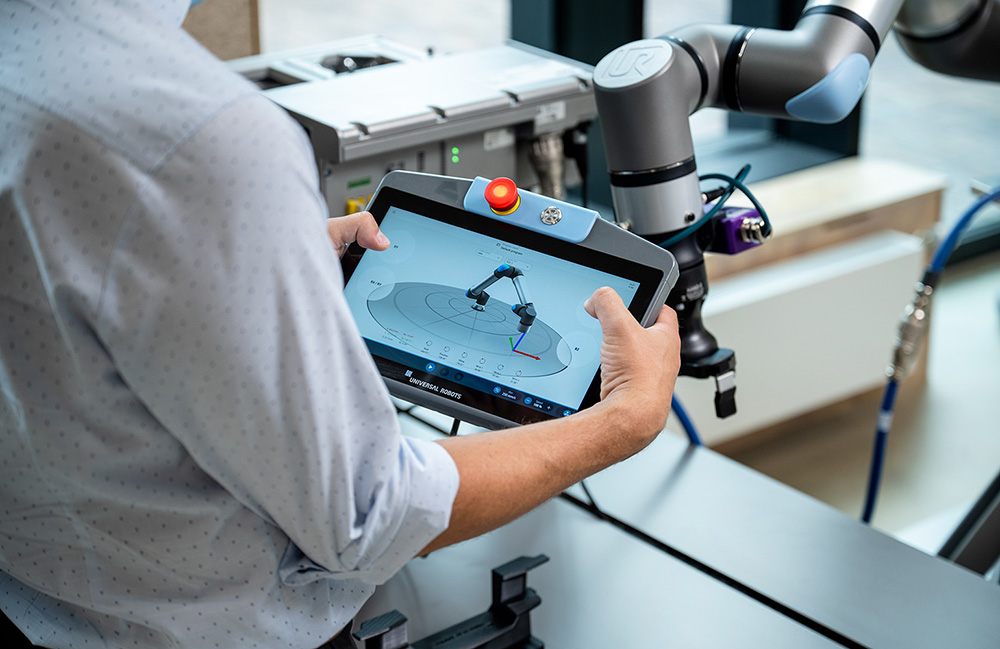
The Gen 7 platform as presented at IMTS: g-Series arm, CB7 Core controller and TP7 Core pendant. Credit: Universal Robots, via The Robot Report.
Universal Robots introduced Gen 7 at IMTS in Chicago on September 14. The platform ships with three new arms: the UR10g-1750, UR17g-1300 and UR18g-950. The model name is the payload in kilograms followed by the reach in millimeters, so the UR18g-950 carries 18 kg at 950 mm. The CB7 Core controller has 40% more compute in a 30% smaller footprint than the previous generation, talks to PLCs, HMIs, MES platforms, IPCs and vision systems over multiple networks, and comes as a standalone box or a compact cabinet-integration version. It also runs the older e-Series and UR Series arms. The TP7 Core pendant is 20% lighter, with a full-HD display and a virtual joystick.
The flange is the part worth studying. The g-Series tool flange is designed to carry a wrist-mounted camera and high-bandwidth sensors, with force-torque sensing, impedance control and RTDE built in. The SP7 Smart Panel sits on the flange with safety-rated freedrive, LED indicators and three configurable buttons that trigger PolyScope X Smart Skills. On the software side, PolyScope X exposes open APIs and ROS 2 communication and can hand AI workloads to an external IPC. Inbolt's CEO Rudy Cohen said its 3D vision guidance now runs natively on the UR controller. Certifications: PLd Category 3 per ISO 13849-1, TÜV certification to ISO 10218-1 and UL 1740, and IEC 62443-4-1 ML3 for cybersecurity at Teradyne Robotics.
Neither the release nor the trade coverage gives a price or a shipping date. The 40%, 30% and 20% figures are relative to unstated baselines. What was shown on the floor was the UR17g-1300 with the SP7 panel and a Weiss Robotics gripper, alongside more than 20 ecosystem partners including Cognex, Schunk, Robotiq and Psyonic.
Unitree's G1+ adds a neck, doubles shoulder torque on paper, and costs $15,000
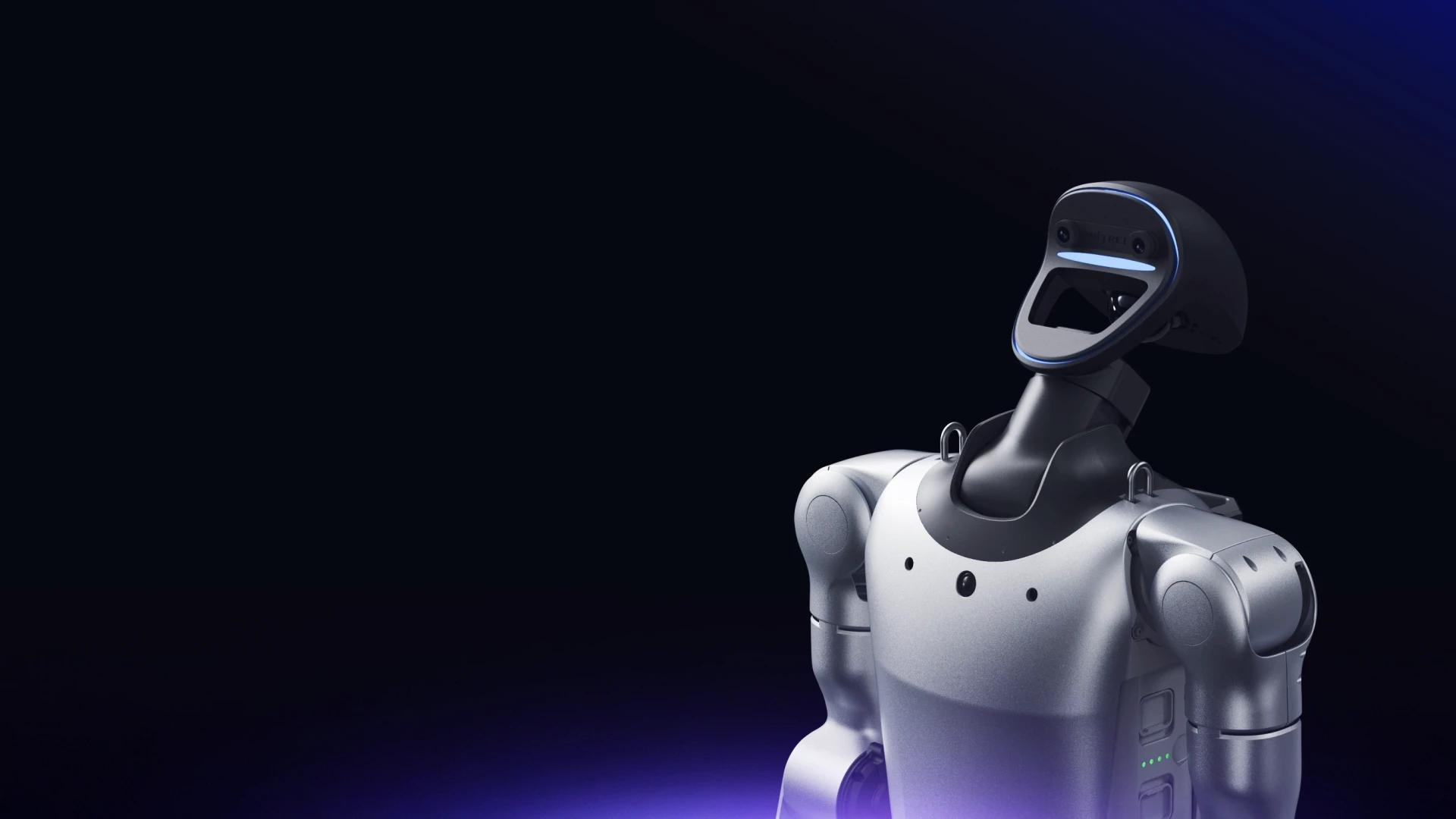
The G1+ turning its head; the new neck has two degrees of freedom. Still from Unitree's launch video. Credit: Unitree, via Humanoids Daily.
Unitree listed the G1+ on September 14 at $15,000 before tax and shipping, $1,500 more than the G1. The robot stands 1.34 m and weighs about 35 kg with its battery, and it has 25 degrees of freedom against the G1's 23. The two new joints are in the head: pitch from -25° to +36° and yaw of ±110°. Each arm has five degrees of freedom and lifts about 3 kg, up from about 2 kg. The EDU version adds optional seven-DoF hands and a three-DoF waist, rated for about 4 kg per arm, with pricing on request.
The motor claims are the headline. Unitree says shoulder and waist peak torque is up 110% with 72% less heating, arm torque is up 43% with 30% less heating, and the thigh motors run 28% cooler. It describes them as low-inertia, high-speed inner-rotor PMSM units. Sensing is new too: a binocular camera with a 60 mm baseline, a 1080p30 wide-angle chest camera, a 3D lidar, touch sensing in the head, a six-microphone array with direction-of-arrival localization, and two 10 W speakers in the waist. The battery is a 13-cell-series 9,000 mAh quick-release pack on a 54 V, 5 A charger, and the robot can now run on continuous external power. Runtime stays at about two hours.
Every number above is Unitree's, and peak joint torque does not translate into a matching gain in what the whole robot can lift or carry. The unchanged runtime with hotter motors is the figure to watch. The launch lands on a rough stretch for the company's stock: on September 9 Unitree closed at 513.93 yuan on Shanghai's STAR Market, 39% below its first-day close of 845 yuan and 53% below the 1,100-yuan intraday peak from the August 19 debut. The 2025 numbers behind the valuation: 1.70 billion yuan in revenue, 51.78% of it from humanoids, and more than 5,500 humanoid units shipped.
UBTECH's Liuzhou plant is sized for a humanoid every 10 minutes; its first half sold 921
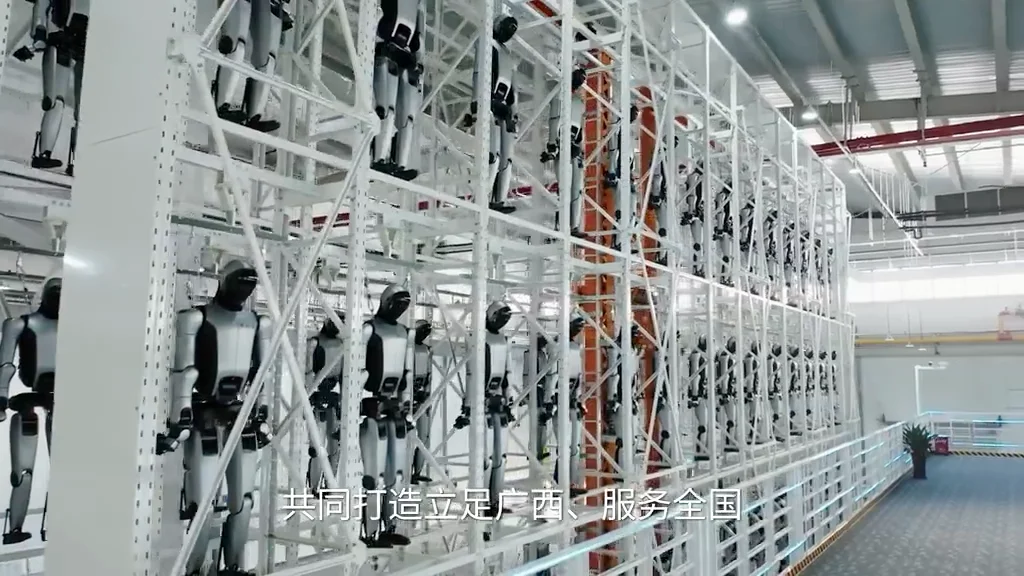
Finished Walker S units in the plant's high-bay ASRS buffer, which UBTECH says holds up to 112 robots. Credit: UBTECH, via Humanoids Daily.
UBTECH commissioned its Industrial Humanoid Robot Super Smart Factory in Liuzhou, Guangxi on September 12 and 13. Xinhua puts the capacity at 10,000 industrial humanoids a year, one every 10 minutes. The building covers 14,000 square meters with 13.8 m of clearance. It builds the Walker S series bipeds, including the Walker S2, plus the wheeled Cruzr S2 and Cruzr Y1.
The line is staffed largely by UBTECH's own products. Cruzr Y1 and S2 mobile manipulators do depalletizing, bin picking and tote replenishment. Wali autonomous forklifts and Chitu haulers move material between stations. Finished robots go through automated torque stations, a four-hour burn-in, and a visual inspection tunnel, then into a 65-square-meter rotating ASRS buffer that holds 112 units. Siemens supplied the digital twin used to validate the line.
The 10-minute takt is a design figure. No output from the line has been published, and there is no order book to size it against beyond UBTECH's interim results: 921 full-size humanoids delivered in the first half of 2026, with enterprise customers at 96% of revenue. That pace is about a fifth of the plant's rated annual output. UBTECH's stated target is a unit production cost under $20,000 by 2030.
Four tactile datasets, and the policies trained on them roughly double their success rates
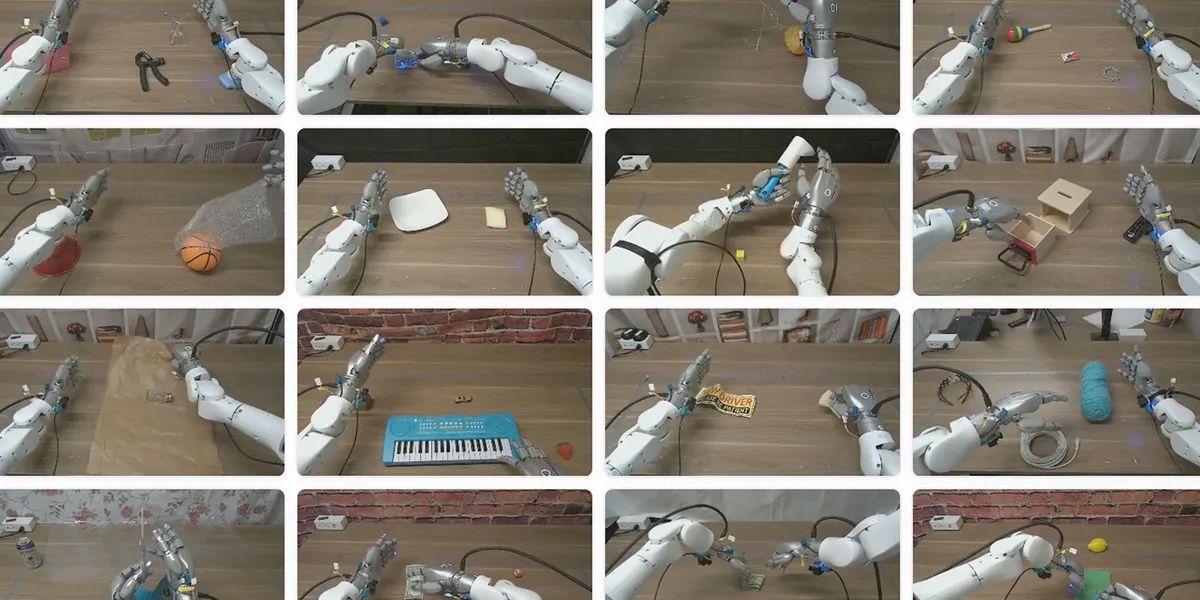
IEEE Spectrum's lead image for its report on tactile datasets. Credit: IEEE Spectrum.
Edd Gent's September 10 report for IEEE Spectrum rounds up the tactile datasets that arrived this year. T-Rex, from Trevor Darrell's lab at UC Berkeley, holds 100 hours of tactile data across more than 200 household objects and actions such as wiping, grasping, twisting and pouring. A policy trained on it hit 65% success across 12 manipulation tasks, close to double the best vision-language-action models the team compared against. Chengbo Yuan at Tsinghua aggregated more than 3,000 hours from 21 sensor types on different robots by mapping every sensor onto a common human-hand template.
NeoteAI, a Fudan University spin-out, reports more than 30,000 hours of synchronized vision and touch collected with its own sensors on robot arms and handheld grippers. Two groups went the other way and inferred touch from cameras. A USC team trained on about 2,700 handheld-gripper demonstrations to predict tactile signals from vision alone. Long Cheng's group at the Chinese Academy of Sciences built a model that predicts the expected tactile signal from what the camera sees, amplifies the surprises and damps the rest. On contact-rich tasks it reached 62.8% success, against 28.2% without touch.
Each result is on its authors' own task set with its own sensor, so the percentages do not compare across papers. Darrell's framing holds up regardless: most dexterous manipulation can be done by humans with their eyes closed, and force, slip and grasp precision are not things a camera measures well. Also this week, UltraSense executives published a contributed piece in The Robot Report claiming 500 µm spatial resolution and 1.25 mN force resolution from ultrasound through an elastomer skin. The company has shipped more than 4 million ultrasound sensors for automotive touch surfaces. The robotics numbers are the company's own and there is no independent test.
Wheels over legs: Maven raises $100M for a palletizing robot and Nucleus drops its biped after a month
Maven's wheeled dual-arm platform working boxes with vacuum grippers. Credit: Maven Robotics, via TechCrunch.
Maven Robotics came out of stealth on September 10 with a $100 million Series A led by RoboStrategy (Nasdaq: BOT), with LocalGlobe, Vine Ventures and XTX Markets Ventures. CEO Hamza Derbas spent nine years in Apple's special projects group; his co-founder Khalid Derbas comes from private equity, and the engineering core was hired out of Apple's shut-down car program. The robot is a wheeled base that moves up to 10 mph, with two arms rated for 30 kg each and vacuum grippers, aimed at mixed palletizing. Maven says it has as many as eight robots running 16-hour shifts at 99% or better uptime at customer sites it does not name. The money builds 250 third-generation units and starts a fourth. Derbas on bipeds for warehouses: they "are very complex, unreliable, and add unnecessary cost."
Nucleus, a European startup, reached the same conclusion in about a month. Nucleus I was built on a Unitree G1. After the company left stealth in August, plant managers asked for more payload, longer runtime and, in the company's telling, "no legs." Nucleus II is a dual-arm torso on a wheeled base with 10 kg per arm, five to nine hours of runtime, and a battery six times the size of the first robot's. It is working at one logistics site, with a target of up to 25 robots by the end of the first quarter, billed per completed task. Co-founder Melvin Schwarz: "Only the factory tells you what to build."
Both uptime and deployment figures come from the companies. Neither names a customer.
Teradyne's case against JAKA is on the UPC docket, and it turns on a brake, a joint and a touchscreen
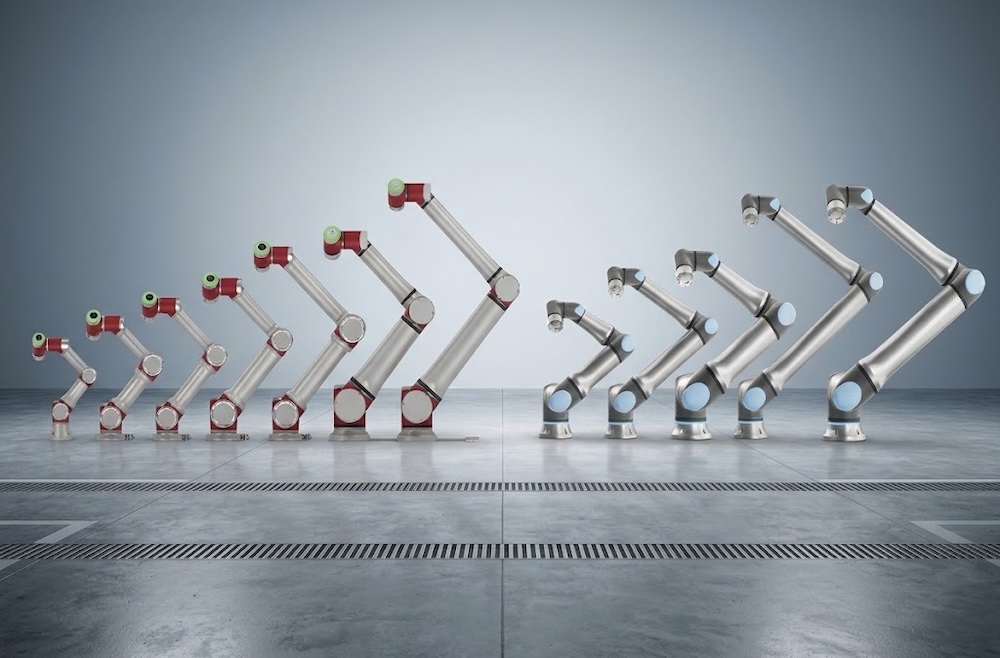
Collaborative arms from JAKA (left) and Universal Robots. Credit: The Robot Report.
The Robot Report pulled the docket on September 10: case UPC-CFI-0003057/2026 in the Copenhagen Local Division of the Unified Patent Court, filed August 24 by Teradyne Robotics A/S against JAKA Robotics GmbH, the German subsidiary of the Chinese cobot maker. Three Universal Robots patents are asserted, all with a March 2006 priority date. EP1996376 covers programming a robot through a touchscreen that shows a 3D representation of the arm. EP3045273 covers a joint safety brake built from a solenoid, a ratchet and an annular friction member, with the encoder arrangement around it. EP3530420 covers the joint construction itself: the output flange and the structure that connects adjacent joints.
Teradyne's August 27 announcement said the case targets a broad range of JAKA cobots sold in the EU and could carry across the 17 EU states in the UPC system. Jean-Pierre Hathout, president of Teradyne Robotics Group, called it enforcement "across both hardware and software." It is the company's second European IP action this year, after a German court granted a preliminary injunction against Elite Robots Deutschland in April over copying of Universal Robots' software. The public docket does not yet list the accused models or the remedies sought.
JAKA told The Robot Report that as of September 2 it had received no legal documents and no notice from the court. A March 2006 priority date puts the family near the end of its 20-year term, which runs from the filing date rather than the priority date. The brake and joint patents describe the mechanisms UR arms have used since the UR5 shipped in 2008.