Meridia, episode 2 — written by Chris Lee
Why can't you remember falling asleep?
September 21, 2026
You have fallen asleep thousands of times, and you have never once caught it happening. You were awake for the last few minutes. You lived them. Your brain just didn't keep them, and it does the same thing every night.
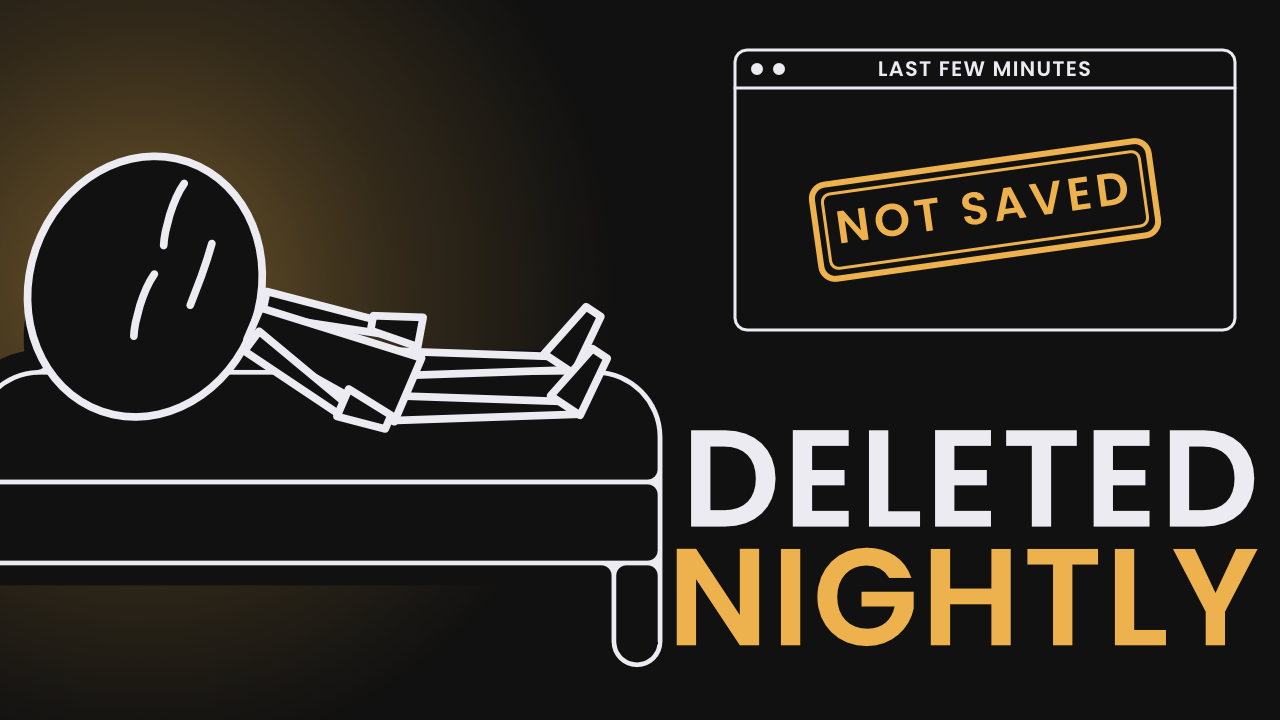
This is the written version of a 7-minute animated episode. Watch it on YouTube.
The word-list test
In the 1990s, sleep researchers played word pairs and sounds to volunteers as they drifted off, then woke them. People woken after thirty seconds of sleep remembered what they had heard. People woken after ten minutes had lost everything from the last one to four minutes before sleep, even though their brain waves show they were awake when they heard it.
Scientists call this sleep-onset amnesia. The night doesn't go missing, only a short window before sleep takes over. And those minutes get saved only if you stay awake afterward. If sleep arrives first, the save never happens. That's the clue: falling asleep doesn't happen all at once. You shut down in pieces.
1. The recorder switches off first
Your brain has no single power switch. Electrodes inside the brain show regions going offline in sequence. The thalamus, a relay station deep in the brain, goes quiet minutes before the cortex.
The order matters because of the hippocampus, named after the seahorse for its shape. Most of what you experience is held there first, like an unsaved document, and only later written into long-term storage. It's your brain's save button.
Recordings from a small group of epilepsy patients found the hippocampus showing signs of sleep minutes before the rest of the cortex. The samples are small, and the link to amnesia is an inference. But the picture is strange. The recorder may clock out while you're still in there experiencing things. The pillow and the drifting thoughts happen to you. They're written on a whiteboard, and by morning it's wiped.
2. You wake up all night
Nobody sleeps straight through. Sleep-lab norms put healthy young adults at around twenty awakenings a night, and more as you get older. Most last under a minute. You roll over, fix the blanket, maybe open your eyes. In the morning, you say you slept straight through.
The same rule applies: an awakening has to last a few minutes before it gets saved. It's why you can sleep through a thunderstorm your brain reacted to, or shut off an alarm and not remember doing it. Your memory of last night has two clean edit points, lights out and the alarm, with dozens of deleted scenes in between, stitched so cleanly you never notice the cuts.
3. The night shift
Why delete anything? Because the brain isn't resting at night. While you sleep, the hippocampus replays the day, at high speed, and sends the important parts out to long-term storage in the cortex. This is memory consolidation, and deep sleep seems to be when most of it happens.
Picture reorganizing a warehouse while new deliveries keep crashing through the door. The leading idea, from the neuroscientist Michael Hasselmo, is that filing old memories and recording new ones use the same machinery, with the chemical acetylcholine switching between them. Run both at once and new input could scramble memories that are still being moved. So the brain seems to mostly lock the loading dock at night. Noradrenaline, one of the brain's "this matters" signals, fits the picture. It starts falling as you drift off and bottoms out when you dream.
That's why the dreams you remember are almost always the ones you wake up from, catching the whiteboard before it's wiped. Reach for your phone first and even that dream dissolves. The amnesia is the cost of storing the rest of your life properly.
How to visit the deleted zone
You can't beat the deletion, but you can visit the border it erases. It's called hypnagogia: drifting images, invented voices, the falling jolt that snaps you awake.
Salvador Dalí napped holding a heavy key over an upturned plate. The moment he dozed off, the key dropped and the clatter woke him. Thomas Edison reportedly did the same with steel balls.
In 2021, researchers in Paris tested the trick. Volunteers rested holding a bottle that fell when they relaxed. Those who slipped into the lightest stage of sleep for about a minute were nearly three times as likely as people who stayed awake to spot a hidden shortcut in a puzzle, 83 percent against 31. Drift any deeper and the boost vanished.
To try it, recline holding something light, like an empty water bottle, and let the drop wake you. Or keep a notebook by the bed and write down a dream the moment you wake.
Tonight, a few minutes of your life will be deleted, and your brain will stitch the gap so cleanly you'll never feel the seam. At least part of you will still be in there when the recorder shuts down.
Next episode: what happens in your brain during anesthesia, when some people come back with dreams and others come back with nothing at all.
Subscribe to Meridia on YouTube to catch it.
Sources and further reading
- Wyatt, J. K., Bootzin, R. R., Anthony, J. & Bazant, S. (1994). Sleep onset is associated with retrograde and anterograde amnesia. Sleep, 17(6), 502–511. doi:10.1093/sleep/17.6.502
- Wyatt, J. K., Bootzin, R. R., Allen, J. J. B. & Anthony, J. L. (1997). Mesograde amnesia during the sleep onset transition: replication and electrophysiological correlates. Sleep, 20(7), 512–522. doi:10.1093/sleep/20.7.512
- Magnin, M., Rey, M., Bastuji, H., et al. (2010). Thalamic deactivation at sleep onset precedes that of the cerebral cortex in humans. PNAS, 107(8), 3829–3833. doi:10.1073/pnas.0909710107
- Sarasso, S., Proserpio, P., Pigorini, A., et al. (2014). Hippocampal sleep spindles preceding neocortical sleep onset in humans. NeuroImage, 86, 425–432. doi:10.1016/j.neuroimage.2013.10.031
- Bonnet, M. H. & Arand, D. L. (2007). EEG arousal norms by age. Journal of Clinical Sleep Medicine, 3(3), 271–274.
- Campbell, S. S. & Webb, W. B. (1981). The perception of wakefulness within sleep. Sleep, 4(2), 177–183.
- Winser, M. A., McBean, A. L. & Montgomery-Downs, H. E. (2013). Minimum duration of actigraphy-defined nocturnal awakenings necessary for morning recall. Sleep Medicine, 14(7), 688–691. doi:10.1016/j.sleep.2013.03.018
- Diekelmann, S. & Born, J. (2010). The memory function of sleep. Nature Reviews Neuroscience, 11(2), 114–126. doi:10.1038/nrn2762
- Hasselmo, M. E. (1999). Neuromodulation: acetylcholine and memory consolidation. Trends in Cognitive Sciences, 3(9), 351–359. doi:10.1016/S1364-6613(99)01365-0
- Gais, S. & Born, J. (2004). Low acetylcholine during slow-wave sleep is critical for declarative memory consolidation. PNAS, 101(7), 2140–2144. doi:10.1073/pnas.0305404101
- Aston-Jones, G. & Bloom, F. E. (1981). Activity of norepinephrine-containing locus coeruleus neurons in behaving rats anticipates fluctuations in the sleep-waking cycle. Journal of Neuroscience, 1(8), 876–886.
- Vallat, R., Lajnef, T., Eichenlaub, J.-B., et al. (2017). Increased evoked potentials to arousing auditory stimuli during sleep: implication for the understanding of dream recall. Frontiers in Human Neuroscience, 11, 132. doi:10.3389/fnhum.2017.00132
- Lacaux, C., Andrillon, T., Bastoul, C., et al. (2021). Sleep onset is a creative sweet spot. Science Advances, 7(50), eabj5866. doi:10.1126/sciadv.abj5866
- Dalí, S. (1948). 50 Secrets of Magic Craftsmanship. Dial Press. ("the slumber with a key")