EV Technology Briefing — compiled and curated by Chris Lee
Ionity adds batteries to dodge the grid queue, and Finland gets its first public megawatt truck charge
Week of October 20 – October 27, 2026
Six stories on the engineering and the rules around it. Charging is mostly a grid problem now, and Ionity and Plugit show two ways around it. Fraunhofer works on the lithium-metal interface. Canada eases its emissions path, Australia tests whether fleets can earn from V2G, and VW reshuffles its driver-assist program.
Charging & Grid
Ionity puts batteries at 50 charging parks to get around the grid-connection queue
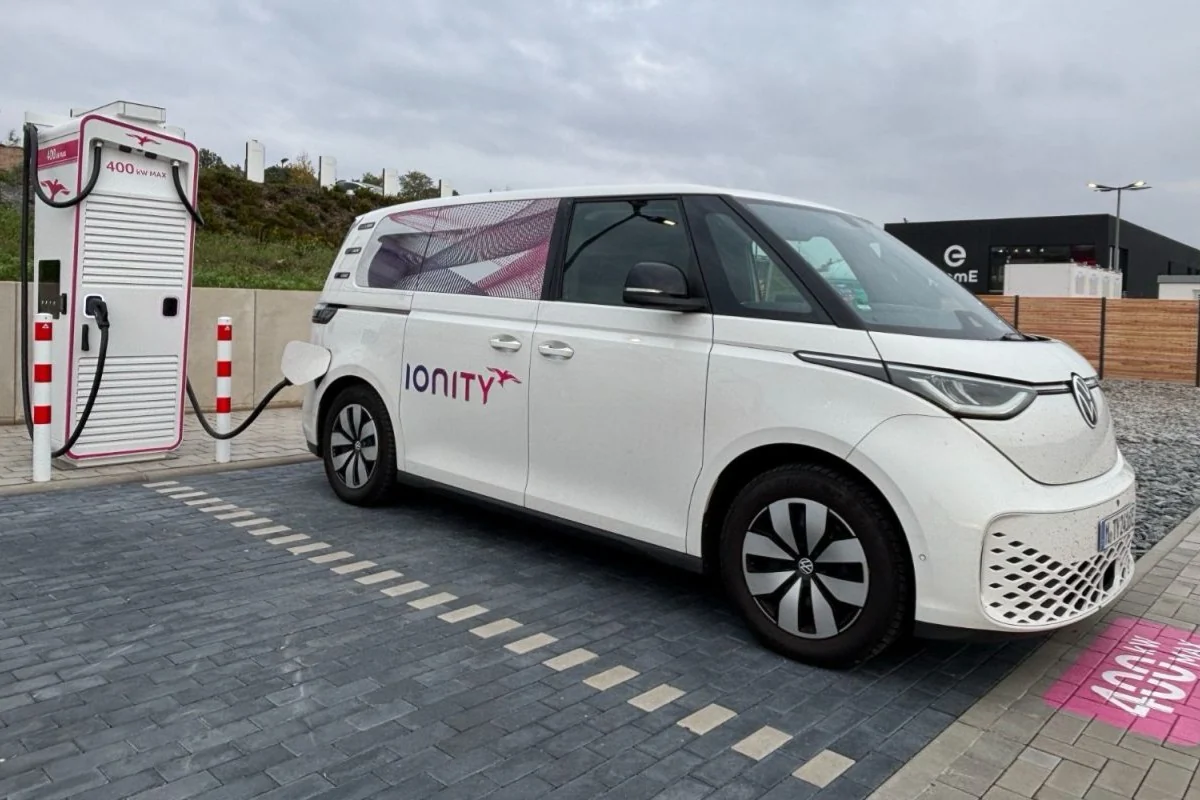
Ionity charging park in Wertheim with the battery storage in the background. Credit: Ionity, via electrive.
Ionity has put its first charging park with an integrated battery system into service in Wertheim, Baden-Württemberg. electrive reported it on October 27. The site grew from four to six Alpitronic HYC400 chargers. Two ABB units rated at 350 kW peak are due soon. Sungrow supplied four modular battery units with 1,028 kWh of total capacity and 500 kW of maximum output.
The main job of the battery is to wait out a grid upgrade. Ionity says a medium-voltage connection upgrade can take up to three years. The battery lets the site run more chargers than the existing connection could feed. An energy management system splits power between the grid connection, the battery, and the chargers. The battery also adds output at peak times and trims peak load on the grid.
Next comes Hemsbach, also in Baden-Württemberg. It is planned as a 12-point park with a solar canopy of more than 223 kWp and a battery above 2 MWh. Unlike Wertheim, it would store solar power for later charging. Ionity plans about 50 battery systems across Europe in 2027, with combined capacity above 20 MWh. It also talks about grid services and possibly energy trading, though it gives no details.
All numbers are company statements. Hemsbach is a rendering, not a built site. Ionity has only used external batteries so far, because one unit can serve chargers of any brand. It says it is still evaluating chargers with built-in storage. The grid connection, not the charger, is the constraint here.
Finland gets its first public megawatt charge for a heavy truck
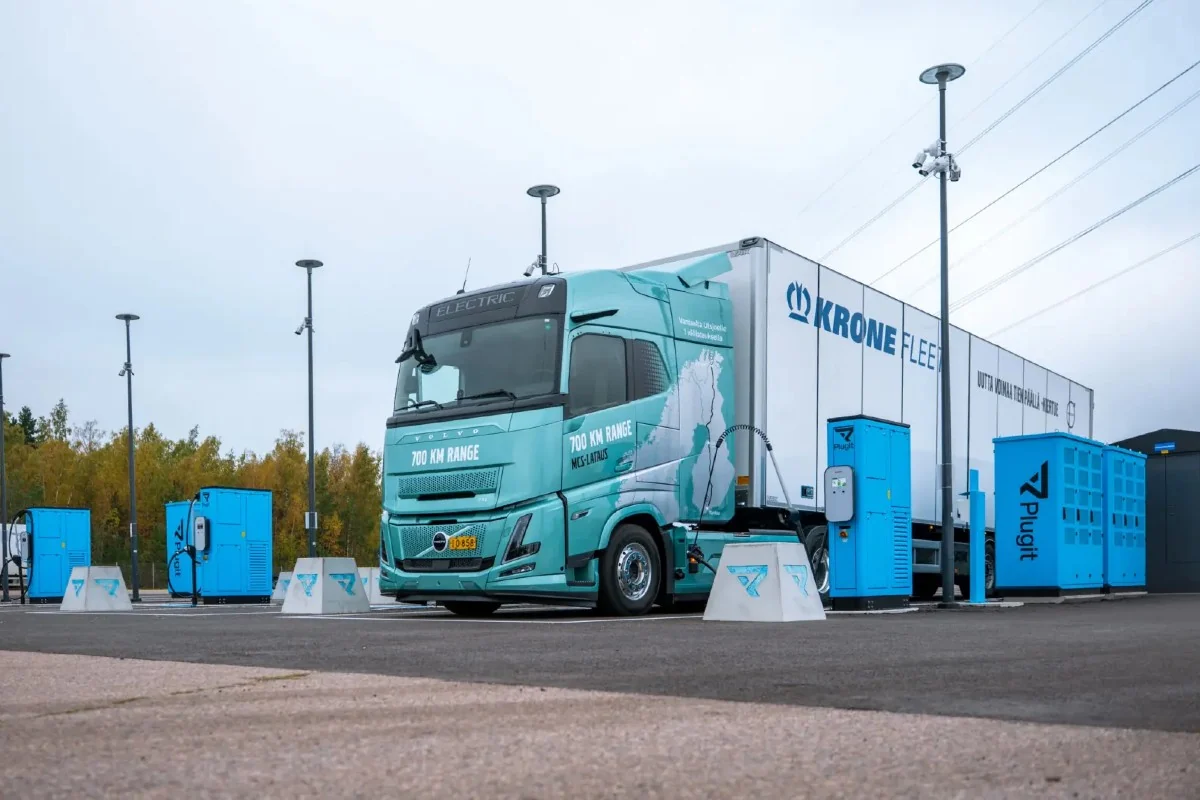
A Volvo FH Aero Electric at Plugit's megawatt charging station in Kotka, Finland. Credit: Plugit, via electrive.
Plugit reports the first public megawatt charging session in Finland. A Volvo FH Aero Electric charged at Plugit's station in Kotka, a port city in the south. Plugit's own post dates the session to October 2. electrive reported it on October 26.
The hardware is Kempower's. It pairs up to two 600 kW power units for up to 1.2 MW in total, with Kempower Mega Satellite dispensers. One MCS connector can take up to 1.2 MW. Alternatively the site can drive two CCS connectors at up to 560 kW each. MCS is the Megawatt Charging System standard for heavy vehicles. It is the truck counterpart of CCS.
Plugit says the truck charged both through Volvo Open Charge and directly with Plugit's cables. Open Charge is Volvo's fleet app for finding, planning, and paying for charging. Both paths worked. The Plugit post says the truck can charge at up to 700 kW and has a range of up to 700 km. It does not report the power actually reached or the charge time, so this is a first-connection milestone, not a performance result.
Scale is small. Plugit runs about 350 public charging points, nine of them built for heavy-duty trucks. Public MCS sites exist only in Kotka and Lieto. Kempower's MCS installations in Norway, Denmark, and Sweden are depot sites, not public ones. Plugit plans more MCS chargers in Finland and Sweden but gives no count or dates.
Fraunhofer tests thin carbon layers to tame the lithium-metal anode interface
Coin-cell batteries, project LIMAC. Stock photo, not lab hardware. Credit: Abdull, Adobe Stock, via Fraunhofer IST.
Two Fraunhofer groups, the Institute for Surface Engineering and Thin Films (IST) in Braunschweig and Fraunhofer USA Center Midwest, are working on a known weak spot of lithium-metal batteries. The project is called LIMAC, for amorphous carbon interlayers for reliable lithium-metal cells. It runs from September 2026 to August 2028. electrive reported it on October 24, from a Fraunhofer release dated October 22.
Lithium metal as the anode could raise energy density, because no host material such as graphite is needed. The trouble is the boundary between the lithium and the solid electrolyte. That interface degrades and drives early failure. LIMAC puts a thin amorphous carbon layer there. The team deposits it on copper current collectors with a laser-arc PVD process, which vaporizes carbon from a target with an electric arc.
The test format is coin cells, compared against reference cells without the layer. The goal is to learn which interlayer properties matter for a stable interface. A life cycle assessment and a concept for scaling up to larger pouch cells run in parallel.
This is early research. The release gives no layer thickness, capacity, or cycle-life figures, and funding comes from Fraunhofer's internal PACT program. Treat it as a method to watch, not a result. Interface layers like this are one of the main open problems standing between lithium-metal prototypes and cells that last.
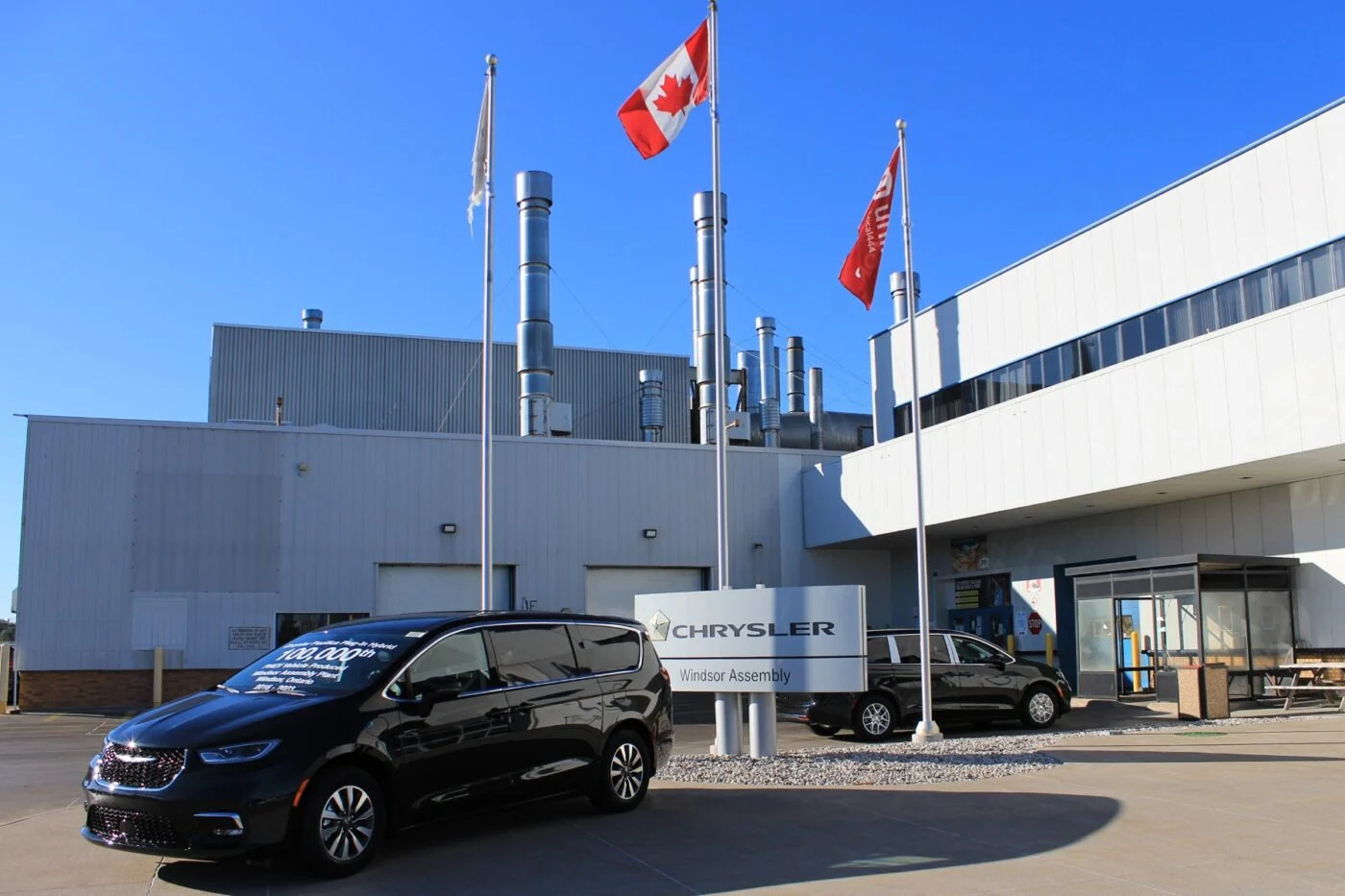
A Stellantis plant in Ontario, Canada. Credit: Stellantis, via electrive.
Canada's federal government and Ontario announced a package on October 21 that holds fleet emission standards for cars and light trucks at 2026 levels through 2029. The fleet-wide greenhouse gas limit stays at 172 g/mile, about 107 g/km. Annual tightening resumes with the 2030 model year. Manufacturers can still generate credits for use in later years.
The 75 percent EV sales goal for 2035 stays on the books. Reaching it would eventually need a fleet average near 74 g/mile, about 46 g/km. Ottawa already scrapped the binding sales quotas from 2023 in February 2026, so that goal is a benchmark, not a requirement. With a four-year freeze, the later steps have to be much steeper.
The package pairs the freeze with CA$2.5 billion over two years for auto projects, up to CA$1.5 billion federal and up to CA$1 billion from Ontario. The stated driver is trade. The US put 25 percent tariffs on Canadian vehicles and parts in March 2025. Prime Minister Carney says Canadian car exports to the US fell by more than 10 percent. Components cross the border up to eight times before a finished car ships.
Reactions split as expected. The Canadian Vehicle Manufacturers' Association welcomed more predictability. Clean Energy Canada warned that the pause pushes pressure into later years and could hurt charging investment. The Pembina Institute called the 2035 target next to impossible, per Electric Autonomy.
Australia funds a 130-vehicle fleet test of whether V2G pays
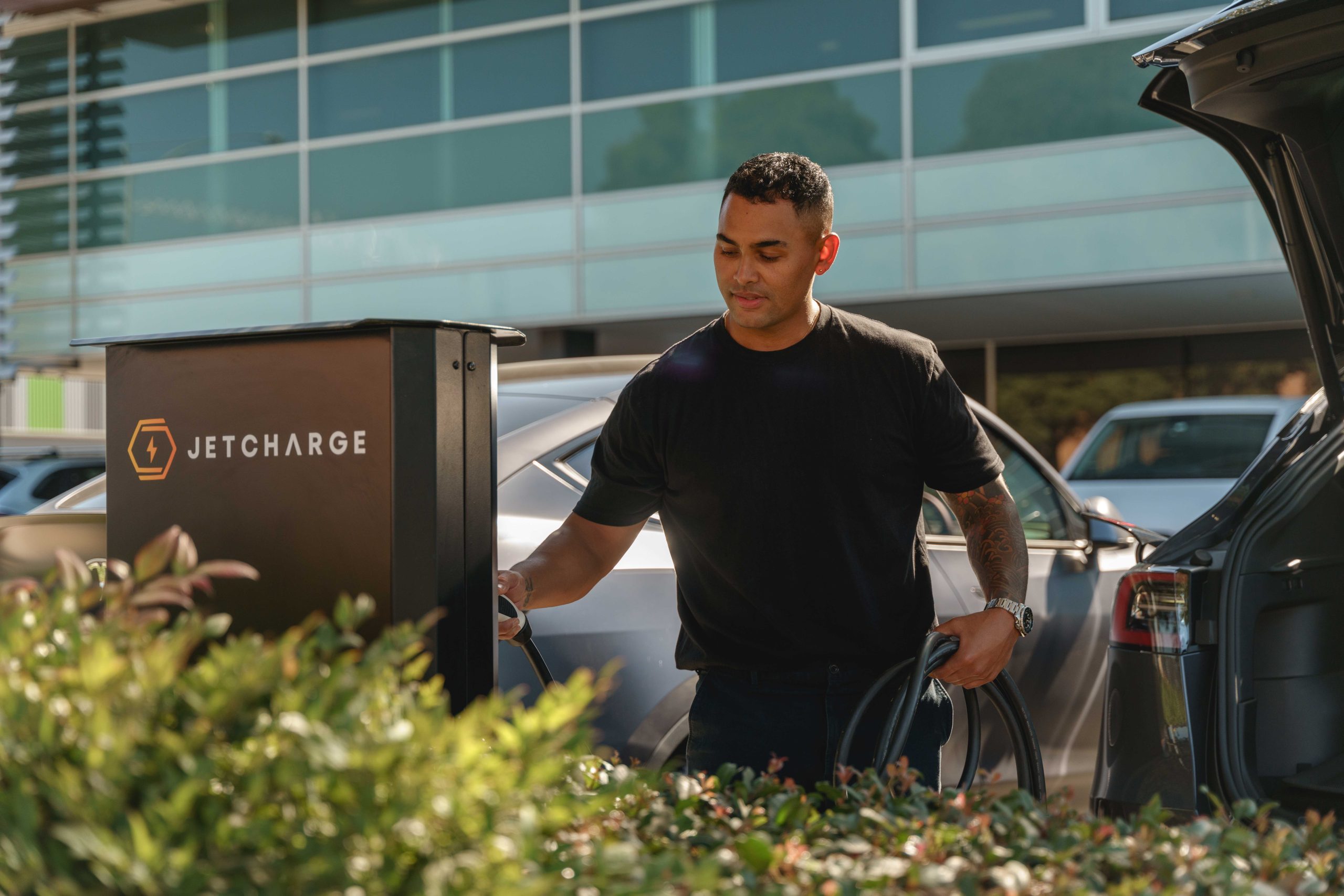
JET Charge site at Port Melbourne, 2024. Credit: JET Charge, via ARENA.
The Australian Renewable Energy Agency is giving AU$4 million to JET Charge for a commercial vehicle-to-grid trial. The project is called Realising Electric Vehicle-to-Grid Services 2, or REVS2. It runs three years, to June 2029, and covers up to 130 electric vehicles with bidirectional chargers. ARENA's release is dated October 21. electrive reported it on October 23.
ARENA says the vehicles will come from the ACT Government fleet. JET Charge will upgrade its charging management system to schedule charging and discharging against electricity tariffs, vehicle availability, and grid needs. ActewAGL will supply a virtual power plant tariff structure. The Australian National University will study the commercial case and share findings with fleet operators.
The question the trial asks is economic, not technical. Bidirectional charging already works in small pilots, including an earlier REVS trial that started in 2020. The open issue is whether a fleet earns enough from grid services to improve its total cost of ownership, and what incentive makes operators take part. A fleet has an advantage over homes: predictable parking schedules.
Nothing is measured yet. The release does not state charger power, the V2G standard, vehicle models, sites, or a total project budget. Check back when results come in.
VW reportedly pools its driver-assist work in one Audi-led unit, with Wayve in the wings
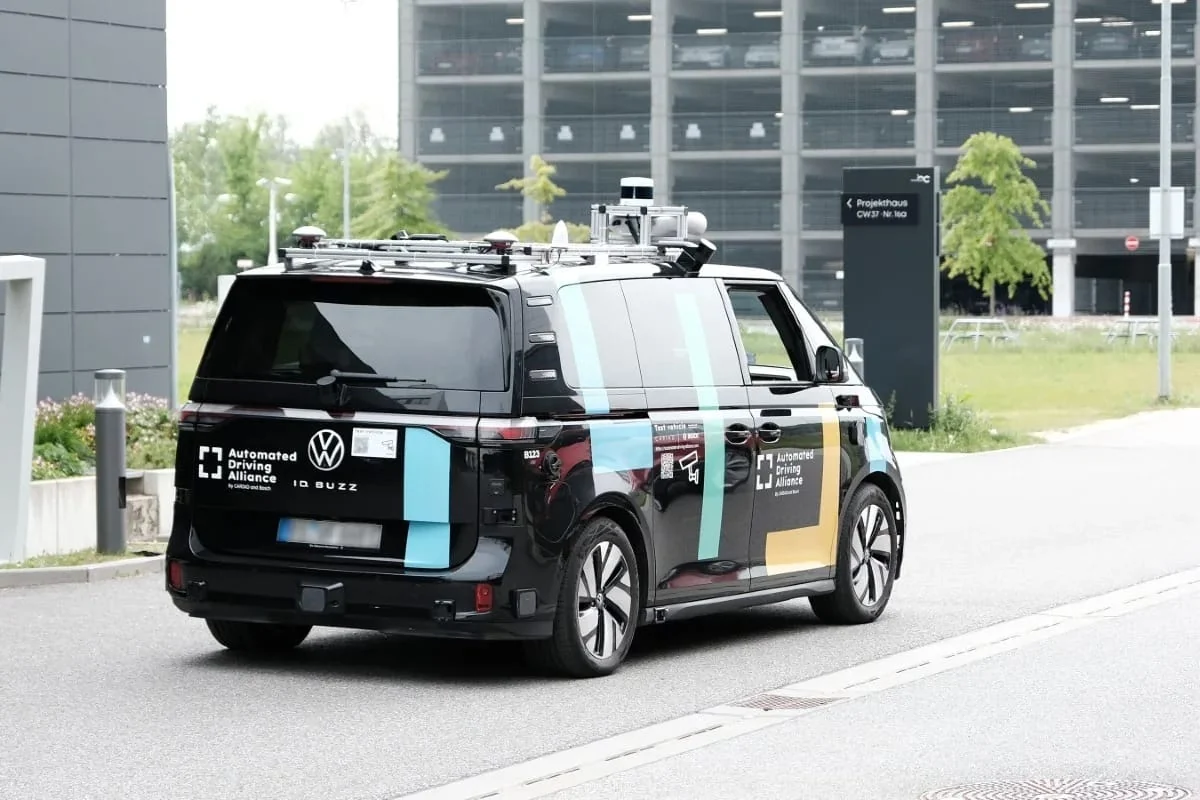
Archive photo: a test vehicle from Cariad and former partner Bosch. Credit: Cariad, via electrive.
Volkswagen is reportedly creating a unit called OneTeam to pool driver-assistance and automated-driving engineers from Cariad and the Group brands in Europe. electrive reported it on October 23, citing dpa and Automobilwoche, who cite an internal VW message. The unit would start in November under Manuel Birke, now Cariad's head of driver assistance technology. He would report to Rouven Mohr, the Audi board member for development, which makes Audi the lead brand for Group ADAS.
The technical split matters more than the org chart. For driver assistance up to SAE Level 2+, Cariad and Bosch developed a stack that is set to debut in the planned compact ID. Every1. Their automated-driving alliance ended early in July. For Level 4 and above, Der Spiegel reports VW has decided to work with the UK start-up Wayve. No contract is confirmed.
Nvidia sits underneath all of it. VW Commercial Vehicles showed the autonomous ID. Buzz AD on Nvidia's Hyperion platform, which pairs compute with a standard sensor layout. VW, Porsche, and Cariad are also building a data platform with Nvidia, Microsoft Azure, and Voxel51 to train and validate automated driving from real driving data and reconstructed scenes.
Treat the details with care. They are reported, not confirmed. Headcount, the split of duties with Cariad, and a possible Wayve and Nvidia pairing for VW are all unknown. The story is a snapshot of how a large maker is trying to fix a software program that has delayed models, including the Audi Q6 e-tron.
Ionity puts batteries at 50 charging parks to get around the grid-connection queue
Articles: electrive, October 27, 2026 ·
Primary: Ionity statements (reported by electrive; no direct release link located) ·
Image: image (Ionity charging park in Wertheim with the battery storage in the background. Credit: Ionity, via electrive.)
VW reportedly pools its driver-assist work in one Audi-led unit, with Wayve in the wings
Articles: electrive, October 23, 2026 ·
Primary: Reports by dpa, Automobilwoche, heise.de, and Der Spiegel (cited by electrive; no direct links located) ·
Image: image (Archive photo of a Cariad and Bosch test vehicle. Credit: Cariad, via electrive. The photo is from 2025 and shows the former Bosch partnership.)
Get the Electric Vehicle Technology Briefing by email