EV Technology Briefing — compiled and curated by Chris Lee
Saft starts solid-state production in Bordeaux, and BYD brings nine-minute charging to Europe
Week of October 13 – October 20, 2026
Six stories on the engineering and the rules around it. Saft opens solid-state lines, though not for cars. BYD and Mercedes-AMG push charging power past 700 kW. Redwood widens its Rivian pack program. The UK weighs a softer sales mandate, T&E puts a number on plug-in hybrid cheating, and the US lets driverless trucks swap triangles for beacons.
Solid-State Batteries
Saft opens solid-state lines in Bordeaux, with aerospace first
Saft solid-state battery cells from the Bordeaux lines. Credit: Saft, via electrive.
Saft, the TotalEnergies battery subsidiary, is starting production of solid-state batteries at its Bordeaux site. electrive reported it on October 19, citing a Saft press release. The lines can build two kinds of cell: a polymer-based semi-solid-state design and a sulfide-based solid-state design. Saft says both run at room temperature, and it calls itself the first French maker of self-developed cells using sulfide and polymer electrolytes.
The headline claims are energy density up to 50 percent above conventional lithium-ion, and a dry electrode process that Saft expects to cut production CO2 by up to 40 percent. Dry coating skips the solvent and the long drying oven that wet slurry coating needs. That is where much of the energy in electrode manufacturing goes.
The target market is aerospace, not cars. Saft recently delivered semi-solid-state cells with partner Safran, and Bordeaux sits in a European aerospace cluster. Saft does not mention road vehicles. The release also gives few specifics: no cell capacity, cycle life, output volume, or customer list.
The context is a small one. Blue Solutions, which already sells lithium-metal-polymer cells, is being restructured after problems in bus applications. Saft's own Automotive Cells Company venture dropped its German and Italian plants and is concentrating on France. Sulfide electrolytes are hard to manufacture at scale, so a working pilot line is a real step. It is still a step toward aircraft and niche uses first.
BYD brings Flash Charging to Europe, and Mercedes-AMG claims 710 kW
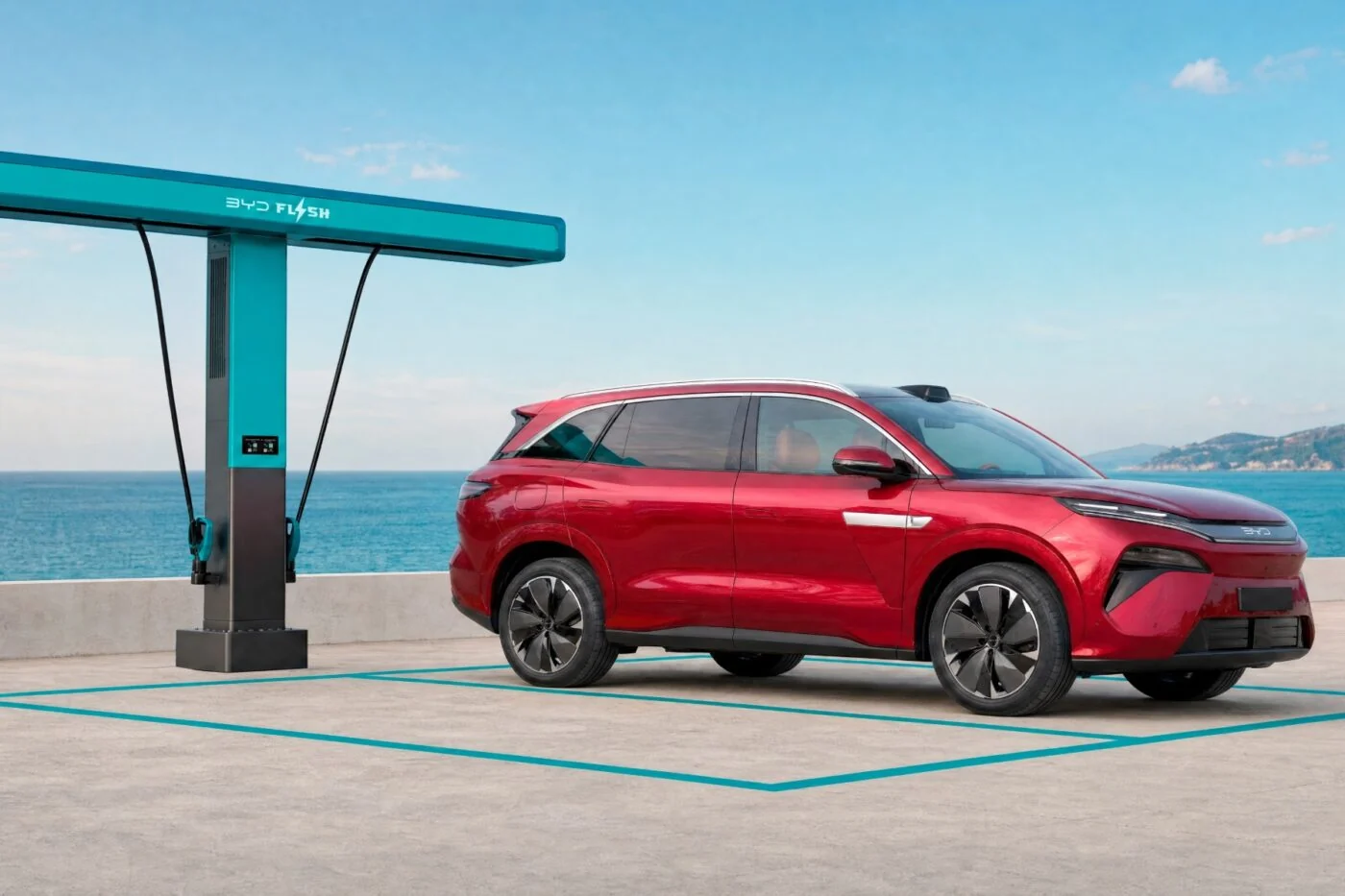
The BYD Atto 8, the first European car with Flash Charging. Credit: BYD, via electrive.
BYD showed the Atto 8 at the Paris Motor Show and introduced its Flash Charging system to Europe with it. The car uses a 115 kWh second-generation Blade Battery. BYD says it charges from 10 to 70 percent in five minutes and from 10 to 97 percent in nine minutes, under the company's stated conditions. At -30°C it says the full charge adds only about three minutes. electrive reported it on October 13.
The fine print matters. Those times need a compatible Flash Charger. BYD plans about 300 in Germany by the end of 2026 and about 3,000 across Europe by the end of 2027. The article does not give the system voltage or peak power. Sales start in Q1 2027, and the price is not announced.
Mercedes-AMG made a similar claim six days later. Its GT SUV, built on the 800-volt AMG.EA platform, is rated for up to 710 kW at a matching charger. That compares with about 600 kW for the GT 4-Door Coupé. Mercedes says the optional 128 kWh pack takes 10 to 80 percent in 16 minutes at a 400 kW charger. Both figures are manufacturer claims. The 710 kW number also needs a charger that does not exist at scale yet.
The pattern is that cars are now ahead of the grid. A 400 kW public charger is still a premium site, and a car that can take 700 kW only matters where a charger can deliver it. For both makers, charger rollout is the real constraint.
Redwood will collect and sort end-of-life Rivian packs through service centers
Second-life Rivian packs in a Redwood Materials storage system. Credit: Redwood Materials, via electrive.
Rivian and Redwood Materials are expanding their partnership. Redwood will collect end-of-life battery packs through Rivian's nationwide service center network. It will also take battery scrap from Rivian's production lines. electrive reported it on October 17.
Redwood will evaluate each pack and choose one of two paths. A pack with usable capacity left can go into stationary storage, either at Rivian facilities or elsewhere. A pack that is too far gone goes to recycling for cobalt, nickel, copper, and lithium. The grading step is the hard part, because it decides whether a pack is worth more as a battery or as feedstock.
The deal builds on an April 2026 project. That one used unused Rivian packs to build 10 MWh of storage at Rivian's plant in Normal, Illinois. Redwood has shifted its focus toward stationary storage since 2025.
The announcement is thin on numbers. There are no pack volumes, storage capacity, timelines, or named sites. Treat it as a collection and logistics agreement. It shows how automakers expect used packs to move, which matters for the recycling math that policy targets assume.
The UK looks set to ease its ZEV mandate, but less than industry wanted
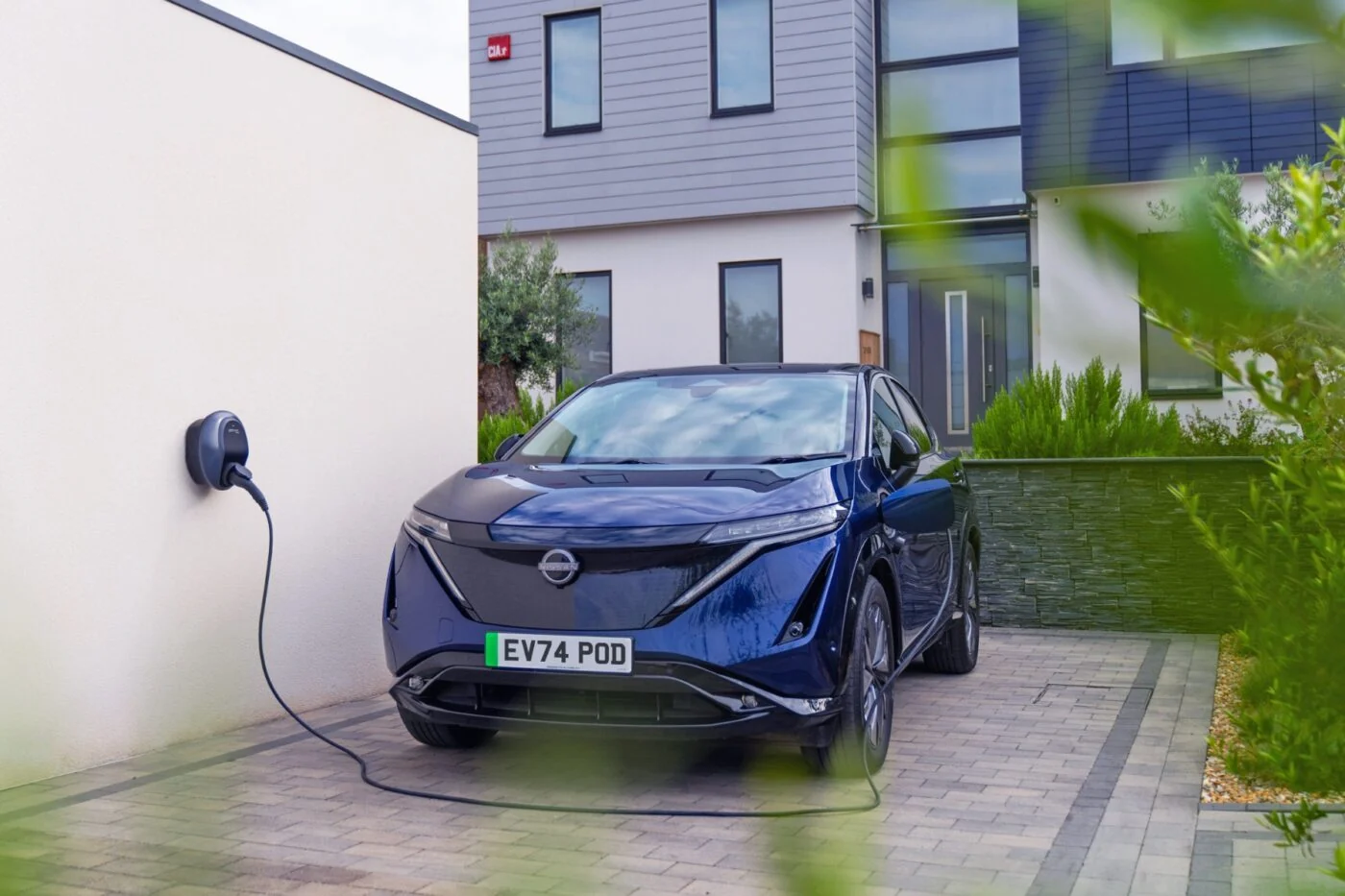
A Nissan Ariya at a home charger in the UK (file photo). Credit: Nissan, via electrive.
The UK government is reviewing its Zero Emission Vehicle mandate and is willing to lower the sales targets for 2027 to 2035. electrive reported the latest on October 19. The consultation opened in mid-August and closes October 23.
The current schedule requires zero-emission cars to make up 38 percent of sales in 2027, 52 percent in 2028, 66 percent in 2029, and 80 percent in 2030. The Financial Times reports, citing unnamed sources, that the 2030 target would drop to 60 percent battery-electric. The remaining 40 percent would be hybrids. Straight petrol and diesel cars would no longer be eligible from 2030. electrive notes that it could not confirm the figure, and industry reaction is unclear.
Fines were already cut from 15,000 to 12,000 pounds per non-compliant vehicle. Makers also get more flexibility to bank and pool credits across years, similar to EU rules. Ford and Nissan had asked for 2030 targets of 40 or 50 percent. A 60 percent target would sit above both.
The market gives some context. The UK EV share is about 26 percent, up from 22 percent a year earlier. That is slower growth than Germany or France. The SMMT, the trade body, argues that regulation can force supply but not demand, and that discounting to hit targets is not sustainable.
T&E says real plug-in hybrid CO2 runs about six times the official figure
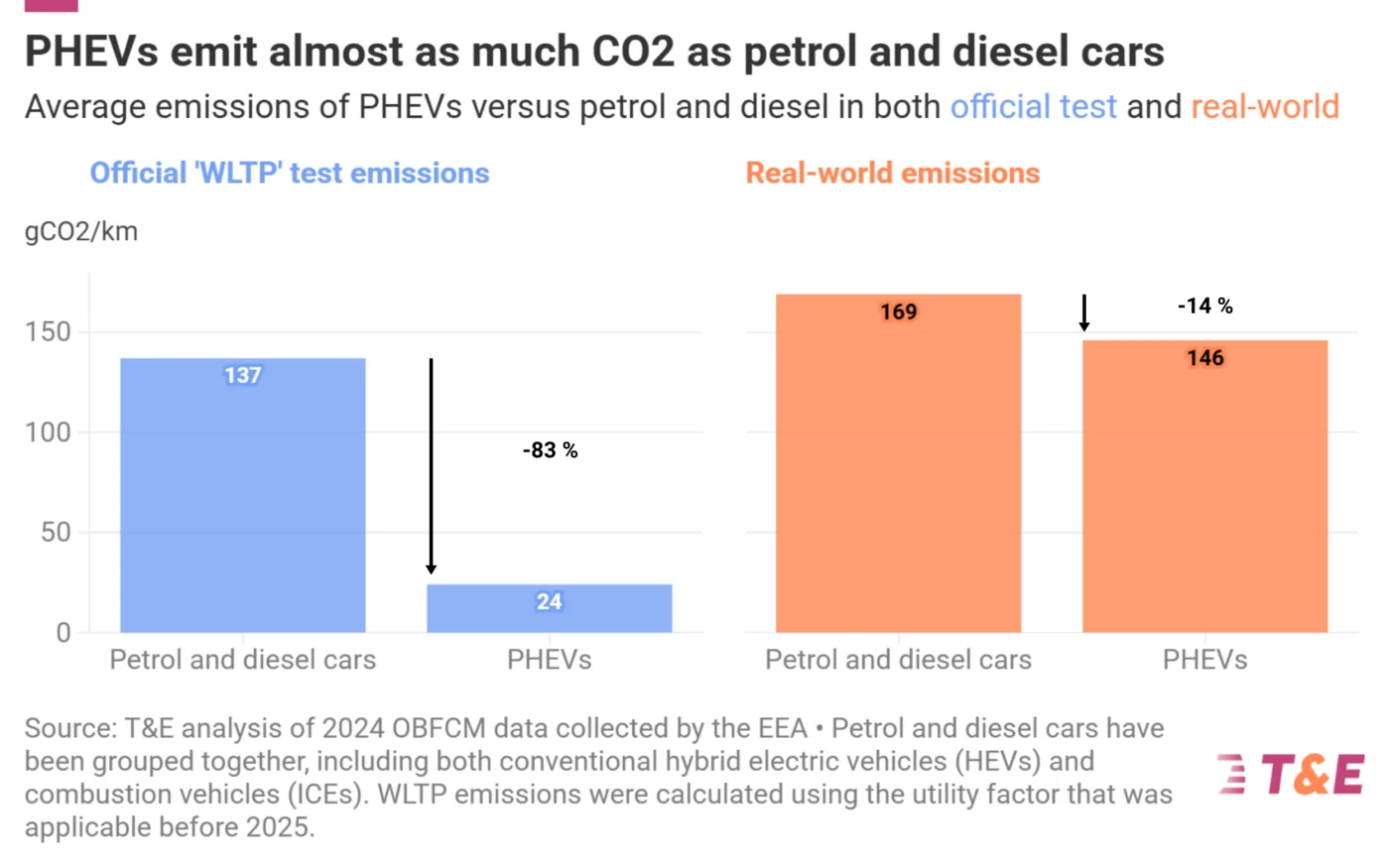
Real-world PHEV emissions compared with WLTP values. Chart, not a photo. Credit: Transport & Environment, via electrive.
Transport & Environment, a Brussels advocacy group, analyzed European Environment Agency data for plug-in hybrids registered in 2024. It found real-world CO2 was about six times the official figure, up from about five times for 2023. The group says that adds roughly 680 euros a year in fuel for the average driver. electrive reported it on October 16, and T&E published on October 15.
On the road, those cars emitted only about 14 percent less than conventional and non-plug-in hybrid cars. The official test implied 83 percent less. The gap comes from the utility factor, the share of driving that regulators assume is electric. Real drivers run the engine more and charge less often than the assumption.
The EU has already tightened the factor, and a further correction is due in November 2026. T&E looked at 20 top-selling models, 51 percent of 2025 sales, and says makers responded in part by changing the numbers rather than the cars. VW's Tiguan went from 55 to 119 km of electric range, yet its official figure rose only from 32 to 36 g/km. For five VW models, about 90 percent of the official increase was offset this way.
Two limits apply. T&E is an advocacy group working from its own analysis, and the 56 percent underestimate it projects for a frozen factor is a projection. An ICCT study of about 8 million vehicles reached a similar conclusion for 2023 with different data, which adds weight. Germany is pushing to freeze the next correction, and that is still under negotiation.
FMCSA lets driverless trucks use cab-mounted beacons instead of warning triangles
A Kodiak AI autonomous truck on a highway. Credit: Kodiak AI, via Trucking Dive.
The Federal Motor Carrier Safety Administration granted a five-year exemption on October 7. It lets Level 4 autonomous trucks use cab-mounted flashing amber beacons instead of the reflective triangles or flares a driver sets out after a roadside stop. Trucking Dive reported it on October 13. The decision is a few days older than this issue's window, but the coverage and fallout landed within it.
The exemption runs from October 7, 2026 to October 7, 2031. Aurora applied in April. Other Level 4 carriers can use it if they notify FMCSA first, and Kodiak AI says it will. Per The Trucker, the beacons must be visible from front and rear and must activate within five minutes of a qualifying stop. Normal hazard lights stay on. Carriers must report crashes involving beacon use within five days and file annual reports on malfunctions and power failures.
FMCSA concluded the beacons would likely be as safe as or safer than the status quo. It received 402 public comments. The Owner-Operator Independent Drivers Association opposed it, arguing Aurora's studies did not cover varied weather, lighting, and traffic. The Autonomous Vehicle Industry Association, Volvo, and the American Trucking Associations supported it.
It reverses the agency's December 2024 denial of a broader Aurora and Waymo request. The rule is narrow. It covers only trucks with no driver to walk out and place triangles, and it does not change requirements for human-driven trucks.
Saft opens solid-state lines in Bordeaux, with aerospace first
Articles: electrive, October 19, 2026 ·
Primary: Saft press release (cited by electrive; no direct link located) ·
Image: image (Saft solid-state battery cells from the Bordeaux lines. Credit: Saft, via electrive.)
BYD brings Flash Charging to Europe, and Mercedes-AMG claims 710 kW
Articles: electrive, October 13, 2026 · electrive, October 19, 2026 ·
Primary: BYD and Mercedes-Benz announcements (cited by electrive; no direct link located) ·
Image: image (The BYD Atto 8, the first European car with Flash Charging. Credit: BYD, via electrive.)
Redwood will collect and sort end-of-life Rivian packs through service centers
Articles: electrive, October 17, 2026 ·
Primary: Redwood Materials ·
Image: image (Second-life Rivian packs in a Redwood Materials storage system. Credit: Redwood Materials, via electrive. Photo from the April 2026 project.)
The UK looks set to ease its ZEV mandate, but less than industry wanted
Articles: electrive, October 19, 2026 · electrive, August 17, 2026 ·
Primary: Financial Times report (paywalled): ft.com ·
Image: image (A Nissan Ariya at a home charger in the UK, file photo. Credit: Nissan, via electrive.)
T&E says real plug-in hybrid CO2 runs about six times the official figure
Articles: electrive, October 16, 2026 ·
Primary: Transport & Environment, October 15, 2026 ·
Image: image (Chart, not a photo: real-world PHEV emissions compared with WLTP values. Credit: Transport & Environment, via electrive.)
FMCSA lets driverless trucks use cab-mounted beacons instead of warning triangles
Articles: Trucking Dive, October 13, 2026 · The Trucker, October 2026 ·
Primary: FMCSA exemption decision (October 7, 2026; no direct link located) ·
Image: image (A Kodiak AI autonomous truck on a highway. Credit: Kodiak AI, via Trucking Dive.)
Get the Electric Vehicle Technology Briefing by email