EV Technology Briefing — compiled and curated by Chris Lee
A battery pack that rewires around weak cells, and a 1.2 MW truck charger that is finally open
Week of October 6 – October 13, 2026
Five stories on the engineering and the rules around it. Chalmers models packs that bypass failing cells. Tesla and Pilot open the first Megacharger site for heavy trucks. Tesla renames its European driver-assist system while the EU vote slips to December. The Commission picks 46 raw materials projects, and Renault and EDF plan home V2G for France.
Battery Systems
Chalmers models a battery pack that switches weak cells out of the circuit
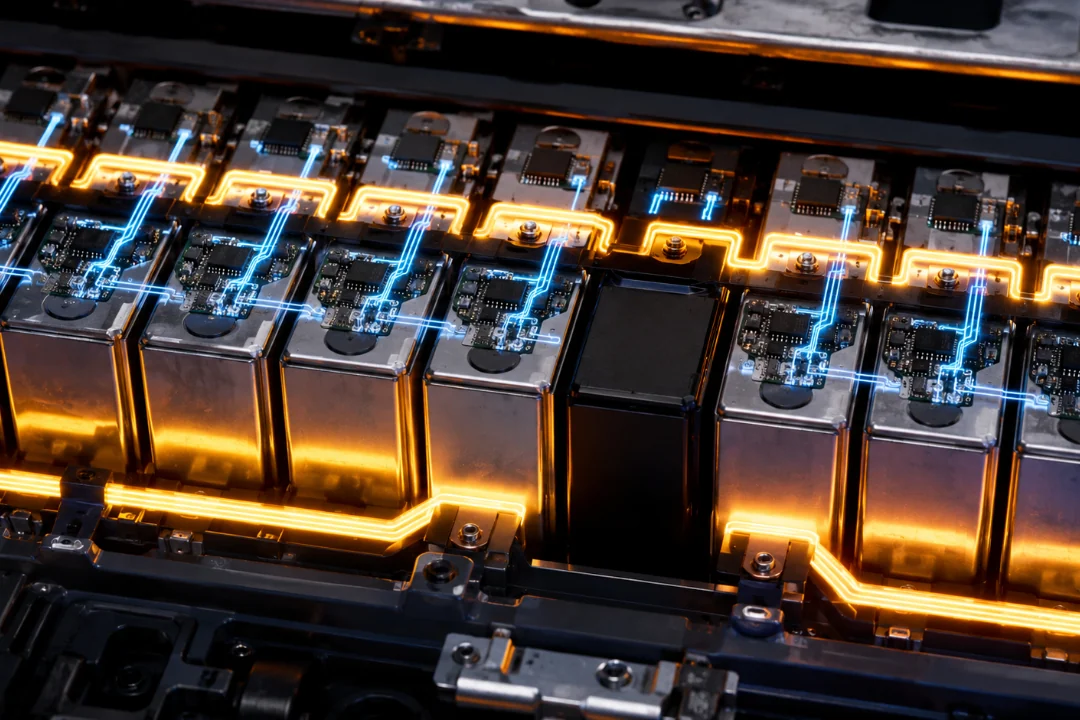
A reconfigurable battery pack with a weak cell bypassed. Credit: Chalmers University of Technology | Albert Skegro, via electrive.
Researchers at Chalmers University of Technology in Sweden, working with PHINIA and Scania, modeled what happens when an EV pack can rewire itself around its weakest cells. The study appeared in Nature Communications under the title "System-level assessment of dynamic reconfiguration for lifetime and cost outcomes in electric vehicle battery packs." electrive covered it on October 9.
The problem is old. Cells in a series string age at different rates, and the weakest one sets the limit for the whole pack. A reconfigurable pack adds switches and control electronics so individual cells or cell groups can be bypassed. The healthy cells keep working while the tired ones sit out.
In the best case, with independent control of every cell, the simulations show lifespan rising by more than 20 percent for some high-voltage vehicles. The gain is largest for electric trucks and long-range cars with many cells in series. For an 80 kWh pack driven 12,000 km a year, a conventional pack reaches its replacement point at about 10 years. The reconfigurable pack gets there roughly 14 months later.
The extra electronics add cost up front. The study suggests longer life and higher resale value can offset that under realistic conditions. Looser cell matching at the factory is a second possible saving, since the pack tolerates more spread between cells.
Treat the 20 percent figure as a ceiling. Per-cell control is the theoretical best case, and cell-group control is the more likely product. The results come from simulation, not fleet data, and the technology has only been tested in research and industrial prototypes. electrive does not link the paper itself, so the numbers here are as electrive reported them.
Tesla and Pilot open the first Megacharger site, with six stalls rated at 1.2 MW each
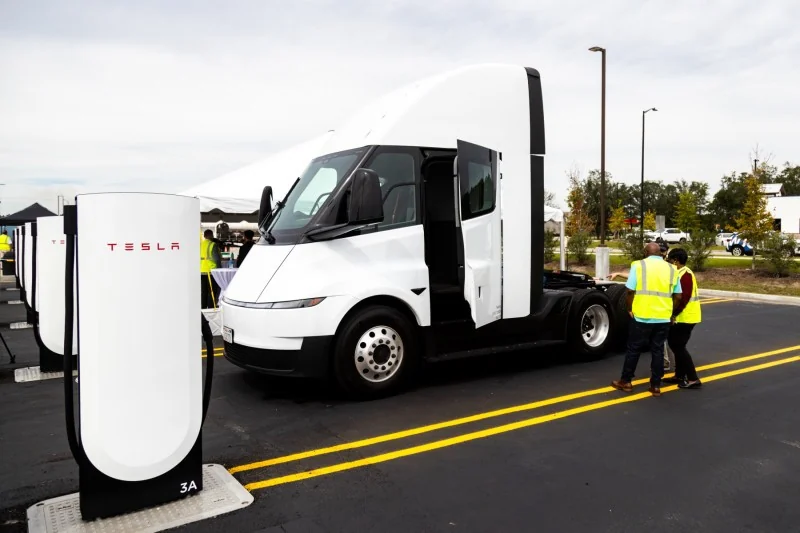
Tesla Semi charging stalls at a Pilot Travel Centers site in Georgia. Credit: Pilot Travel Centers, via electrive.
Pilot Company and Tesla opened the first Tesla Megacharger site for heavy trucks at Pilot location 1390 in Ellabell, Georgia. Pilot announced it on October 8, and electrive added detail on October 12. Six stalls are live. Twelve more locations are under construction, and three are near completion: Tulare, California, Fort Stockton, Texas, and North Las Vegas, Nevada.
Tesla rates each stall at up to 1.2 MW. Per Pilot, that lets a Tesla Semi recover 60 percent of its charge in 30 minutes. Sites will have four to eight stalls built on Tesla's V4 cabinet technology. The 1.2 MW figure applies when one truck is plugged in. Tesla's design can serve up to eight trucks at once, but each then gets less power.
Tesla also says the decentralized layout needs more than 50 percent less space than current electric truck charging. That is Tesla's claim, with no independent measurement attached. electrive reports that most internal components match Tesla's passenger-car Superchargers, with the cable, plug, and a few parts changed. Sharing parts across the two networks is how Tesla expects to hold costs down.
The network is closed for now. The chargers are for Tesla customers and the Semi, though electrive notes they could open to other brands later, as the car Superchargers did. No date is given. Pilot is also installing universal truck chargers under a 2022 agreement with Volvo Group.
Planned corridors include I-5 and I-10 across California, Georgia, Indiana, Nevada, and Texas. Pilot has more than 900 locations in North America, so the site count has room to grow. The open question is power. Six stalls at 1.2 MW is a large grid draw at a truck stop, and neither source says how the utility connections were handled.
Tesla renames FSD in Europe while the EU vote slips to December
Tesla Assisted Driving, the new European name for FSD (Supervised). Credit: Tesla, via electrive.
Tesla is marketing its supervised driver-assistance system in Europe as "Tesla Assisted Driving" instead of "FSD (Supervised)." electrive reported the change on October 12. Tesla's German and several other European sites already carry the new label. The rename is not worldwide.
The reason is regulatory. Tesla's approval so far is a provisional EU type approval under Article 39 of Regulation 2018/858, issued by the Dutch road authority RDW in April. It is not a standard type approval. Nine member states have recognized it individually: the Netherlands, Lithuania, Estonia, Denmark, Belgium, Slovenia, Czechia, Croatia, and Slovakia.
Tesla wants one EU-wide approval through a vote of the Technical Committee on Motor Vehicles. That needs a qualified majority of at least 15 of 27 states representing at least 65 percent of the EU population. The vote has been postponed several times and is now expected in December at the earliest. The October 6 committee agenda listed only a 25-minute continued discussion.
Germany matters most. Germany's transport minister, Steffen Bilger, called the "FSD" name misleading and said the driver must stay attentive at all times. France, Italy, and Spain have not adopted the Dutch approval. electrive's September 28 report, citing Electrek, says France raised urban speed and attentiveness, and Sweden objects to features such as setting speeds above the limit.
The system is not driverless. The human stays responsible and must be ready to take over. Tesla's own safety figures (4.1 times fewer accidents than manually driven Teslas over 100 million km) are unverified claims from the company. A new name does not change the technical question regulators are weighing, which is how well the system keeps drivers engaged and obeys speed limits.
The EU picks 46 raw materials projects, 19 of them recycling
EU flag outside the European Commission in Brussels. Credit: European Union, 2026, via electrive.
The European Commission selected 46 new Strategic Projects under the Critical Raw Materials Act, out of 102 applications. electrive reported it on October 9. The projects sit in 16 member states and get faster permitting and better access to financing.
By stage, 8 are extraction, 11 are processing, 19 are recycling, and 8 are integrated. The battery-relevant counts are nickel 12, cobalt 10, lithium 7, manganese 5, and graphite 4. Others target rare earths for permanent magnets, plus magnesium and tungsten. Germany leads with eight projects, four of them recycling.
The Commission's own assessment is that the projects could fully cover the 2030 extraction targets for lithium and nickel, and meet the lithium processing target. Recycling could reach the EU benchmarks for lithium and cobalt. For cobalt processing, about 89 percent of the target value could be covered. Those are Commission projections phrased as "could," not commitments.
The law sets the 2030 targets: extract 10 percent of annual strategic raw material demand in the EU, process 40 percent, recycle 25 percent, and take no more than 65 percent of any one material from a single third country. Permitting limits are 27 months for extraction and 15 months for processing and recycling.
Progress on the first round is mixed. Of the 2025 projects, 25 have finished environmental impact assessments and 17 hold construction permits. No funding amounts are given for these 46. The Commission says more than 2 billion euros has been mobilized since RESourceEU launched at the end of 2025, but that figure is cumulative. Another call is planned before the end of 2026.
Renault and EDF plan a home V2G package for France by summer 2027
Renault Twingo E-Tech Electric (file photo, not the V2G hardware). Credit: Renault, via electrive.
Renault Group and EDF Group signed a partnership on October 8 to launch a bidirectional charging offer for private customers in France. Renault, Alpine, and Dacia EVs would be able to return stored energy to the grid, or power the house, through a home wallbox. The solutions are expected by summer 2027.
The package would be sold through Renault's dealer network. It would include a home charger installed by IZI by EDF and a smart charging service from Dreev, another EDF subsidiary. EDF says Dreev has already served more than 100,000 customers in France and Europe with smart charging.
The partners are working on three areas for single-family homes: selling and installing chargers, services that optimize charging, and services that use the car's battery for household loads or send it back to the grid when needed. Renault's release says V2G could reduce charging costs by an amount equal to up to 10,000 km of driving a year. That depends on the model, its consumption, and how long the car stays plugged in.
Notably absent: wallbox power ratings, tariffs, prices, a list of compatible models, and any statement of which standard the hardware will use. This is an initial-phase announcement, and the partners say they still have to refine the offer. The savings figure is Renault's own estimate with no method published.
Chalmers models a battery pack that switches weak cells out of the circuit
Articles: electrive, October 9, 2026 · Chalmers press release via Cision ·
Primary: Chalmers press release (linked above); Nature Communications paper (no direct link located) ·
Image: image (A reconfigurable battery pack with a weak cell bypassed. Credit: Chalmers University of Technology | Albert Skegro, via electrive.)
Tesla and Pilot open the first Megacharger site, with six stalls rated at 1.2 MW each
Articles: electrive, October 12, 2026 · Pilot Company newsroom, October 8, 2026 ·
Primary: Pilot Company newsroom (linked above) ·
Image: image (Tesla Semi charging stalls at a Pilot Travel Centers site in Georgia. Credit: Pilot Travel Centers, via electrive.)
Tesla renames FSD in Europe while the EU vote slips to December
Articles: electrive, October 12, 2026 · electrive, September 28, 2026 ·
Primary: German Federal Ministry of Transport statement (https://www.bmv.de/SharedDocs/DE/Artikel/StV/Digitalisierung-der-Mobilitaet/aktueller-stand-tesla-assistenzsysteme.html) ·
Image: image (Tesla Assisted Driving, the new European name for FSD (Supervised). Credit: Tesla, via electrive.)
The EU picks 46 raw materials projects, 19 of them recycling
Articles: electrive, October 9, 2026 · European Commission press release IP/26/2113 ·
Primary: European Commission press release IP/26/2113 (linked above) ·
Image: image (EU flag outside the European Commission in Brussels. Credit: European Union, 2026, via electrive.)
Renault and EDF plan a home V2G package for France by summer 2027
Articles: electrive, October 12, 2026 · Renault Group press release, October 8, 2026 ·
Primary: Renault Group press release (linked above) ·
Image: image (Renault Twingo E-Tech Electric (file photo, not the V2G hardware). Credit: Renault, via electrive.)
Get the Electric Vehicle Technology Briefing by email