EV Technology Briefing — compiled and curated by Chris Lee
GM will build manganese-rich cells at scale, with a 33 percent density edge over LFP
Week of September 29 – October 6, 2026
Fast chemistry news is mostly claims this week, and the useful work is separating the claim from the evidence. GM commits to mass-producing LMR cells in Tennessee. T&E says Europe's cell supply is fine but its cathode supply is not. Tesla adds a deliberate way to tear a plug out of a Supercharger, and Musk gives a candid reason the robotaxi stops at 11 PM. Water opens 400 kW sites in South Korea that serve both NACS and CCS cars.
Cell Chemistry
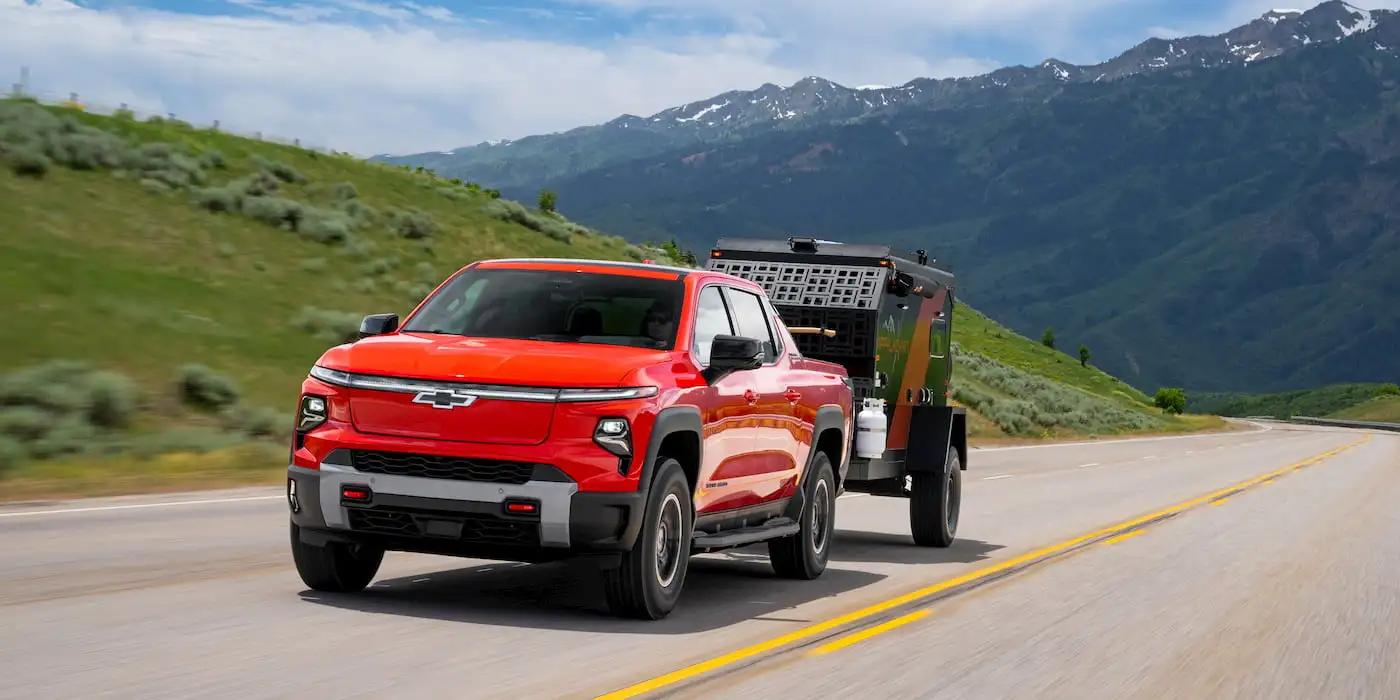
GM bets on manganese-rich cells that beat LFP by a third on energy density
Prismatic LMR battery cells. Credit: General Motors / Ultium Cells, via Electrek.
GM and LG Energy Solution say Ultium Cells' Spring Hill, Tennessee plant will become the first in the world to mass-produce prismatic lithium manganese-rich (LMR) cells. GM announced the plan on September 29. Plant upgrades start late this year and finish in 2028, and the first vehicle with LMR cells is also due in 2028.
LMR is a cathode chemistry that keeps nickel and cobalt low and leans on manganese. GM's claim is 33 percent more energy density than lithium iron phosphate (LFP) at comparable cost. That puts LMR between cheap LFP and costly high-nickel cells. GM is aiming it at electric trucks and full-size SUVs, with a target of more than 400 miles of range. Those are the vehicles where LFP's lower energy density hurts most.
The plant will make LFP and LMR cells in pouch and prismatic formats. Ultium Cells is putting about $1 billion into the plant through 2030, according to Wards Auto. The upgrade adds roughly 500 jobs, which takes the workforce to about 1,700.
Two caveats. GM and LG first described this chemistry more than a year ago, so the news is the production commitment, not the cell. And GM itself says high-nickel cells will keep the top range. For reference, the Silverado EV's high-nickel pack gets up to 478 miles. The 33 percent figure is a company claim against LFP, with no cycle-life or fast-charge data attached. LMR has historically struggled with voltage fade over cycling, and nothing in this announcement says how that was solved.
T&E says Europe will have enough cells by 2030, but the cathode material is the gap
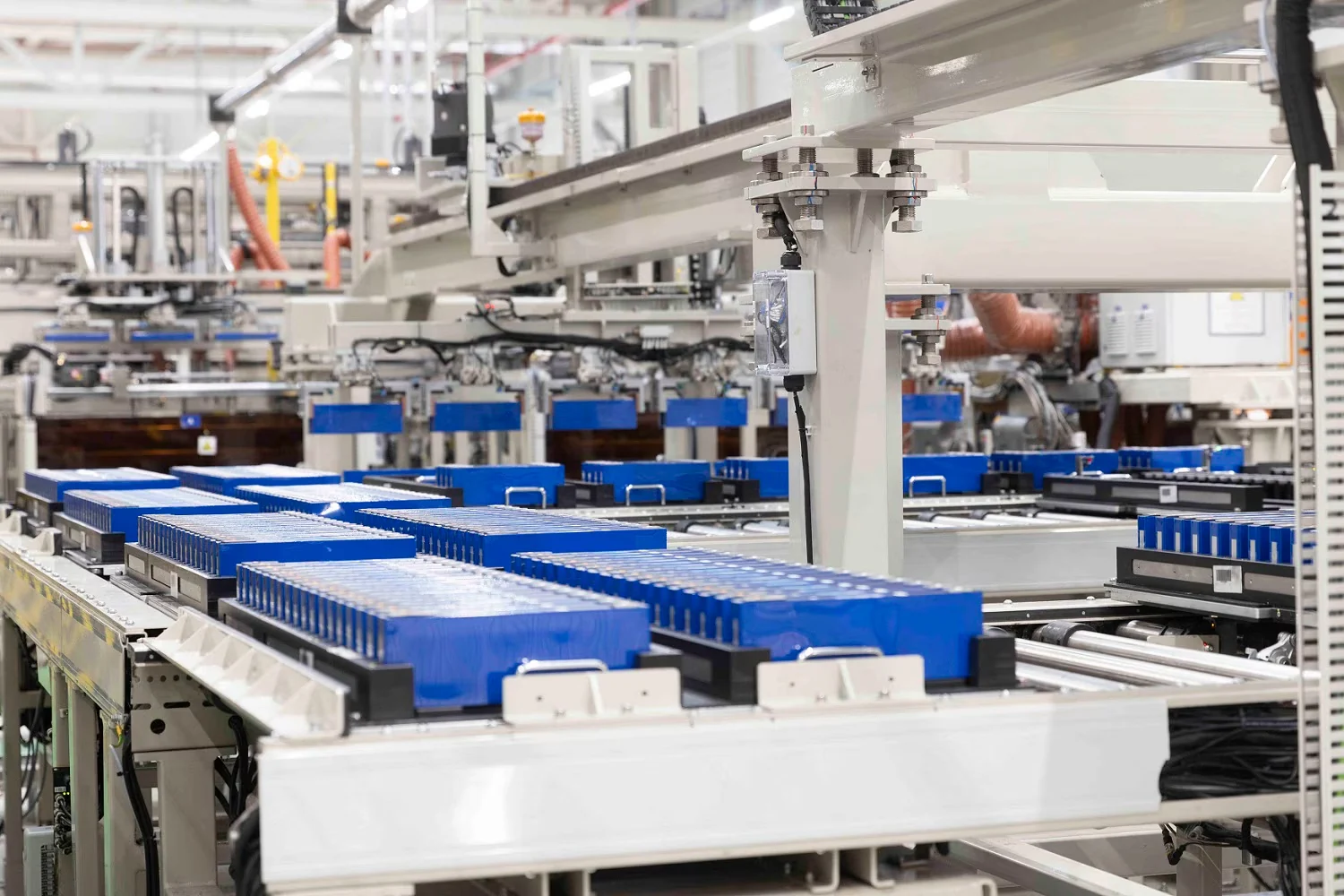
View inside CATL's battery factory in Arnstadt, Germany. Credit: CATL, via electrive.
Transport & Environment (T&E), a European clean-transport group, published an analysis on October 1 that contradicts automaker claims about a "Made in EU" battery shortage. It concludes that European cell production will cover demand from vehicles covered by the planned Industrial Accelerator Act by 2030. Production meets demand for funded company cars by 2027, and for company and private cars together by 2030, if medium-probability projects get built.
The weak link is upstream. T&E counts 529,000 tonnes of cathode active material (CAM) capacity announced for 2030, but only 177,000 tonnes once projects are weighted by likelihood. Precursor (pCAM) capacity is 552.6 GWh announced and 217.9 GWh likely. T&E says China controls 90 to 95 percent of global CAM and pCAM production.
Ownership is mixed. About 85 percent of active EU cell capacity belongs to non-European companies, and 72 percent of production is by South Korean makers. CATL runs plants in Arnstadt, Germany and Debrecen, Hungary. The proposed local-content rules would count production location, not manufacturer nationality.
The risk is cancellations. T&E notes that 25 percent of cell capacity announced since 2022 was cancelled or suspended, and Germany's 2035 pipeline roughly halved after projects like ACC Kaiserslautern and Cellforce fell through. T&E also says local-content requirements could lift EU battery demand 34 percent over the 2027 baseline. T&E is an advocacy group, and its "likely" figures depend on its own probability weighting.
Tesla lets drivers rip the plug out of a Supercharger in an emergency
Emergency Drive Away feature illustration. Credit: Not a Tesla App.
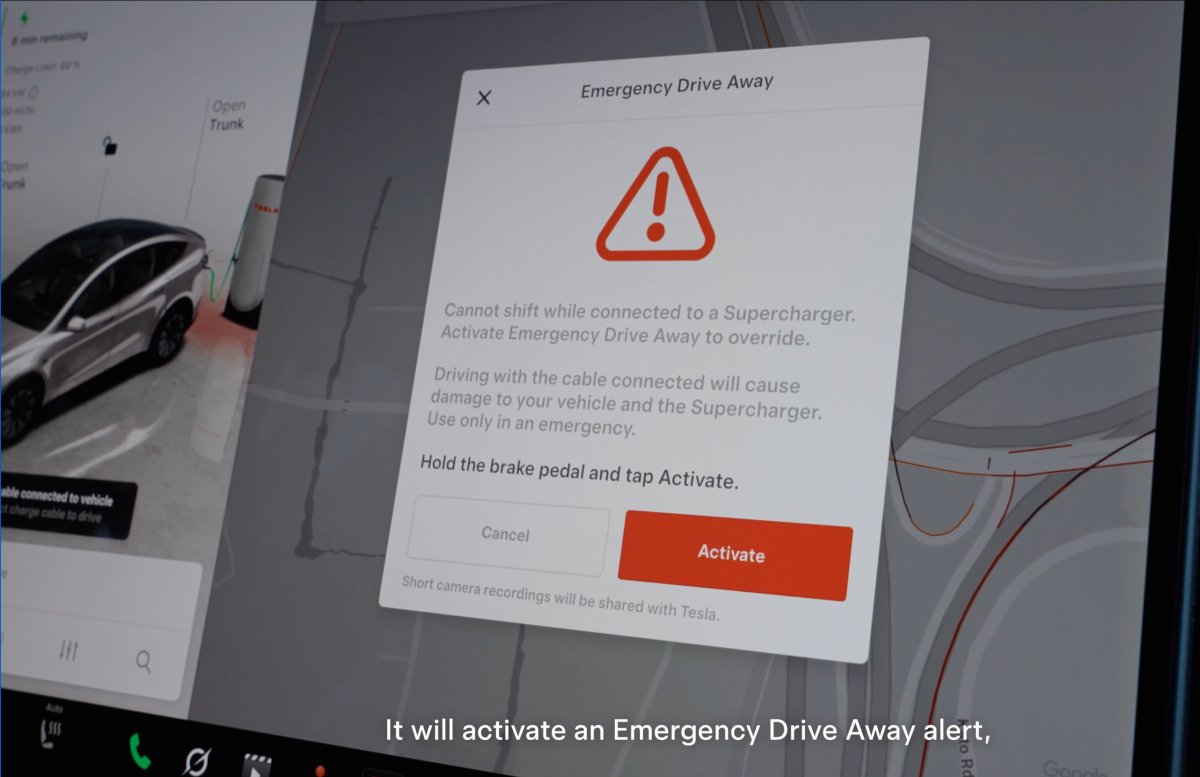
Tesla's software update 2026.38.3 adds Emergency Drive Away at U.S. Superchargers, reported October 2. If a driver shifts into gear while plugged in, a red prompt appears on the touchscreen. The driver holds the brake and taps Activate, and the car can then pull away. The connector breaks off, and glycol coolant leaks from the cable.
The reason is personal safety. Until now a driver who felt threatened at a charger had to get out and unplug. Third-party breakaway adapters existed, and Tesla previously sued makers of such connectors, calling them highly unsafe. Tesla's Director of Charging described the feature as "a feature we hope you never need."
It is not free. Using it damages the charge port, so a service visit is required. The stall's electrical and civil repairs can run up to $25,000. Short camera clips go to Tesla automatically so it can check that the situation was real, and Tesla warns against abuse. It excludes Model S and X built before 2021.
This is a connector design question as much as a feature. A deliberately sacrificial coupling has to separate cleanly without leaving a live, exposed conductor, and the coolant leak shows the cable was not built to part. Tesla has not published how the pedestal de-energizes before separation, so that part is not confirmed. Availability outside the U.S. depends on regional approval.
Musk says Tesla's robotaxi can't yet see a gray kitten on gray asphalt at night
Camera versus lidar night detection visualization. Credit: Electrek.
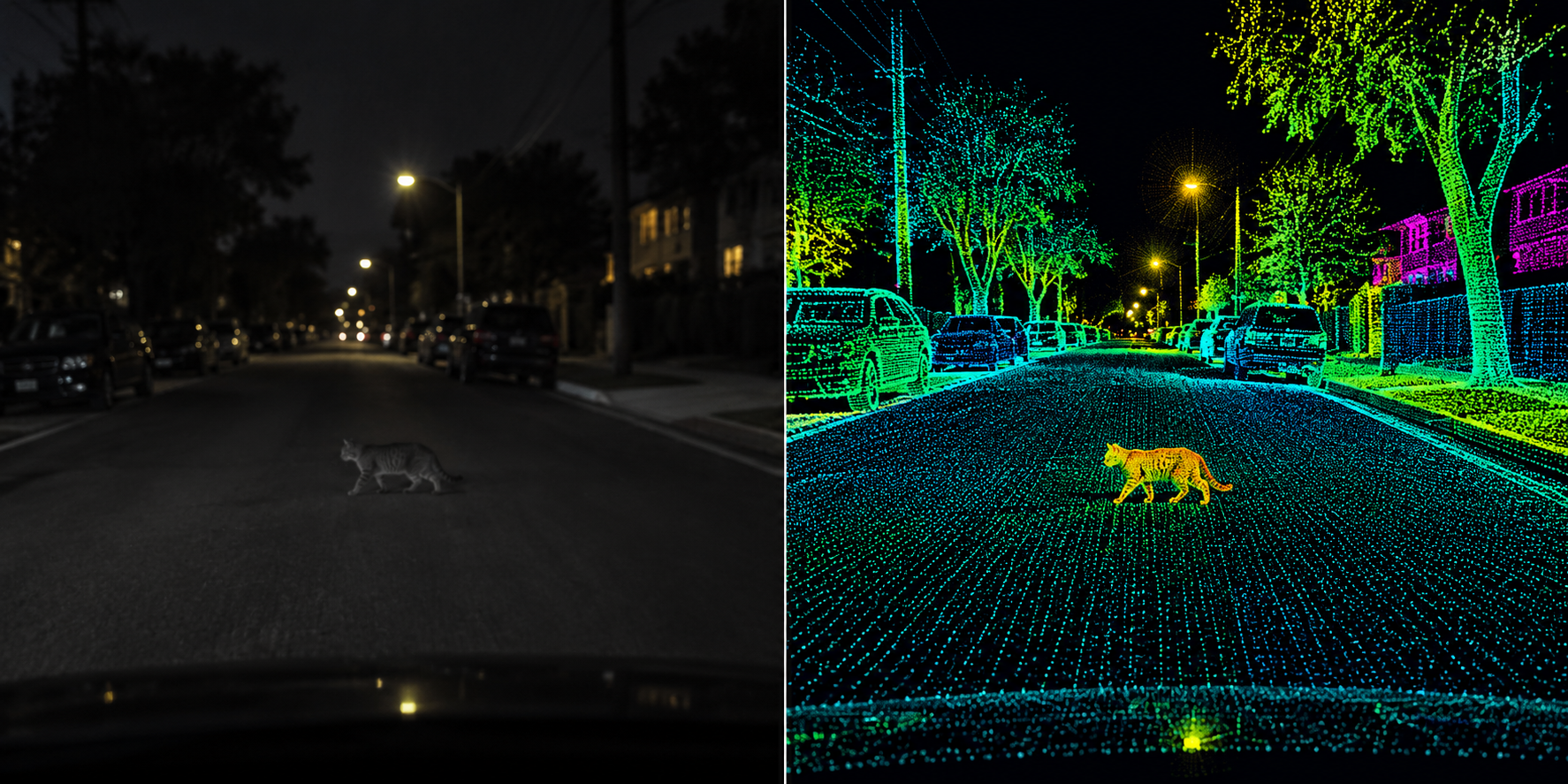
Elon Musk explained why Tesla's Robotaxi service in Austin does not run late at night, per Electrek on October 3. His words: "The main thing we're trying to solve is making sure that we don't run over pets when they're hard to see at night. Literally trying to avoid grey kittens on grey tarmac in the dark." Tesla recently extended hours from 10 PM to 11 PM.
The sensing problem is physical. Cameras are passive. They need ambient light and contrast, and a dark animal on dark pavement offers neither. Lidar and radar are active sensors. They emit their own laser or radio energy and measure the return, so they work regardless of lighting or color, and lidar returns a 3D shape.
Electrek contrasts this with Waymo, which it says runs about 4,000 driverless vehicles around the clock with 13 cameras, 4 lidars and 6 radars each. It also says lidar costs competitors a few hundred dollars per vehicle. Both figures come from Electrek, not from Waymo or an independent source here.
Tesla's approach is camera-only. Whether that can reach night-time performance matching active sensors through software alone is the open engineering question. This admission is a rare public statement of a specific failure case. It also bears on regulators, since an operating-hours limit is itself a safety control.
South Korean operator Water opens 400 kW sites with both NACS and CCS connectors
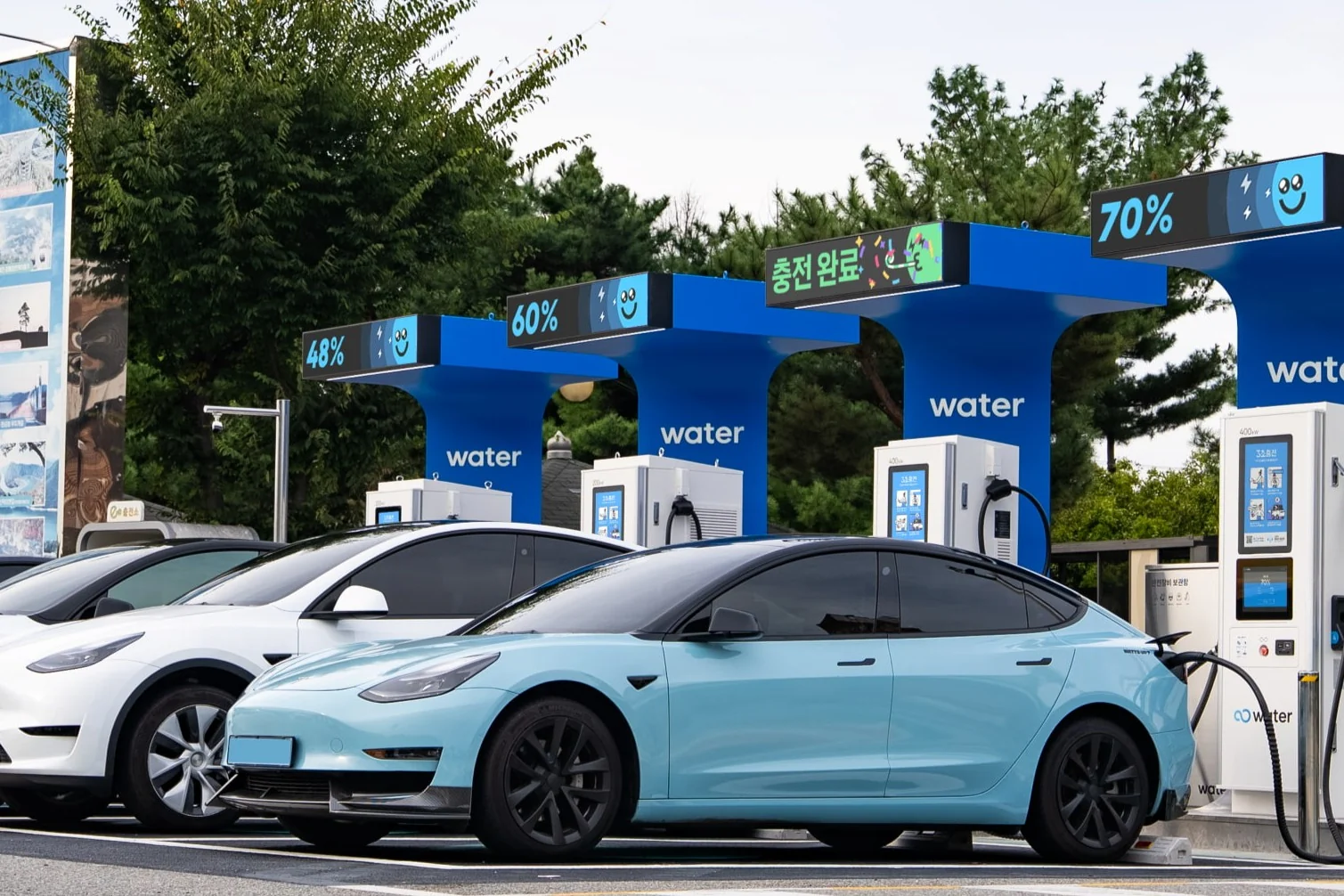
Water fast-charging station at Cheongju Rest Area. Credit: Water Charging, via electrive.
Water, a South Korean charging operator, plans 23 new highway fast-charging sites with 123 chargers, electrive reported October 3. The mix is 62 chargers at 400 kW, 46 at 200 kW and 15 at 100 kW. The first site, at Cheongju Rest Area, is open with two 400 kW and two 200 kW units.
Both NACS and DC Combo connectors are supported. Tesla vehicles are expected to charge at about 120 to 200 kW depending on model, per the report. That gap between charger rating and what the car accepts is the practical limit on any of these sites.
Water is pricing at 294 won (about 0.19 euros) per kWh for one year as a promotion. When the build-out finishes, Water expects to run 397 chargers across 73 highway rest areas. Brite Energy Partners' Yoo Dae-won argues rest areas are the only places where charging speed directly changes a driver's trip time.
Dual-connector sites matter because standards are still moving. Korea has historically used CCS1-style DC Combo, and Tesla owners there use NACS. Serving both from one pedestal avoids stranding either group. The report gives no cabinet or power-sharing details.
T&E says Europe will have enough cells by 2030, but the cathode material is the gap
Article: electrive.com/2026/10/01/te-analysis-sufficient-european-battery-cells-by-2030 ·
Primary: Transport & Environment analysis (linked above) ·
Image: image (View inside CATL's battery factory in Arnstadt, Germany. Credit: CATL, via electrive.)
Musk says Tesla's robotaxi can't yet see a gray kitten on gray asphalt at night
Article: electrek.co/2026/10/03/tesla-robotaxi-pets-night-musk-lidar/ ·
Primary: Musk statement as quoted by Electrek (original venue not confirmed) ·
Image: image (Camera versus lidar night detection visualization. Credit: Electrek.)