EV Technology Briefing — compiled and curated by Chris Lee
Geely's fast charger tries to repair the cells it stresses
Week of September 22 – September 29, 2026
Fast charging usually trades battery life for speed, and most of the industry's answer has been better cooling. Geely is trying something different: pulsing current through the cells to reactivate the lithium that plated out during a fast charge, and claiming up to 20 percent more cycle life. Elsewhere this week, EVgo previews a 750 kW architecture that shares power across stalls, China's new five-year battery plan sets 2030 targets for solid-state cells and 15,000-cycle batteries, a Vanderbilt and Maryland team gets sulfur to trade a third electron in a lithium-sulfur cell, and Mercedes commits to an end-to-end learned driver from Wayve.
Charging & Cell Management
Geely's 2.25 MW charger sends pulses through the cells to undo lithium plating
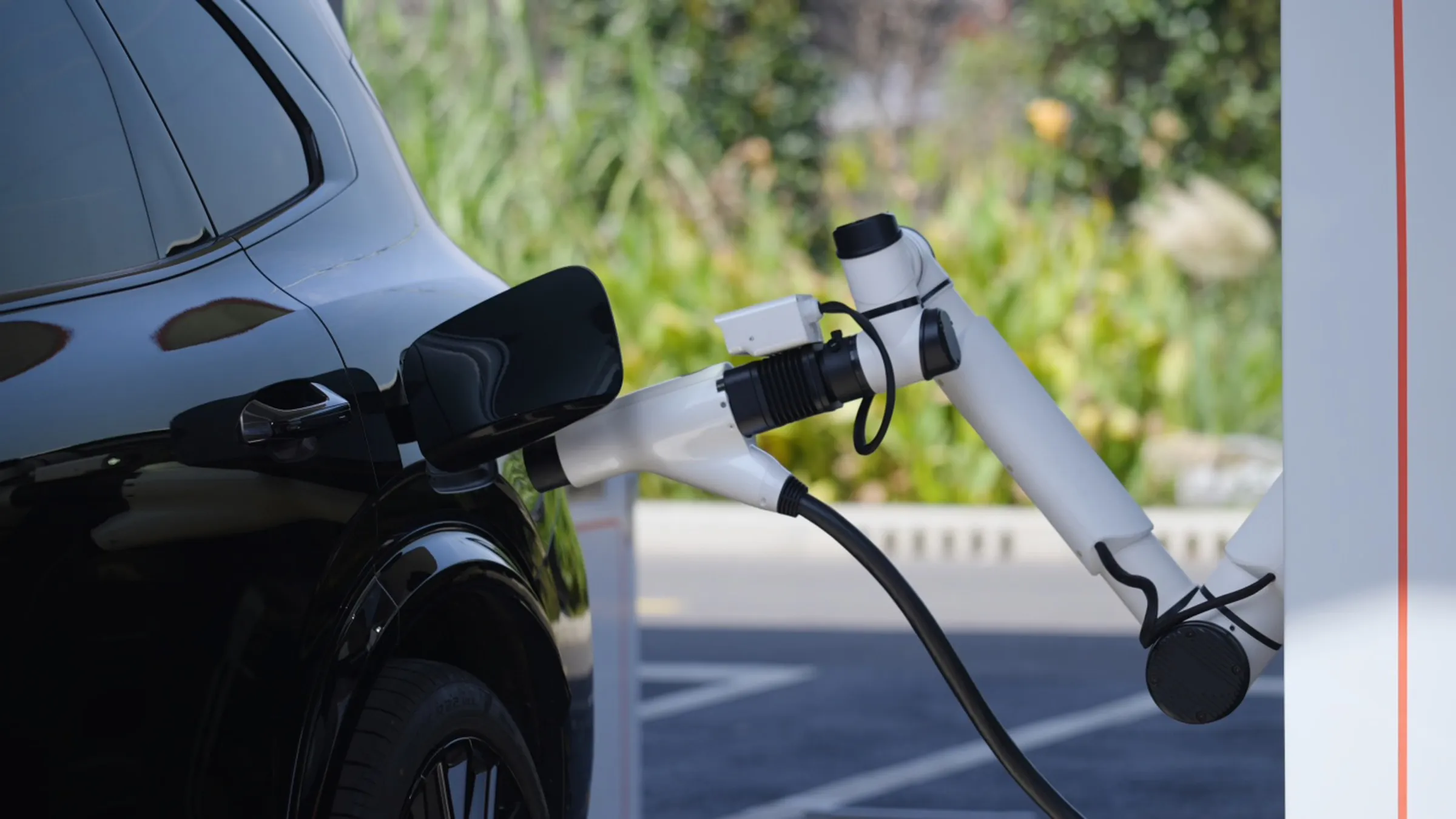
Geely Smart Charging robotic arm plugging into an EV. Credit: Geely Auto Group, via Electrek.
Geely Auto Group announced a charging system on September 23 that pairs a very high power station with a method for repairing the cell damage that fast charging causes. The station is a fifth-generation design with a 2,250 kW peak. In Geely's demonstrations, a Lynk & Co 10 and a Zeekr 001 went from 10 to 70 percent in 4 minutes 30 seconds and from 10 to 97 percent in 8 minutes 40 seconds.
The more interesting part is the cell chemistry. Fast charging pushes lithium ions into the graphite anode faster than they can move in. The excess plates out as metallic lithium on the surface, where it stops being usable capacity. Geely says its "lithium-ion pulse restoration" sends micro-pulse currents through the cells to reactivate that stranded lithium. A low-rate home charging strategy is meant to reverse more of the damage overnight. Geely claims up to 20 percent more cycle life.
An AI model called Xingrui PowerMind, developed with the Chinese startup StepFun, manages the session. It predicts battery temperature up to 30 seconds ahead and adjusts current before the pack gets hot instead of after. Geely targets an average cell temperature below 55°C and a peak below 65°C. A five-point liquid cooling loop covers the station battery, charging pile, cable, port and vehicle pack.
Two cell designs were named. Geely's Shendun Golden Battery peaks at 12C. The next-generation Ultra Short Blade Battery peaks at 6C and generates about 10 percent less heat, which Geely attributes to laser-welded cell tabs.
Treat the numbers as company claims. The 20 percent cycle-life figure is "up to," and no test protocol, cell count or independent data has been published. The 2.25 MW peak also needs a matching vehicle and a station with the grid capacity to feed it. Still, restoring plated lithium with current pulses is a specific mechanism that outside labs can test.
EVgo's 750 kW system shares power across stalls instead of fixing each stall's rating
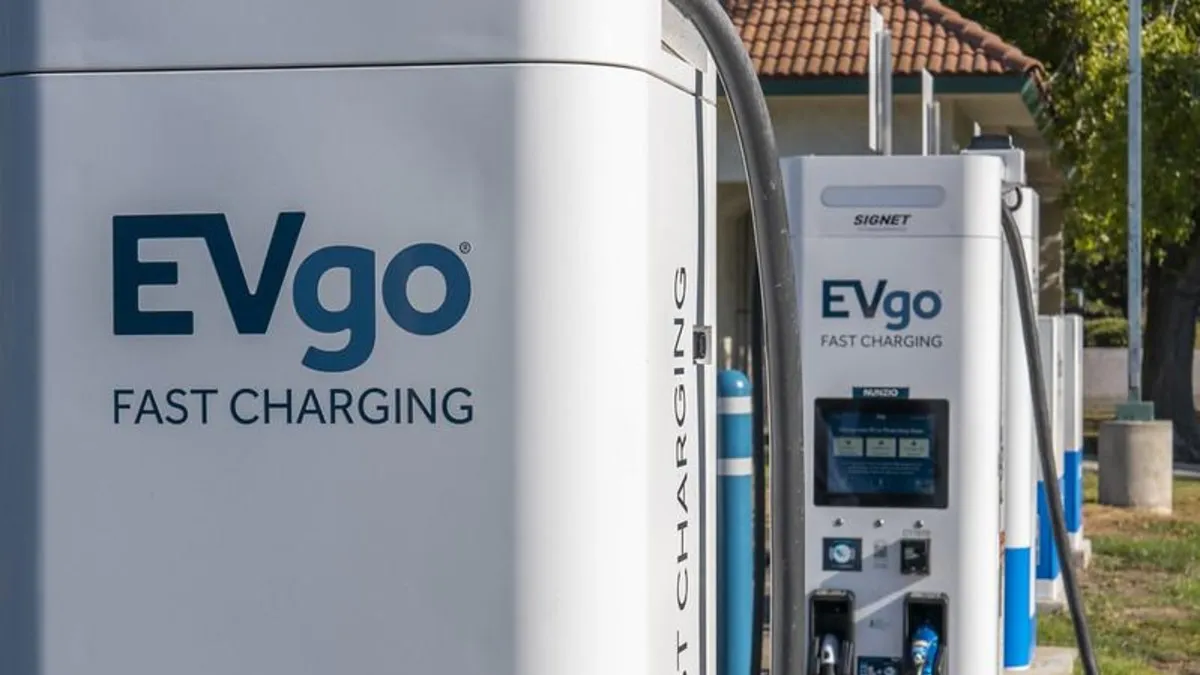
EVgo fast-charging stations, a 2025 file photo, not the new 750 kW system. Credit: CA.gov, via Electrek.
On September 29, EVgo previewed a next-generation charging system rated up to 750 kW, developed with Delta Electronics at EVgo's Innovation Lab in El Segundo, California. Delta already supplies the 350 kW dual-head chargers in EVgo's network. The company says the fastest-charging EVs sold in the US could charge in roughly 10 minutes, though Electrek points out EVgo gave no state-of-charge range for that figure, and the result will depend on the vehicle, battery temperature and starting charge.
The design choice worth noting is dynamic power sharing. A conventional charger site assigns a fixed power rating to each stall, and a driver with a slow car can occupy a stall built for a fast one. EVgo says its system distributes power across connected vehicles in real time. Most cars get the maximum they ask for. When several high-power vehicles plug in together, they split what is available in proportion. EVgo's pitch is that no driver has to hunt for the right stall.
The release specifies NACS connectors and lists easier-handling cables, touchless payment and improved hardware and firmware reliability. Coverage adds some color. Yahoo Autos describes the sharing this way: if a Lucid Gravity and a Tesla Model 3 are on one stall, the Gravity could draw about 400 kW and the Model 3 about 250 kW. That example is the outlet's illustration, not an EVgo spec. One trade write-up also describes a single 750 kW cabinet feeding up to six dispensers, about 125 kW each. No other outlet or EVgo document confirms that, so treat it as unverified. None of the coverage gives voltage, current or cabinet specs. The 750 kW figure roughly doubles the 350 kW maximum in EVgo's network today.
The final charger design will be unveiled in 2027, with deployment after that. Electrek notes that is later than the second half of 2026 EVgo had originally projected. This is a preview of an architecture, not a product on sale. EVgo operates more than 1,200 fast-charging locations in 47 states, and its CEO says charge rates on the network are up nearly 20 percent in the last two years. That trend is the case for building headroom into the site.
China's battery plan puts numbers on solid-state, cycle life and defect rates
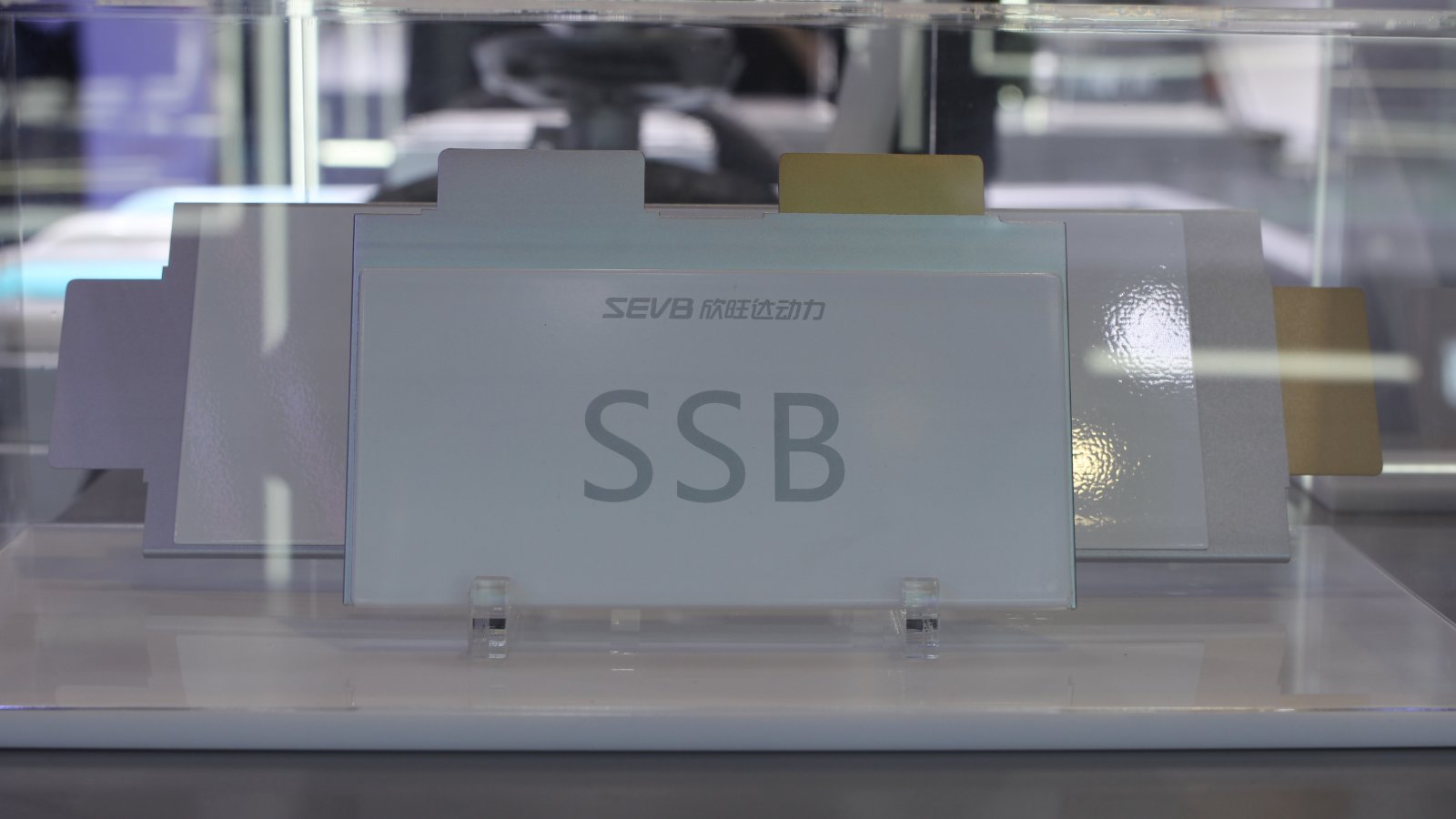
A Sunwoda solid-state battery cell on display at the Shanghai Auto Show in April 2025. Credit: CnEVPost.
China's Ministry of Industry and Information Technology, together with six other agencies including the National Development and Reform Commission and the Ministry of Transport, issued the Battery Industry Development Plan for the Fifteenth Five-Year Period. The document is dated September 14 and was reported September 28. It covers 2026 to 2030.
The plan's headline target is initial large-scale use of all-solid-state batteries by 2030. The engineering priorities it names are ionic conductivity, cycling stability, cost, pressure-system engineering and scaled production of high-performance solid electrolytes. Pressure systems matter because many solid-state cells need sustained stack pressure to keep the electrode and electrolyte layers in contact.
Two other targets are quantitative. Long-life lithium batteries should reach 15,000 charge-discharge cycles, and leading manufacturers should hold product defect rates at parts-per-billion level. The plan also backs sodium batteries, citing cost, safety and resource availability, with cold-resistant high-energy-density power cells and long-life storage cells as goals.
The policy pieces reach past chemistry. The plan proposes a digital identity system for products including EV power batteries and says China will explore internationally accepted battery passport arrangements. Companies must set up used-battery collection in proportion to their sales and build recycling capacity in major export markets where feasible. It also supports mergers and restructuring, and it calls for faster domestic exploration of lithium, cobalt and other critical minerals.
A five-year plan sets direction and funding priorities rather than binding performance specs, and "initial large-scale use" is not defined in the coverage. It is still the clearest statement yet of which technologies Beijing wants to back through 2030. The battery passport language also lines up with the EU's own passport requirements.
Chlorine lets sulfur trade a third electron in a lithium-sulfur cell
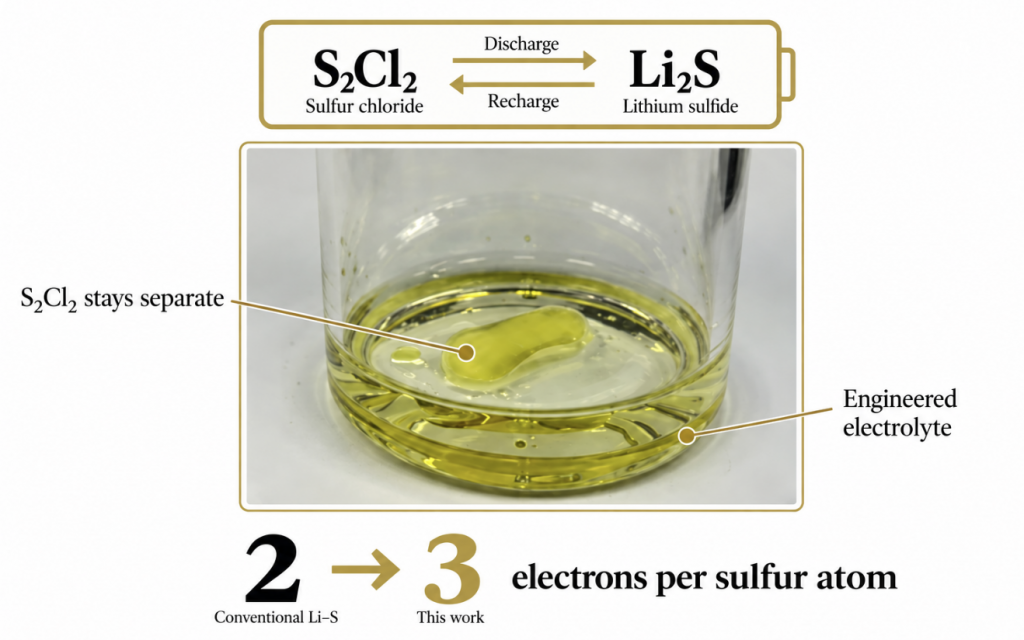
Illustration accompanying the Vanderbilt announcement. Credit: Vanderbilt University.
Lithium-sulfur cells attract EV researchers because sulfur is cheap and stores a lot of charge per gram. Conventional chemistry has sulfur exchange two electrons. A team from Vanderbilt University and the University of Maryland, led by De-en Jiang, added chlorine so that sulfur exchanges three. The work was published in Nature Energy, and Vanderbilt announced it on September 22.
The electrolyte is the hard part. The team used molecular simulations to design one that keeps chloride available to react with sulfur while stopping unwanted side reactions at the lithium metal electrode. The result is a 58 percent increase in sulfur's charge storage. Average operating voltage rises from 2.05 V to 2.54 V. Energy density reaches more than 1,700 Wh per kilogram of sulfur.
That figure is per kilogram of sulfur, which is the active material, not of the whole cell. The researchers project about 37 percent higher specific energy at stack level than conventional lithium-sulfur, or 477 Wh/kg. A projection is not a measurement.
The caveats are large. The cells were coin cells and single-layer pouch cells, and the pouch cell kept 78 percent of its capacity after 100 cycles. That is far short of what an EV pack needs. The prototype uses a lithium metal electrode, modest amounts of sulfur and more electrolyte than a commercial cell could carry. Every extra gram of electrolyte eats into the stack-level number.
This is a lab result on a mechanism, and the useful thing to watch is whether other groups reproduce the third-electron step with less electrolyte. Nobody should expect it in a car this decade on the strength of this paper alone.
Mercedes adds a third driver-assist stack, this one trained end to end
Wayve test vehicle. Credit: Wayve, via Electrek.
On September 22, Wayve and Mercedes-Benz announced a production agreement to bring the Wayve AI Driver into Mercedes vehicles within about two years. Mercedes CTO Jörg Burzer called it the first integration of the Wayve AI Driver in the premium segment. Mercedes describes the capability as advanced urban and highway point-to-point driving assistance.
The technical approach is what sets it apart from the rule-based stacks most automakers ship. Wayve calls it AV2.0: one end-to-end learned model that maps sensor input to driving output, instead of separate hand-built modules for perception, prediction and planning. The company says it operates without HD maps, geofences or city-specific retraining. The sensor suite includes radar as well as cameras, which is a different bet from vision-only systems. Training runs on Nvidia hardware hosted on Microsoft Azure, and the driver will run on Mercedes hardware inside its MB.OS operating system.
The announcement leaves out the details a regulator would ask for. It gives no SAE automation level, no named models and no date firmer than "within the next two years." Mercedes already sells Drive Pilot, a Level 3 system for highway traffic jams, and Electrek reports it is also working with Nvidia's Alpamayo stack at Level 2+. That would put three driver-assist stacks in one company's lineup.
End-to-end models are hard to certify because there is no module boundary to test separately. How Mercedes and Wayve plan to validate a learned driver at the point-to-point level is the open engineering question, and this announcement does not answer it.
China's battery plan puts numbers on solid-state, cycle life and defect rates
Article: cnevpost.com/2026/09/28/china-unveils-5-year-battery-plan/ ·
Primary: MIIT plan document, dated September 14, 2026; no direct link found, so CnEVPost's report is the source here ·
Image: image (CnEVPost; A Sunwoda solid-state battery cell on display at the Shanghai Auto Show in April 2025. Credit: CnEVPost.)