EV Technology Briefing — compiled and curated by Chris Lee
The fast charger that brings its own battery
Week of August 25 – September 1, 2026
Six stories this week, and two of them are really about the same problem: what happens to the grid when a charger asks for a megawatt and a half. BYD's answer is to put a battery inside the charger, and it now has ten thousand of them in the ground. Estonia's answer is a five-megawatt berth for a ferry that spends its life pulling in and out of the same two docks. In between, Asahi Kasei found a cheap way to pay silicon's first-cycle tax, Addionics is attacking cold-weather range with electrode geometry instead of heaters, Waymo put a date on the first commercial robotaxi service in the EU, and two Japanese automakers who could not merge agreed to share an electrical architecture instead.
Charging & Grid
BYD's tenth thousandth Flash Charger, and the buffer that makes it possible
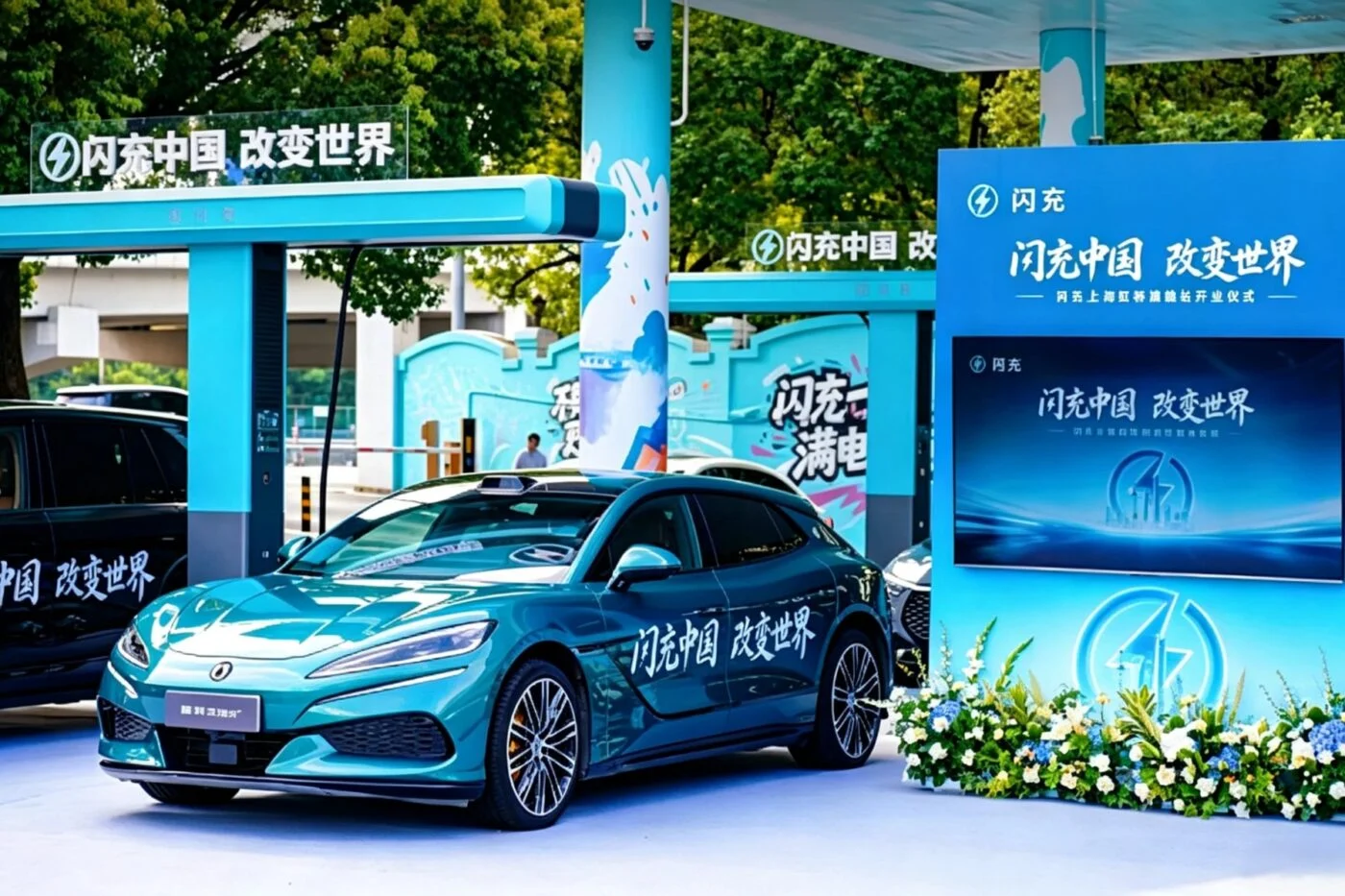
A charging park with second-generation Flash Chargers in Shanghai. Credit: BYD, via electrive.
BYD opened its ten thousandth second-generation Flash Charger in Shenzhen this week, half of the 20,000 it said in March it would install by the end of the year. The stations are T-shaped, carry two liquid-cooled cables that can both be plugged into the same car, and run at up to 1,500 kW. The cables are heavy enough that BYD hangs them from an overhead rail so a driver can move them.
The interesting engineering is not the 1,500 kW. It is that BYD gives every station its own energy storage and calls the result a station within a station. The buffer charges from the site's existing electrical service while nothing is plugged in, then discharges hard for the few minutes a car is actually drawing full power. A 1.5 MW continuous draw is substation territory and would need an interconnection study, a transformer and a queue position. A 1.5 MW burst backed by a local battery mostly needs the service that was already there. BYD's CEO has said installing one is about as involved as installing an air conditioner, which is marketing, but the underlying claim is real: the company can add sites without adding grid capacity in step with them.
The charging speed is only meaningful with the second-generation Blade Battery on the other end. BYD quotes 10 to 97 percent in nine minutes on a dual-gun station, which is where both cables into one car earns its keep. About a third of the sessions on the network so far have come from other brands, so the stations are not a walled garden, though non-BYD cars get whatever their own architecture can accept.
The remaining target is the part to watch. BYD completed 4,239 stations in the first two months of 2026 and needs roughly 80 a day for the rest of the year to reach 20,000, which CN EV News notes is more than double the pace of the last five months. The rollout partners are the reason it is not absurd: Sinopec, PetroChina, CNOOC, Teld and JD.com, which between them own an enormous amount of already-electrified real estate beside roads. Abroad, the first UK stations are in with 300 planned by year-end, and a Flash Charger appeared briefly at a German internal event in early summer before being removed again.
Paying silicon's first-cycle tax with lithium carbonate
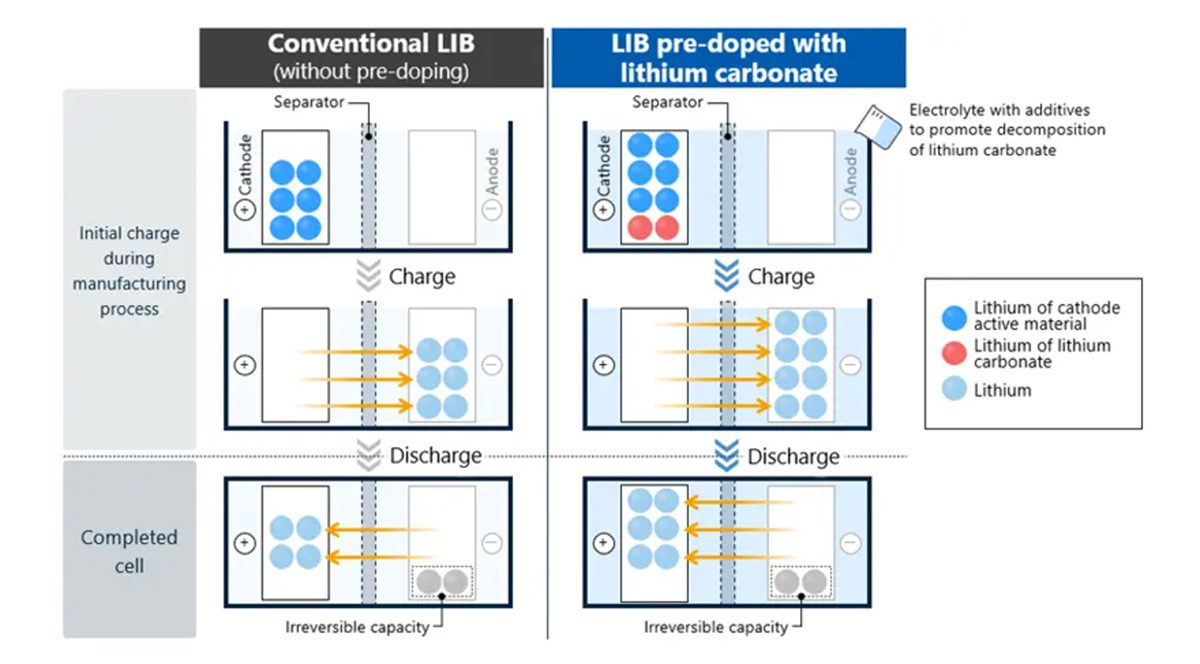
Image supplied with Asahi Kasei's announcement. Credit: Asahi Kasei, via Charged EVs.
Silicon holds far more lithium per gram than graphite, which is why nearly every cell maker is blending some into an otherwise graphite anode. It also eats a large slug of lithium permanently on the first charge, building a solid-electrolyte interphase that never gives the lithium back. That irreversible loss caps how much silicon you can use. The usual fix is to overbuild the cathode so there is spare lithium to lose, which costs cathode material, which is the expensive part of the cell.
Asahi Kasei announced on 20 August a pre-doping route that pays the tax with lithium carbonate instead. Li2CO3 is cheap and already qualified across the battery supply chain. The reason nobody uses it as a sacrificial lithium source is that its decomposition voltage sits well above where a lithium-ion cell normally operates, so it just sits there inert. Asahi Kasei's contribution is a set of electrolyte additives that promote the carbonate's decomposition inside the voltage window a standard cell already runs in. Blend the carbonate into the cathode, and the first charge breaks it down and releases its lithium into the cell.
The measured result is modest and specific, which is a point in its favor. On an NMC cell with an anode of 90 percent graphite and 10 percent silicon monoxide, the company measured a 10 percent gain in energy density. It also claims better cycle life and a low cost per watt-hour, and says the process needs no significant changes to an existing production line.
That last claim is the one that decides whether this matters. Prelithiation has working solutions already, including lithium-metal foils and pre-lithiated additives, and they tend to require dry rooms, handling equipment and materials that a cell plant has to import. A powder you mix into the cathode slurry and an additive package in the electrolyte are a different class of change. Last week's DOE round funded a US silicon-anode electrode plant and a US ultra-thin lithium-metal film plant in the same breath, which is a decent measure of how much the industry expects to spend on this problem. Asahi Kasei is now running proof-of-concept evaluations with customers, with licensing phased to each one's stage of development.
Fixing cold-weather range with geometry instead of heat
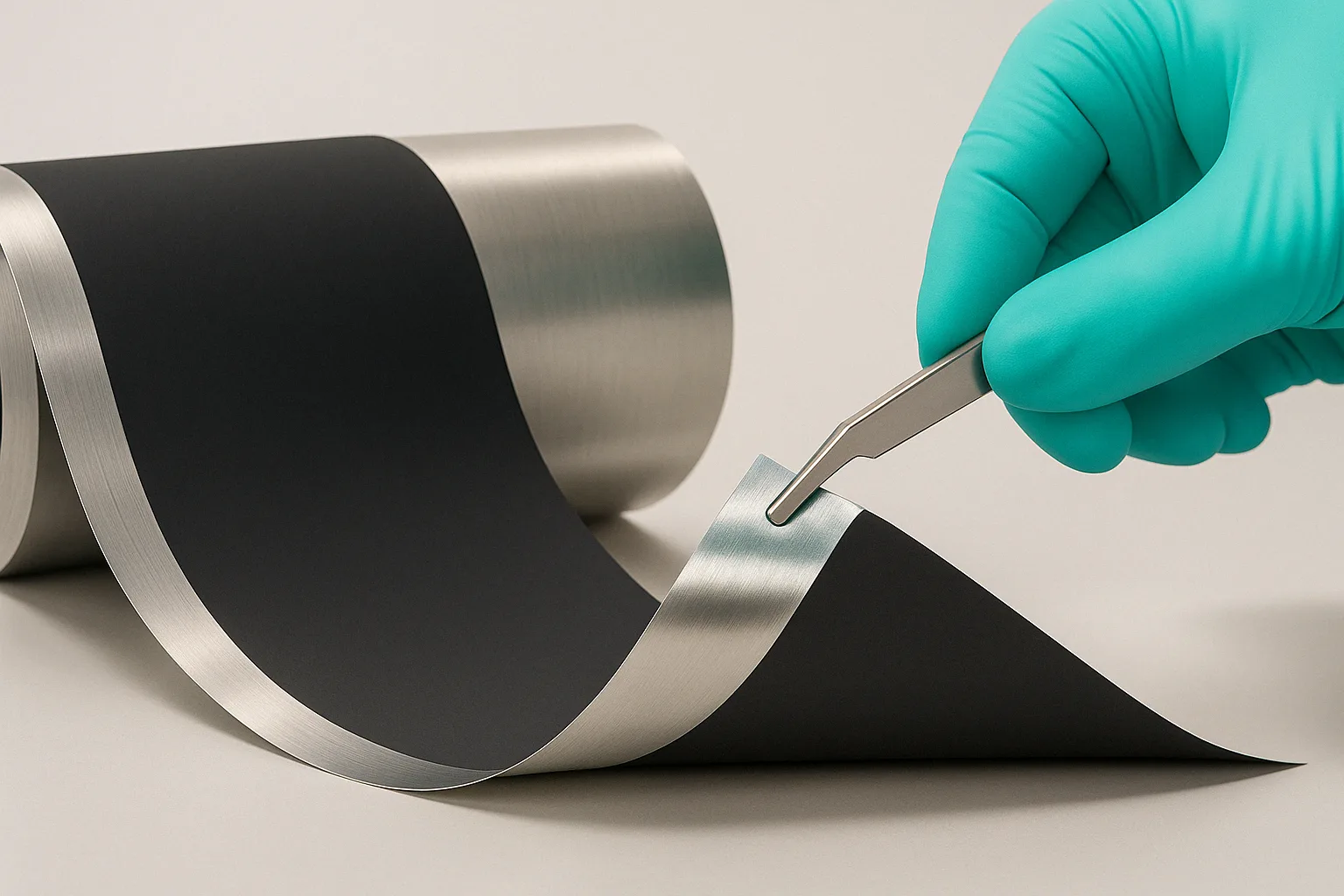
Image supplied with Addionics' announcement. Credit: Addionics, via Charged EVs.
A lithium-ion cell loses capability in the cold for unglamorous reasons. Ion transport through the electrolyte slows, ions move into the electrode more reluctantly, polarization climbs, and the pack both delivers less energy and safely accepts less charge current. The standard answer is a heater, which spends energy to buy energy back and adds time before a fast charge can start. Addionics says an EV can shed up to 40 percent of its range in a severe winter once cabin heating, pack heating and pre-conditioning are all pulling from the same battery.
The company introduced a low-temperature architecture on 25 August built on what it calls Smart 3D Porous Current Collectors. Instead of a flat metal foil with active material coated on both faces, the collector is an engineered three-dimensional porous structure, so electrolyte and lithium ions can move through the plane of the collector rather than only around it. Addionics argues this opens extra transport paths into the electrode, shortens the effective distance an ion has to travel, and spreads electrochemical activity through a larger volume of material rather than concentrating it near the surface. If the cold penalty is fundamentally a transport problem, shortening the transport path is the direct attack on it.
Worth being clear about what has and has not been shown. This is a company announcement with a mechanism and a target list, not published third-party data, and Addionics has not put a number on how much cold-weather energy or charge acceptance the structure recovers. The named applications reach past cars into electric trucks, defense drones, spacecraft and aviation, which is a familiar shape for a materials company looking for a first customer wherever the pain is worst.
The truck case is the one that translates cleanly into money. A loaded semi at highway speed pulls hard and continuously, so a cold pack that cannot deliver its rated power turns into either a lighter payload or a route the fleet does not run in winter. On a spacecraft, cutting the heater budget ripples through the whole power system, because the battery, the solar array and the launch mass are all sized against each other.
Estonia buys a five-megawatt berth for a ferry that does not exist yet
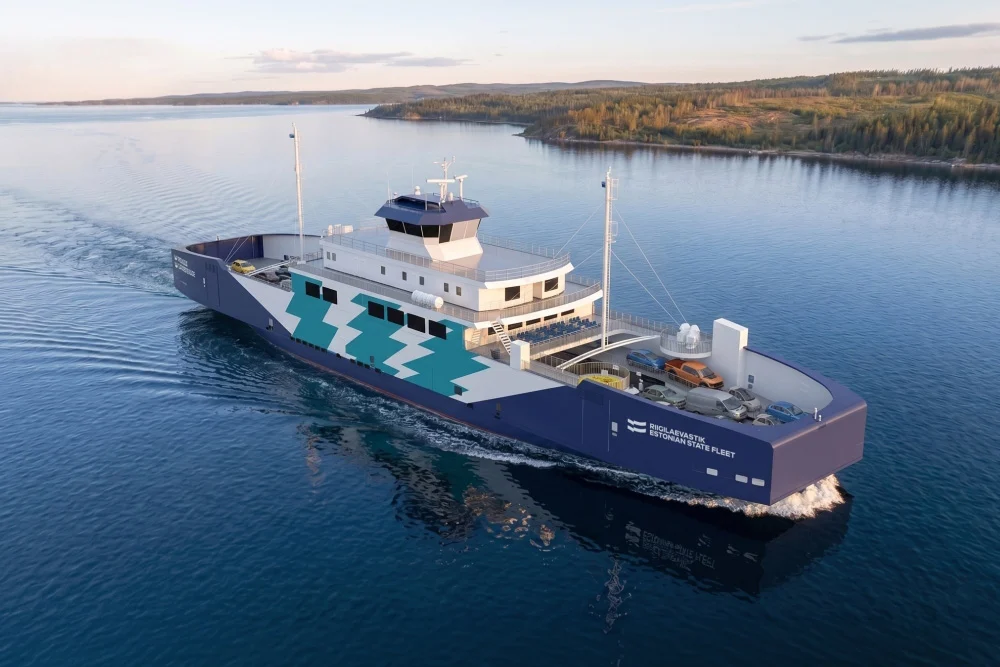
The new ferry will carry a battery of around 3 MWh. Designer's rendering; the vessel is not due until the end of 2028. Credit: LMG Marine, via electrive.
Norway's PSW Power & Automation has won the contract to put a Megawatt Charging System on the Virtsu to Kuivastu crossing, the link between the Estonian mainland and the island of Muhu that carries traffic on to Saaremaa. Two charging points go in on each side, each rated up to 5 MW, on a 1,500 V architecture that leaves headroom above what the first vessel will use. PSW says it has already installed more than 250 MW of shore power and more than 100 MWh of integrated battery storage around the Nordics.
MCS was written for heavy road transport, and the road deployments this year have been real but cautious. The maritime case fits the connector better than trucking does. A ferry on a fixed crossing berths in the same place, at the same rate, dozens of times a day, with a dwell time set by loading rather than by charging. That is the duty cycle high-power charging was designed around, and it removes the two things that make truck-stop megawatt charging hard: unpredictable arrivals and a site that has to serve strangers.
The numbers line up sensibly. The new ferry will carry roughly 3 MWh, so a 5 MW berth is around 1.7C, fast enough to top up meaningfully during a turnaround without punishing the pack. The vessel is due at the end of 2028, takes 380 passengers and 110 cars or eight lorries, and came in at 50 million euros, about eight million over the original budget. PSW says the shore installation will not be reserved for it, so any other suitably equipped vessel can use the same berth.
Ordering the charger now, more than two years ahead of the ship, is the part worth noting. Shore power at this scale is a grid connection, a civil works project and a permitting exercise before it is a charger, and those clocks run longer than shipbuilding.
Waymo puts a date on Munich, and the long pole is not the software
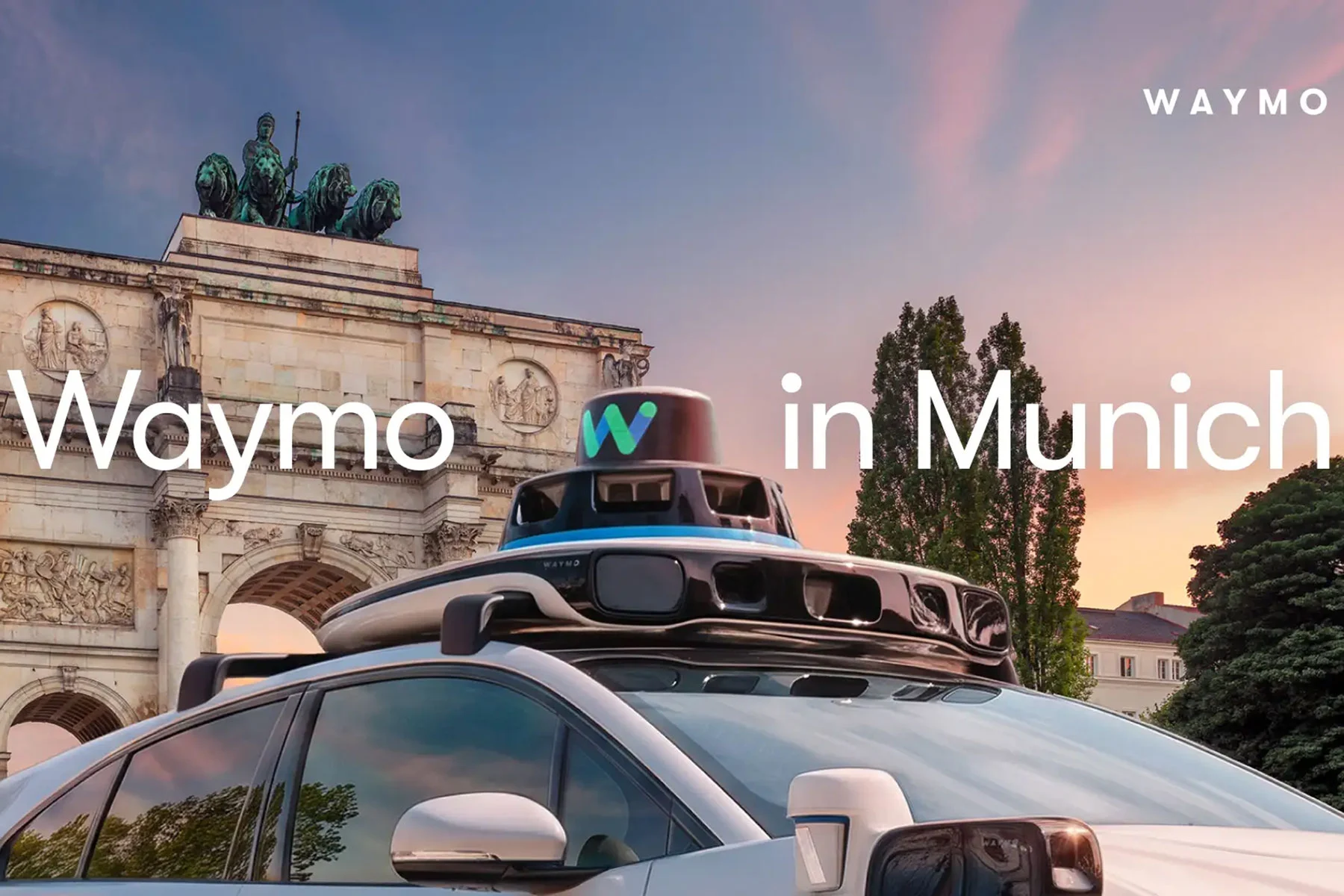
Waymo will run only battery-electric vehicles in Munich. Credit: Waymo, via electrive.
Waymo's first cars reach Munich streets in the coming weeks with trained safety drivers aboard. That phase is for building high-resolution maps and characterizing local traffic before the Waymo Driver is turned loose on it. Commercial driverless service is planned for the end of 2027. If the schedule holds, Munich becomes the first city in the European Union with a regular driverless robotaxi service, which would put it ahead of London, where Waymo has been preparing since spring.
The groundwork has been visible for months. Waymo Germany GmbH was entered in the commercial register in Munich in mid-June, with autonomous ride-hailing named in its stated purposes, and hiring for operations staff in Munich followed. The fleet will be battery-electric, though no model has been named. In the US, Waymo has just put the Zeekr-built Ojai into paid service in San Francisco, Los Angeles and Phoenix, running the sixth-generation Driver.
What has not happened is the approvals. Waymo says it is still in discussions at municipal, state and federal level, and the regulatory work is the longer pole here. Mapping a city is a known quantity for this company, with more than 20 million autonomous rides and 350 million kilometres behind it. Getting a German authority to sign off on a driverless commercial service that nobody has run there before is not. Both clocks have to reach zero at the same time, and only one of them is under Waymo's control.
The political signalling is unusually direct about that. Christian Hirte, Parliamentary State Secretary at the federal transport ministry, framed the announcement as proof that autonomous mobility services can operate regularly in Germany, and Florian Herrmann of the Bavarian State Chancellery said the state intends to cut regulatory barriers further. Waymo is unlikely to have Munich to itself either; Uber and the Israeli firm Autobrains have both announced programmes there. Waymo's safety record comes from Phoenix and California, and it does not automatically transfer to a dense European city with different road geometry and different assumptions about who yields.
Nissan and Honda could not merge, so they are sharing an electrical architecture
Illustrative Nissan press image; the agreement covers electronics and software, not any specific model. Credit: Nissan, via electrive.
Nissan and Honda signed a development agreement on 31 August to standardize a set of electronic control units between them, along with the vehicle operating system and parts of the middleware and vehicle control software that run on those ECUs. The target is a shared E/E architecture reaching production in both companies' next-generation vehicles from fiscal 2029. The stated goal is uniform specifications, pooled engineering and the scale that follows.
Two things stand out. The first is what this admits. These two tried to merge and the talks collapsed in early 2025 over terms. Coming back to the table for electrical architecture specifically says that of everything they could have shared, this is the piece neither can afford alone. That tracks with the rest of the industry: Volkswagen, which is not small, buys E/E architecture work from Rivian and Xpeng.
The second is the date. Fiscal 2029 sounds distant until you count what has to move. Standardizing ECUs across two companies means agreeing on function allocation, which decides how many controllers there are and where they sit, which sets the wiring harness, the power distribution topology and the fault behavior of everything downstream. Then every supplier interface on both sides has to be renegotiated against the new spec. Three years is not a long runway for that, and it is the reason these programmes get announced years before anything ships.
The announcement names ECUs, the OS, middleware and vehicle control software. It does not say whether the physical topology changes with them, and that is the question worth asking when more detail comes out. Standardizing the boxes and the software while leaving each company's domain layout intact is a much smaller undertaking than agreeing on a common zonal architecture, and the two get described in nearly the same language.