EV Technology Briefing — compiled and curated by Chris Lee
Four million cars called back over a piece of trim
Week of August 18 – August 25, 2026
Six stories this week. The lead is the largest recall in Chinese automotive history, and the defect is not a battery or a motor. It is an interior door release that is the same color as the panel around it. Elsewhere, the Department of Energy put $500 million behind seven minerals and battery-recycling projects, a Korean group traced a chunk of nickel-rich cathode aging back to how the precursor powder was stored before it ever reached a furnace, Geely gave a date for a 500 Wh/kg solid-state pilot, Nevada authorized thousands of paid robotaxis in Clark County, and PG&E added four more carmakers to the list of vehicles allowed to push power back into a house.
Safety & Standards
China calls back four million cars over a door release nobody can find
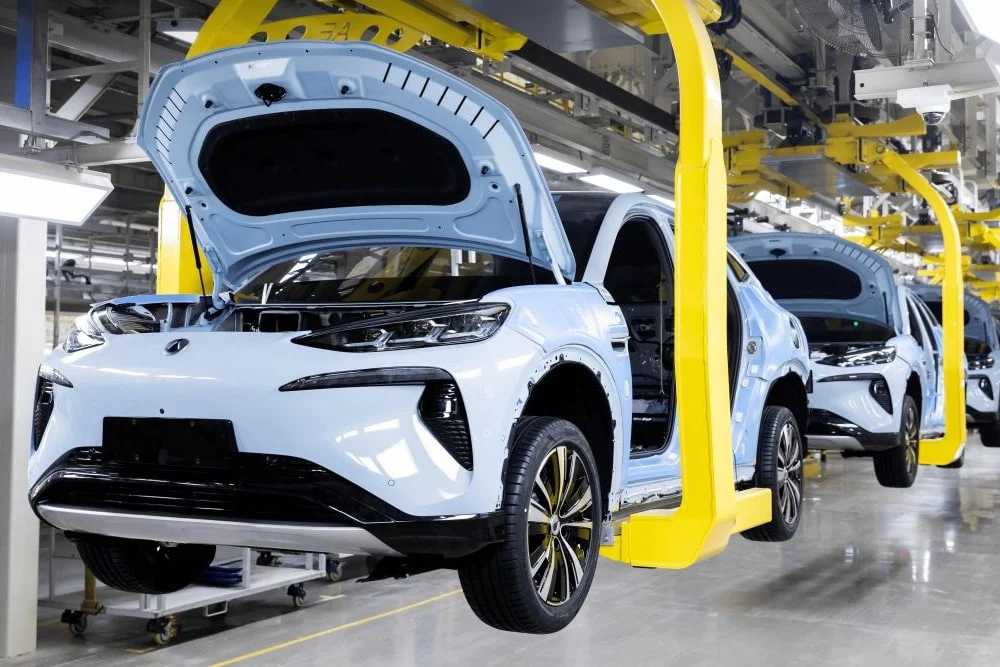
Retractable door handles are standard equipment across most of the Chinese market, including BYD's Denza brand. Archive image from 2024. Credit: BYD, via electrive.
China's market regulator, SAMR, announced recalls covering eleven automakers on Friday. The fault is the mechanical emergency door release inside the cabin. On most of the affected cars it is molded in a color close to the surrounding trim, which makes it hard to locate under stress and hard to explain to a rescuer who has never sat in that model. If a crash takes out the low-voltage system, the electric releases stop working and that hidden lever becomes the only way out. More than four million vehicles are covered for this issue alone.
Tesla carries by far the largest share. It will recall close to 2.98 million imported and China-built Model 3, Model Y, Model S and Model X from 25 September, adding warning labels and pushing an over-the-air update that drops the windows automatically after a crash. Xiaomi is recalling 390,435 SU7s from the 2024 model year and plans to change the unlocking logic and window-lowering behavior in software. Leapmotor covers 371,200 C11 and C01 units, Xpeng 264,842 across the G6, P7+ and X9, and Zeekr 92,658 units of the 007 and X. Chery, Dongfeng, Arcfox and FAW round out the list, with remedies ranging from labels to replacing the cover over the mechanical release. Nine of the eleven manufacturers are fixing this with stickers.
That is the part worth sitting with. A label is a remedy for a discoverability problem, not for a mechanism problem, and SAMR appears to have accepted it because the mechanism itself is already being legislated out. China is tightening its door-system rules and will become the first country to largely ban concealed and retractable handles in their current form on new vehicles from 2027, with mechanical unlocking required rather than optional. The recall patches the installed base while the standard fixes the design.
The reach of this is not domestic. NEVs hit a record 60.4 percent of Chinese new-car sales in July, and 553,000 were exported that month, up 145.5 percent year over year and more than half of all Chinese vehicle exports for the second month running. Safety rules written for that production base travel with the cars. US regulators have been looking at electrically actuated door systems for the same reason, and there is now a large, specific precedent to point at.
Separately and on the same day, Tesla announced a recall of roughly 2.74 million Model 3 and Model Y in China over driver monitoring: the current torque-based steering-wheel check does not satisfy Chinese regulators, and Tesla will bring the interior camera into the loop via software. Counting everything announced that day, the total passes seven million vehicles.
The DOE puts $500 million into seven links of the battery chain
The Department of Energy headquarters in Washington, DC. Stock photograph. Credit: DCStockPhotography/Shutterstock.com, via Mining Technology.
The Department of Energy's Office of Critical Minerals and Energy Innovation announced $500 million on 20 August for seven projects across minerals processing, battery manufacturing and recycling. It is the third round under the Battery Materials Processing and Battery Manufacturing and Recycling programs, which have now awarded $1.82 billion to 14 projects in the two earlier rounds. Assistant Secretary Audrey Robertson told Reuters the round drew hundreds of applications.
Read as a list of technologies rather than a list of companies, the selections are unusually coherent. Three awards of $100 million each go to Lilac Solutions for a direct lithium extraction and refining plant on the Great Salt Lake, targeting 5,000 tonnes a year of battery-grade lithium carbonate in phase one with first production in 2028; to Jervois for a domestic cobalt refinery producing battery-grade sulphate; and to Nth Cycle for a southeastern facility running its electro-extraction process on black mass from end-of-life packs and manufacturing scrap.
Four more take $50 million apiece and sit further down the materials stack. Princeton NuEnergy gets a Georgia demonstration plant that recovers and rejuvenates nickel-bearing cathode material from production scrap using a low-temperature plasma process. Coreshell Technologies gets US capacity for silicon-anode electrodes and cells built on domestically sourced metallurgical silicon in place of imported graphite, paired with dry-coated cathodes. Arcanum Ventures gets a Gulf Coast plant making battery-grade ethylene carbonate, an electrolyte solvent. Elevated Materials gets a facility producing ultra-thin lithium-metal films and pre-lithiated materials.
That last pair is the interesting signal. Ethylene carbonate and thin lithium foil are not headline chemistries. They are inputs that a US cell plant currently has to import, and they are exactly the sort of bottleneck that does not surface until the gigafactory is built and the line is waiting on a drum of solvent. Nth Cycle's award also lands weeks after the administration blocked exports of black mass. Robertson said the two were not connected but that the US "needs to and will build the ecosystem" to process that material domestically.
Cathode aging that starts before the powder reaches the furnace
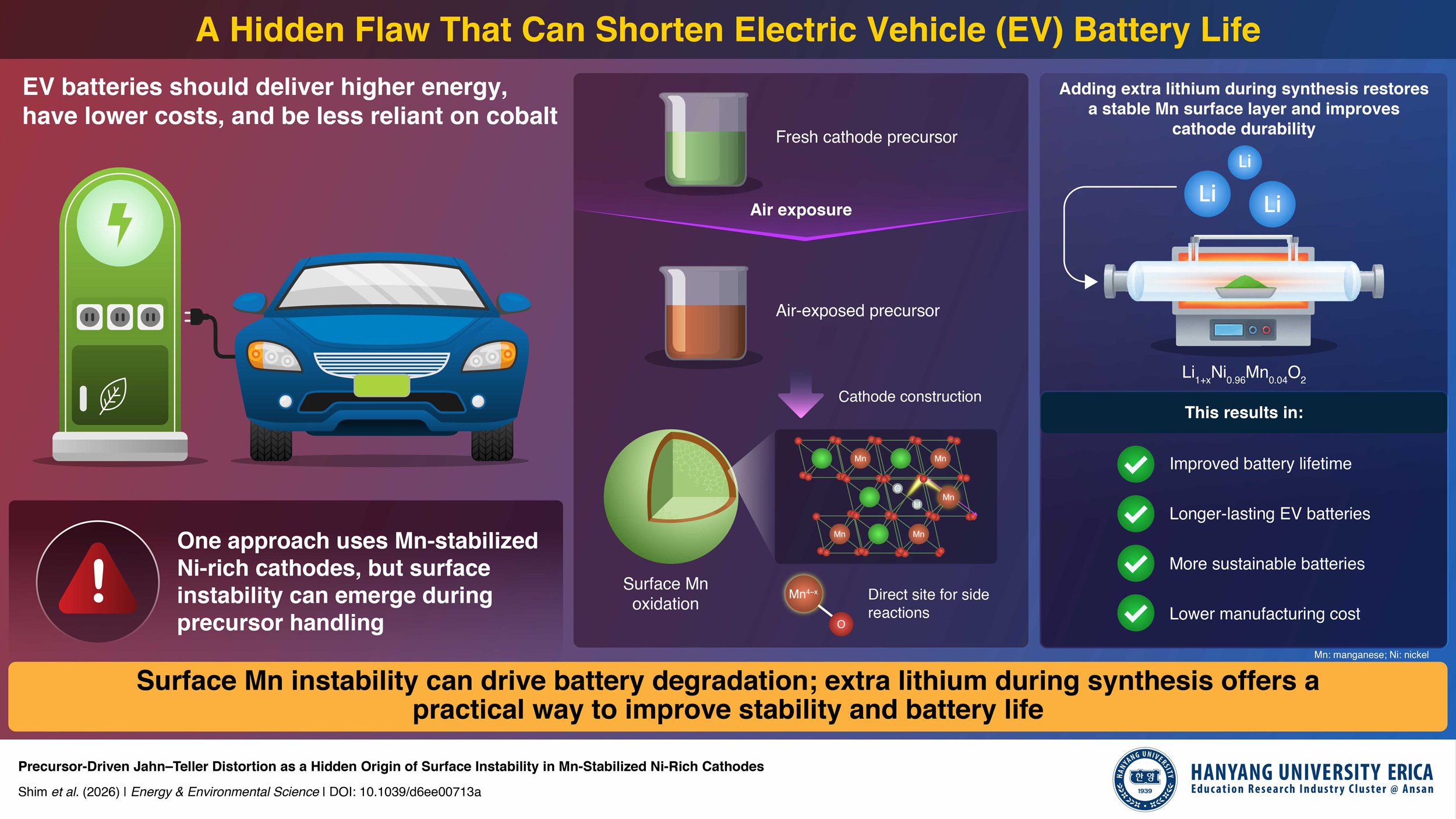
Hanyang's summary of the degradation pathway, from air-exposed precursor to distorted surface manganese. Research infographic, not a photograph. Credit: Hanyang University ERICA, via Charged EVs.
A team at Hanyang University ERICA, led by Professor Jin Ho Bang with PhD scholar JinHa Shim, has published a result that reads like a manufacturing memo dressed as materials science. High-nickel cathodes often carry a manganese-rich shell over a nickel core; the shell is there to protect the surface and cut cobalt content. The group found that if the precursor powder sits in air before synthesis, manganese at the particle surface oxidizes and forms defective regions full of Jahn-Teller distorted manganese species.
Those distorted sites are reactive. They decompose electrolyte, dissolve transition metal into it, and drive damaging reactions at the graphite anode. In extended cycling the effect nearly doubles the rate of capacity fade in nickel-rich systems. Nothing in that chain shows up as a defect in the finished powder. The cathode looks right, the cell builds fine, and the penalty arrives thousands of cycles later.
The fix is cheap, which is the point. Increasing the excess lithium during synthesis suppresses the defective surface phase and restores stable manganese-oxygen bonding; the modified cathodes held more than 90 percent of capacity. No new coating, no new equipment, no line redesign. "We found that a manganese-rich shell, which is normally introduced to protect high-nickel cathodes, can instead become a catalyst for degradation if the precursor chemistry is not carefully controlled," Bang said. "Even small variations in precursor storage history can substantially affect battery stability."
Anyone who has chased a field failure back through a supply chain will recognize the shape of this. The variable is not in the spec, so nobody logs it, so it cannot be correlated with anything. Bang's framing is that precursor handling deserves to be a controlled parameter in its own right. The work appeared in Energy & Environmental Science, volume 19, issue 12.
Geely names a year, a number, and an adhesive supplier
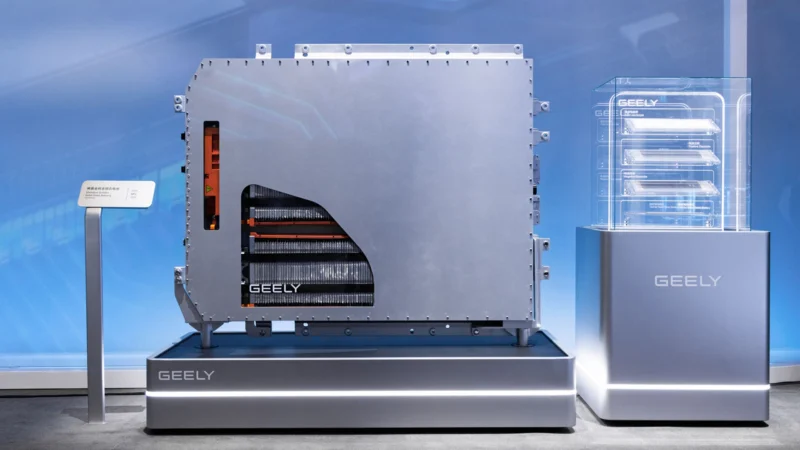
Geely's own graphic for the solid-state program, showing the claimed 500 Wh/kg figure. Brand graphic, not a photograph. Credit: Geely, via electrive.
Geely says real-world validation of its solid-state cells has been running through this year and that a pilot deployment across the Geely Holding brands starts in 2027. Which brands and how many cars is not disclosed. The portfolio spans Geely, Zeekr, Lynk & Co, Volvo, Polestar, Lotus and Smart, so the range of possible answers is wide.
The headline number is 500 Wh/kg for the most advanced variant, and per reporting on the announcement, that figure is quoted at pack level rather than cell level. For scale, the first-generation Zeekr Golden Brick pack lands around 128 Wh/kg. Geely pairs the number with a claim of more than 1,000 km of range, without naming the drive cycle or how it was measured. Capacity, charge rate and cell chemistry are all absent.
The one hard detail is a supplier. Geely is working with Dow on materials, specifically an adhesive for solid-state cells that stays stable from minus 40 to plus 120 degrees Celsius. That is a more informative disclosure than the energy density, because bonding and stack pressure are among the things that actually decide whether a sulfide or oxide stack survives thermal cycling in a car. A company talking about adhesive temperature limits is a company that has been building stacks.
The date matters more than the number. BYD is targeting demonstration vehicles in 2027 and small-scale production of dual-solid-electrolyte cells. CATL is aiming at pilot production in 2027 while publicly walking expectations back; CEO Robin Zeng put its solid-state work at level four of nine on a technology readiness scale in June. Three of the largest players in the industry now converge on the same year for the same word, and that word is pilot.
Waymo is cleared for up to 1,000 vehicles in Clark County under the new permits. Credit: Waymo, via Engadget.
The Nevada Transportation Authority approved Autonomous Vehicle Network Company permits for Tesla, Waymo and Uber at its 20 August meeting, clearing all three to charge for driverless rides in Clark County. Tesla's permit allows up to 5,000 vehicles over the next twelve months and reportedly covers the whole state provided the company notifies the agency before expanding coverage. Waymo is cleared for 1,000, and Uber for another 1,000, which it will run with Zoox and Motional.
Tesla's ceiling is not a plan. In the session Q&A the company said it would be "extremely happy" to have 2,500 robotaxis on Nevada roads by 2027, which is half the authorized number. The permit is headroom, not a forecast, and the difference between those two readings is most of the coverage this story got.
The operational detail is the more useful one. Tesla told the authority it is working with law enforcement on a five-minute step-by-step video that first responders can follow at a scene involving one of its autonomous vehicles. That is the same category of problem as this week's lead story: a vehicle whose failure modes are not legible to the person who has to deal with them at the roadside. Emergency-responder interaction is one of the areas NHTSA singled out when it updated its AV guidance earlier this summer, and it is turning into a routine condition of doing business at the state level.
Waymo had already been allowed to run without safety drivers in Las Vegas from July. The change here is the fare box, and a state authority sizing three fleets in one afternoon.
PG&E's bidirectional list grows by four carmakers and two chargers
PG&E announced the expansion on 24 August. Corporate logo supplied with the release, not a photograph. Credit: Pacific Gas and Electric Company, via PR Newswire.
PG&E expanded its Vehicle-to-Everything program on 24 August, adding Bidirectional Energy and PowerFlex as approved partners and opening the eligible-products list to Kia, Volvo, Polestar and Nissan. The approved pairings are specific, because in V2X the vehicle and the charger are qualified together, not separately: Nissan Leaf model years 2018 through 2025, the 2025 Volvo EX90 and the 2025 Polestar 3 all with the dcbel Ara; the Kia EV9 from 2024 and the EV6 from 2025 with the Wallbox Quasar 2. General Motors adds the 2027 Chevrolet Bolt, the Cadillac Celestiq and the Escalade IQL from 2025.
Those pairings qualify for up to $13,000 in additional incentives from California Energy Commission grant funding, layered on PG&E's own $2,500 upfront, $3,000 in disadvantaged communities, plus a $1,500 early-adopter payment for the first 250 enrollees. Commercial customers get $2,500 for a three-phase bidirectional charger under 50 kW and $4,500 at or above 50 kW. Enrollment runs through 30 June 2027.
The list is the story. Bidirectional charging has spent years being demonstrated and is now being administered, and an eligible-products list with named model years is what administration looks like. Every entry on it represents an onboard charger, a communication stack and an inverter that have been through interconnection review together. That is slow, unglamorous work, and it is the actual gate between a car that can technically export power and a car a utility will let export power.
PG&E is also running this on the commercial side, working with the Fremont, Oakland and San Francisco school districts on bidirectionally capable electric bus fleets. School buses remain the cleanest fit for V2G anywhere: large packs, a predictable duty cycle, and a long midday and summer parked window that lines up with when the grid wants the energy.