EV Technology Briefing — compiled and curated by Chris Lee
China's solid-state race gets a date: CATL and BYD both say 2027
Week of August 4 – August 11, 2026
Six stories this week, and the biggest is a calendar entry. CATL told investors it will start pilot production of solid-state cells in 2027, days after BYD's latest patent batch pointed at the same year. CATL also passed an unusually harsh safety test on a 350 Wh/kg aviation battery, and researchers in Korea found that simply storing cathode precursors in air can cut a battery's life nearly in half. On the infrastructure side, EVgo is putting Tesla's V4 Superchargers on its own network under its own brand, i-charging certified its 1.5 MW charger for North America, and California switched on $3,500 point-of-sale rebates for first-time EV buyers.
Solid-State Batteries
CATL and BYD both put 2027 on the solid-state calendar
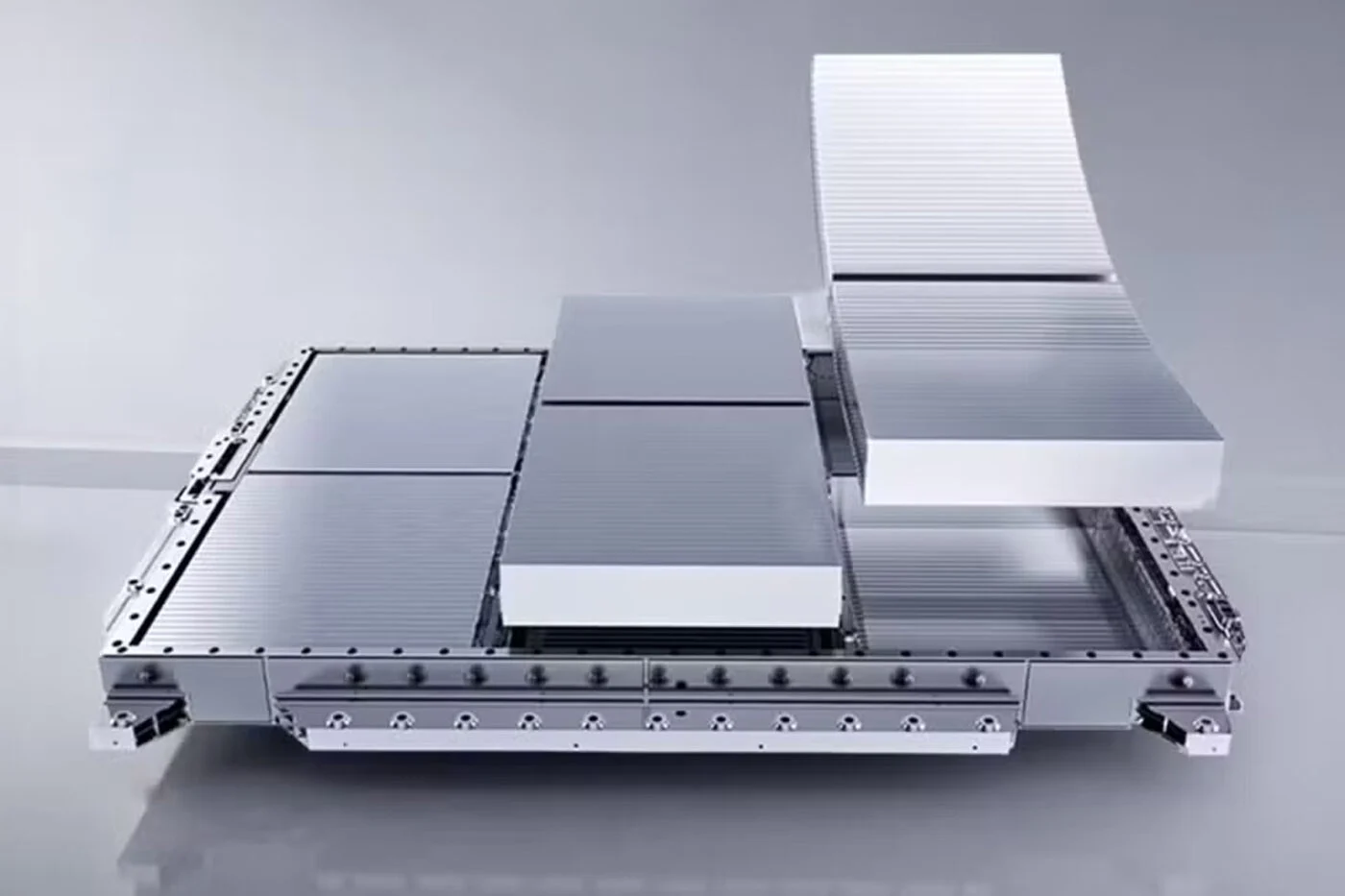
BYD's second-generation Blade Battery. The solid-state cells would eventually succeed it. Archive image. Credit: BYD, via electrive.
China's two battery giants now agree on a date. CATL told investors this week that it intends to begin small-scale production of its first solid-state cells in 2027. The target itself is old, but repeating it five months before 2027 starts reads as a company still on schedule. Days earlier, Chinese media reported that BYD plans pilot production of its dual-electrolyte solid-state cells in the same year. Neither company has named a month.
BYD backed its timeline with paperwork. Six newly published patents cover the hard part of solid-state design: keeping solid particles in contact with other solid particles. One filing adds an ion-conducting interlayer between halide and sulphide electrolytes to stop them reacting with each other. Another uses a solid electrolyte as a buffer between the cathode's active material and a sulphide electrolyte, with a thermal release limit of 117 joules per gram. Two more rework the cathode itself, one pairing monocrystalline and polycrystalline materials in a dual-layer structure, the other blending lithiated metal oxides and metal sulphides with electrolyte to cut interfacial resistance. The last two go to manufacturing: ionic-liquid wetting agents distributed in a gradient across the electrode, and a quality metric called "Re" that demands at least 60 percent of each cathode particle's perimeter touch electrolyte particles.
The realism check still comes from CATL's own CEO. Robin Zeng said in June that solid-state remains at level four of nine on the Technology Readiness Level scale and that he does not expect mass-market cells before 2030, with premium platforms first. Put this week next to the national solid-state standard covered here three weeks ago and the Factorial/SK On manufacturing MoU from last week, and the pattern is consistent: the technology is leaving the lab slowly, but the industrial machinery around it is being built now.
CATL's 350 Wh/kg aviation pack survives a double thermal runaway
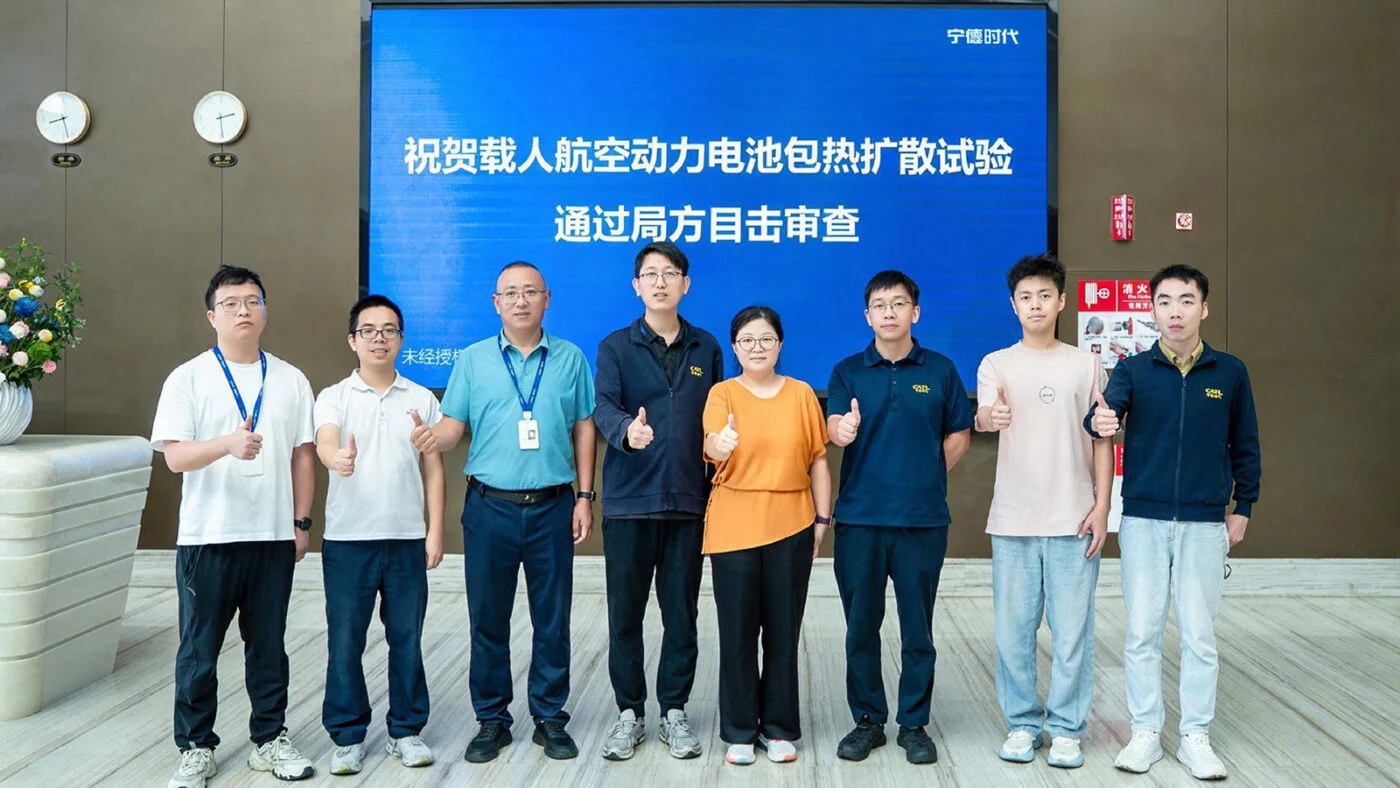
CATL's aviation battery system for passenger eVTOLs uses prismatic cells at 350 Wh/kg. Credit: CATL, via electrive.
CATL also had an aviation announcement, and the test protocol is the interesting part. Its new battery system for passenger eVTOLs uses prismatic cells at 350 Wh/kg, well above anything in a production car. To prove the pack can contain a failure, engineers deliberately triggered thermal runaway in two adjacent cells at the same time, once in the centre of the pack and once at the corners. In no test did the failure spread to other cells. Standard propagation tests trigger a single cell; doubling it raises the bar considerably. China's aviation authority CAAC was involved in manufacturing, inspection and testing.
CATL says the system is ready for series production, with eVTOL developer AutoFlight as the first customer. That relationship runs deeper than a supply deal: CATL put several hundred million dollars into AutoFlight as a strategic investor in 2024. Passing the test does not clear the pack to carry paying passengers, and more certification steps remain.
Why it matters for cars: aviation is where energy density and failure containment get pushed hardest, and the same containment engineering flows back down. A 350 Wh/kg prismatic cell that provably cannot propagate a two-cell failure is a data point for every pack designer, whether or not it ever flies.
Leaving cathode powder out in the air can halve a battery's life
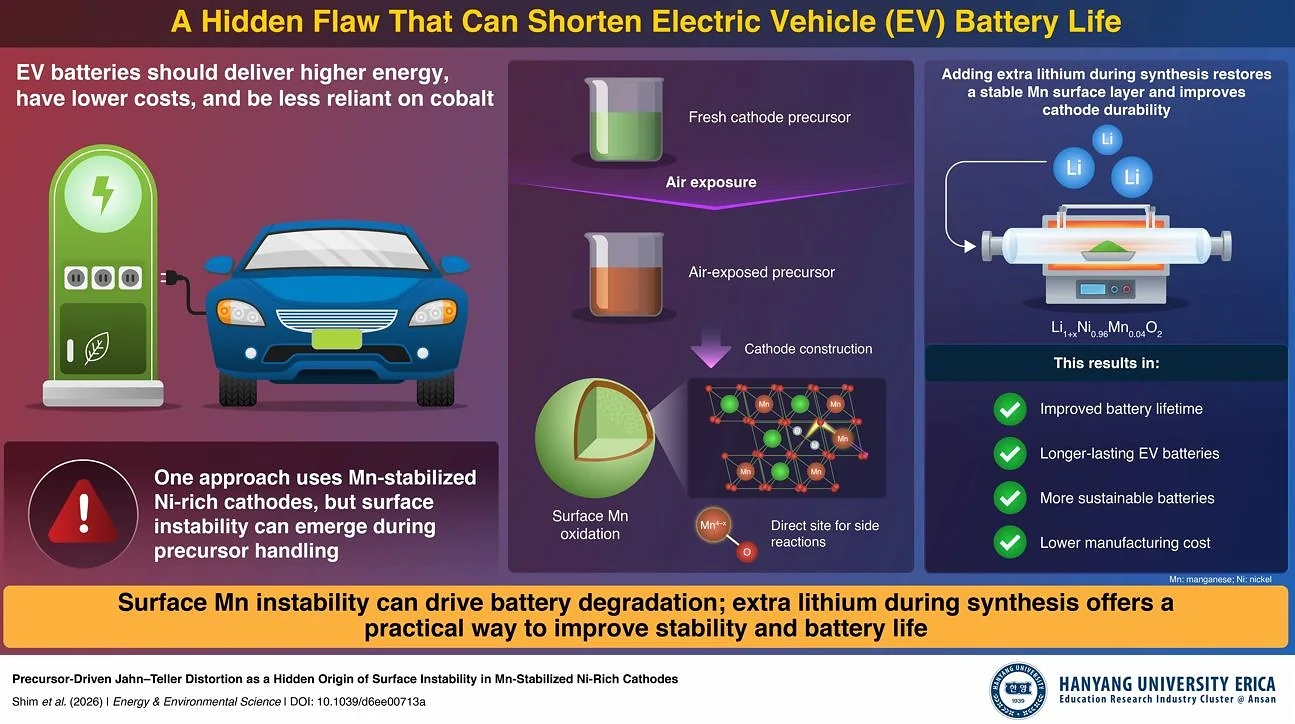
How air exposure creates a degradation catalyst in cobalt-free high-nickel cathodes. Research graphic, not a photo. Credit: Hanyang University, via electrive.
Researchers at Hanyang University in South Korea found a failure mode hiding in plain sight. They study cobalt-free cathodes built as a nickel-rich core with a manganese-rich protective shell, a leading candidate to replace today's high-nickel chemistries without the cobalt. The problem: storing the precursor powder in ordinary air oxidises manganese on the particle surface. That creates defective regions containing Jahn-Teller-distorted manganese species, which react aggressively with the electrolyte, dissolve transition metals and set off harmful reactions at the graphite anode. In long-term cycling, the effect nearly doubled capacity loss.
The twist is that the manganese shell exists to protect the cathode. "A manganese-rich shell, which is normally introduced to protect high-nickel cathodes, can instead become a catalyst for degradation if the precursor chemistry is not carefully controlled," said Prof. Bang. The fix is refreshingly cheap: raise the lithium content during synthesis. That suppresses the defective surface phase and restores a stable manganese-oxygen bond, and treated cathodes held over 90 percent of capacity in the same tests.
The finding does not touch the LFP and NMC packs in today's EVs. It is aimed at the next generation, and its practical message lands on the factory floor rather than the lab bench: for these chemistries, how long a bag of precursor sat in humid air becomes a spec, the same way moisture control already is for electrode coating.
EVgo will run Tesla V4 Superchargers under its own brand
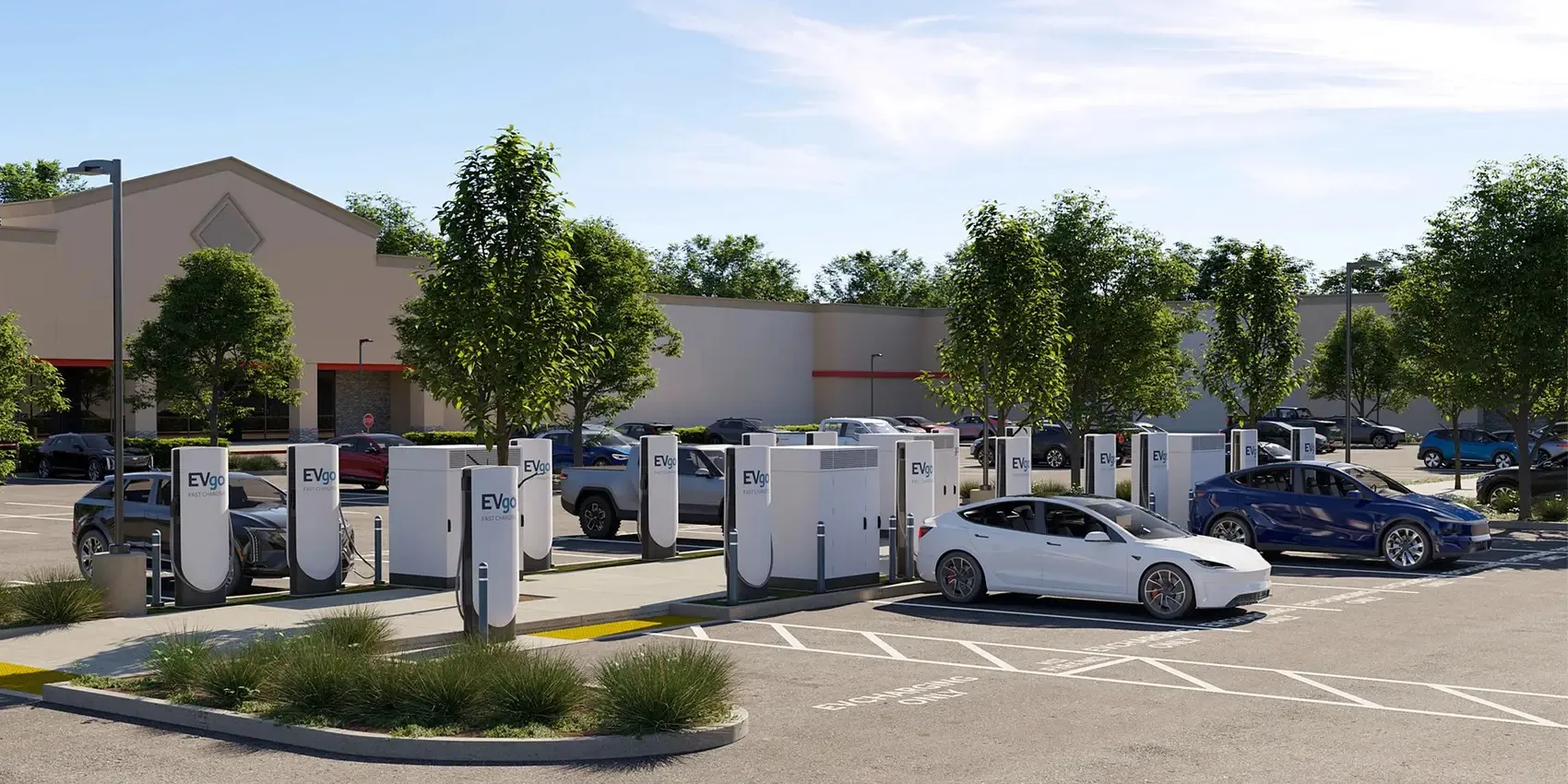
EVgo Superchargers pair Tesla V4 hardware with EVgo branding. Rendering, not a photo. Credit: EVgo, via Electrek.
EVgo signed on to Tesla's Supercharger for Business program and will deploy hundreds of Tesla V4 Superchargers across US cities as "EVgo Superchargers," owned and operated by EVgo. Construction starts this fall, first sites open in the second half of 2026, and each location runs up to 20 stalls sited near stores and restaurants. The hardware delivers up to 500 kW across 400 to 1,000-volt vehicle architectures, enough to add roughly 200 miles of range in 15 minutes on a car that can take it.
Two details make this more than a hardware order. Every stall gets Tesla's Magic Dock, so NACS and CCS vehicles both charge with no adapter. And the sites appear inside Tesla's in-car navigation and Trip Planner, which routes the millions of US Teslas to a third-party network for the first time at this scale. EVgo says network demand has grown more than 700 percent in three years and that it had 240 NACS connectors operating as of July 31, with more than 35 NACS-equipped models expected in the US by year end.
Three weeks ago this briefing covered IONNA, the automaker-owned consortium building its own dual-connector network. Now the largest independent operator is buying its hardware from Tesla itself. The connector war ended; the buildout race is being run with the winner's equipment.
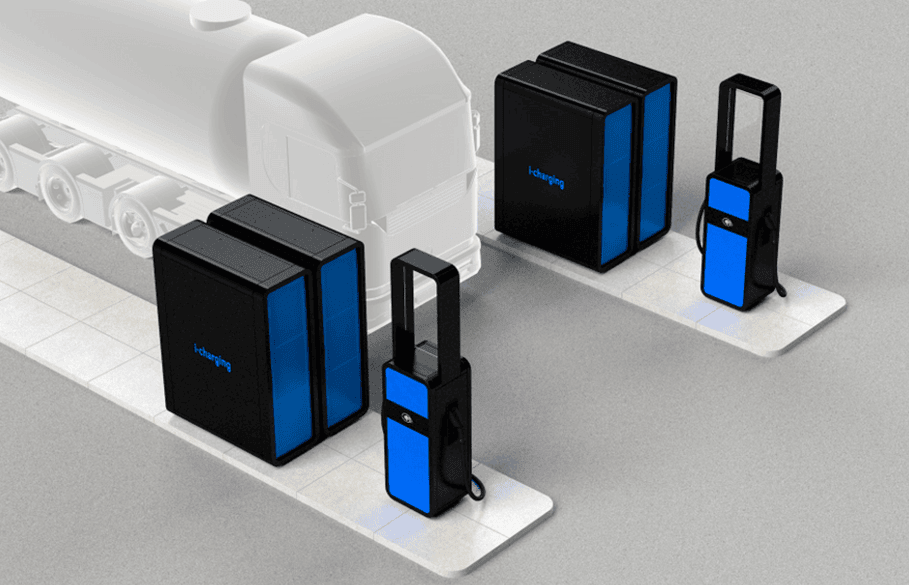
i-charging's 1.5 MW charger is now certified for North America
The i-light delivers up to 1.5 MW over MCS or 800 kW over CCS. Product image. Credit: i-charging, via Charged EVs.
Two weeks ago this briefing covered i-charging's 1.6 MW MAX platform entering commercial delivery in Europe. This week the company cleared the paperwork hurdle on this side of the Atlantic: its i-light charger earned Intertek ETL certification, confirming compliance with UL 2202, UL 2231 and CSA C22.2 No. 346, the electrical safety standards US and Canadian authorities require for high-power DC equipment.
The i-light is built for medium and heavy-duty vehicles. It delivers up to 1.5 MW per output over MCS, the Megawatt Charging System standard, or up to 800 kW over CCS, and carries a 37-inch transparent display sized to be read from a truck cab. "Fleet operators demand charging infrastructure that meets the mission-critical duty cycles of the medium- and heavy-duty EVs on the road today, and is ready for MCS as the standard matures," said Jeff Cohen, CEO of i-charging USA, which is headquartered in Atlanta.
Certification is unglamorous news, but it is the actual gate. Megawatt hardware has existed for a while; ETL listing is what lets a US fleet depot legally install it. With Dongfeng's 1.5 MW prototype covered last week, megawatt charging now has certified hardware moving in both the Chinese and North American markets.
California turns on $3,500 instant rebates for first-time EV buyers
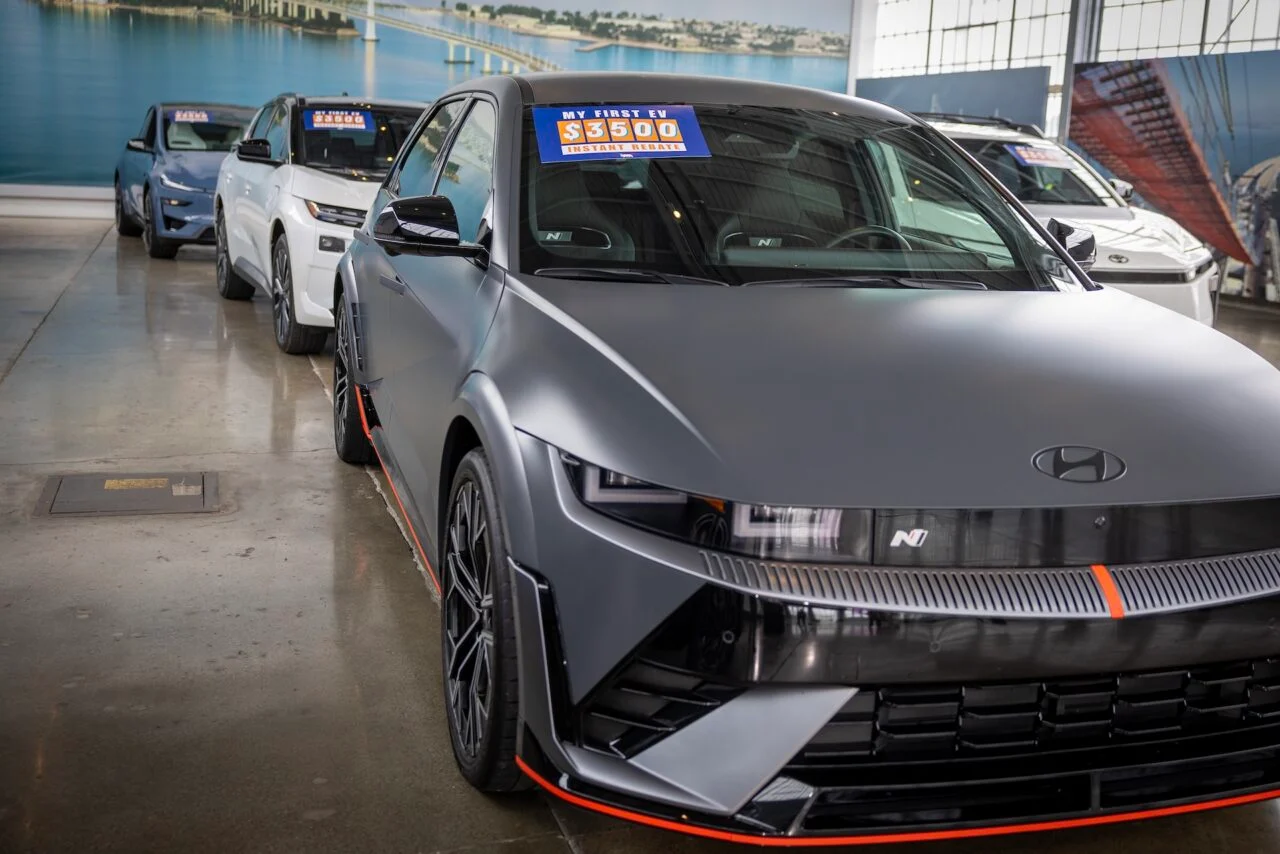
MyFirstEV applies the rebate at the point of sale rather than as a claim afterward. Credit: California State, via electrive.
California's MyFirstEV program went live. Any California resident buying or leasing their first zero-emission vehicle gets $3,500 off a new one or $1,750 off a used one, applied at the point of sale instead of claimed months later. New vehicles qualify up to a $50,000 MSRP; used ones cap at $25,000 and must come through a manufacturer's pre-owned program. The state is putting in $135.5 million, and participating manufacturers match it dollar for dollar, so the pot totals $271 million.
The rollout is staged by manufacturer. Hyundai, Lucid and Tesla are in from launch. Ford, Rivian, Chevrolet and Kia join in August; Toyota/Lexus, Honda and Subaru follow in September, with Mitsubishi in November and Nissan and Volvo undated. The design is worth watching: making the automaker co-fund and deliver the discount at the register avoids both the rebate-processing lag and the dealer-markup capture that dogged earlier programs.
The context is the vacuum left by the federal $7,500 credit's demise. California is testing whether a half-sized, first-buyer-only, matched-funding incentive can keep adoption moving in the largest US EV market, where transportation still produces 60 percent of smog-forming pollution and 40 percent of greenhouse gas emissions.