EV Technology Briefing — compiled and curated by Chris Lee
Zoox gets the first paid-robotaxi exemption, and China charges a battery in under four minutes
Week of July 28 – August 4, 2026
Six stories this week, and the regulatory thread from the last two briefings pays off. NHTSA granted Zoox the exemption it had been waiting on, the first ever for a purpose-built robotaxi carrying paying passengers. In China, Hongqi demonstrated a 12C battery that goes from 10 to 70 percent in under four minutes, and Dongfeng answered with a 1.5 MW charger plus a kilovolt-class SiC drive unit. Factorial and SK On want to make solid-state cells on existing lithium-ion lines, Hyundai is folding its V2G work into one global brand, and the EU opened the application window on €1.5 billion in interest-free battery loans.
Autonomy & Regulation
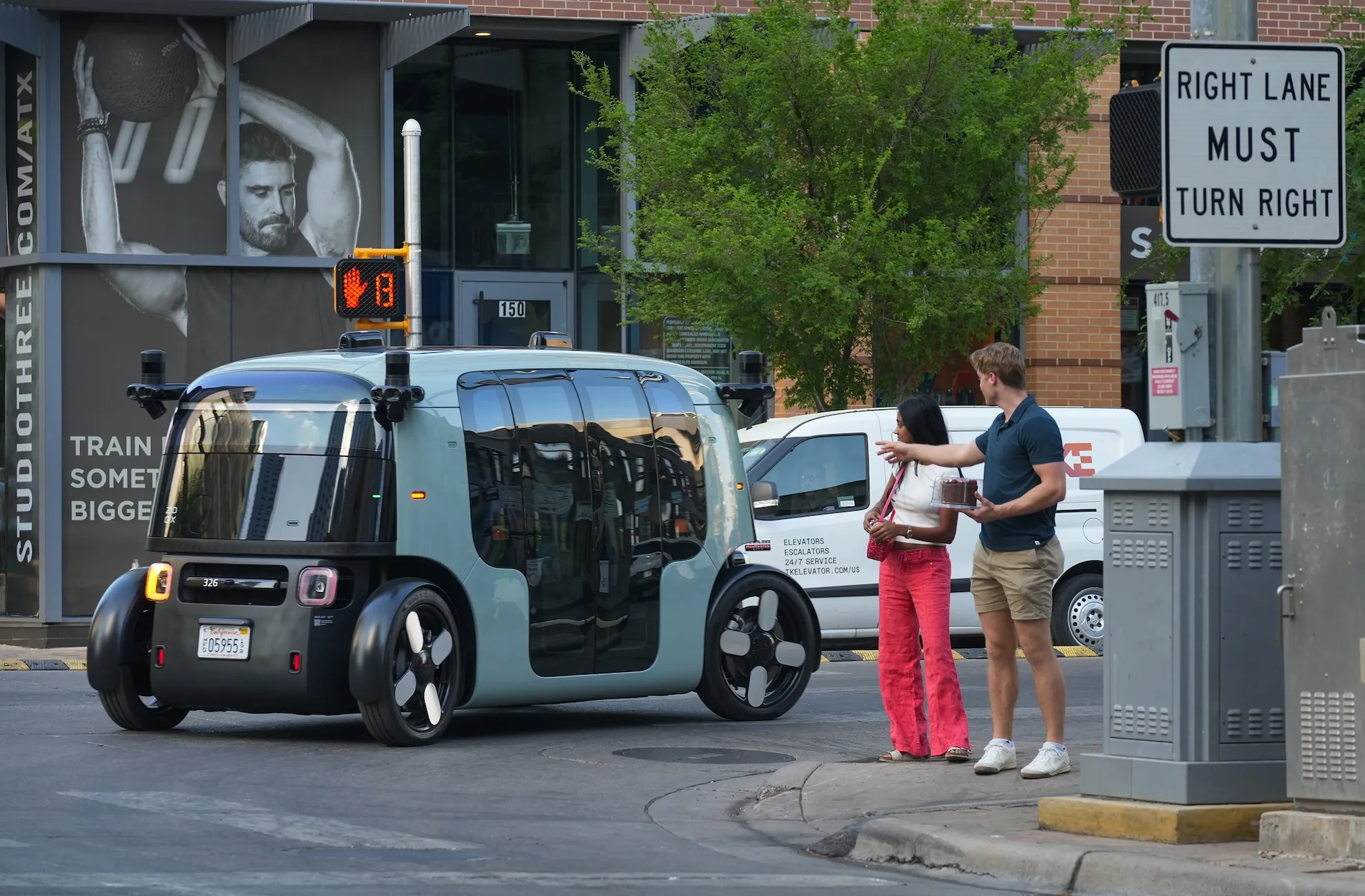
Zoox clears the last federal hurdle: paid rides in a robotaxi with no steering wheel
Zoox's carriage-style robotaxi has no driver's seat, steering wheel, or pedals. Credit: Jay Janner / The Austin American-Statesman via Getty Images, via TechCrunch.
Two briefings ago, NHTSA was ordering robotaxi developers to fix emergency-scene behavior. Last week it proposed deleting the brake-pedal requirement, and we noted that Zoox "took the exemption route and is still waiting on its commercial ruling." On July 30 the ruling landed. NHTSA granted the Amazon-owned company a temporary exemption from eight federal motor vehicle safety standards, including windshield defrosting and light-vehicle braking, and with it the first-ever permission to charge passengers for rides in a purpose-built robotaxi. The decision is published in the Federal Register.
The guardrails are real. Zoox is capped at 2,500 commercial vehicles per year for two years, under what the agency calls an "enhanced, adaptable oversight structure that can evolve as Zoox's technology advances." Paid service starts in Las Vegas. California, where Zoox is headquartered and already gives free rides, still requires driverless deployment permits from the CPUC and DMV. CEO Aicha Evans called it "the first-ever commercial exemption for a purpose-built robotaxi from NHTSA."
The same Thursday, NHTSA announced an updated exemption process that lets automakers temporarily sell limited numbers of non-compliant vehicles to test new technology, plus a three-year, $5 million consortium with SAE Industry Technologies Consortia to gather data toward a single national AV performance standard. It is also reviewing an exemption application from delivery-robot startup Robomart. Put next to last week's FMVSS 135 proposal, the direction is consistent: fewer design mandates tied to a human driver, more behavioral oversight, and a permanent certification path being built while exemptions bridge the gap.
Hongqi's 12C cell: 10 to 70 percent in 3 minutes 41 seconds
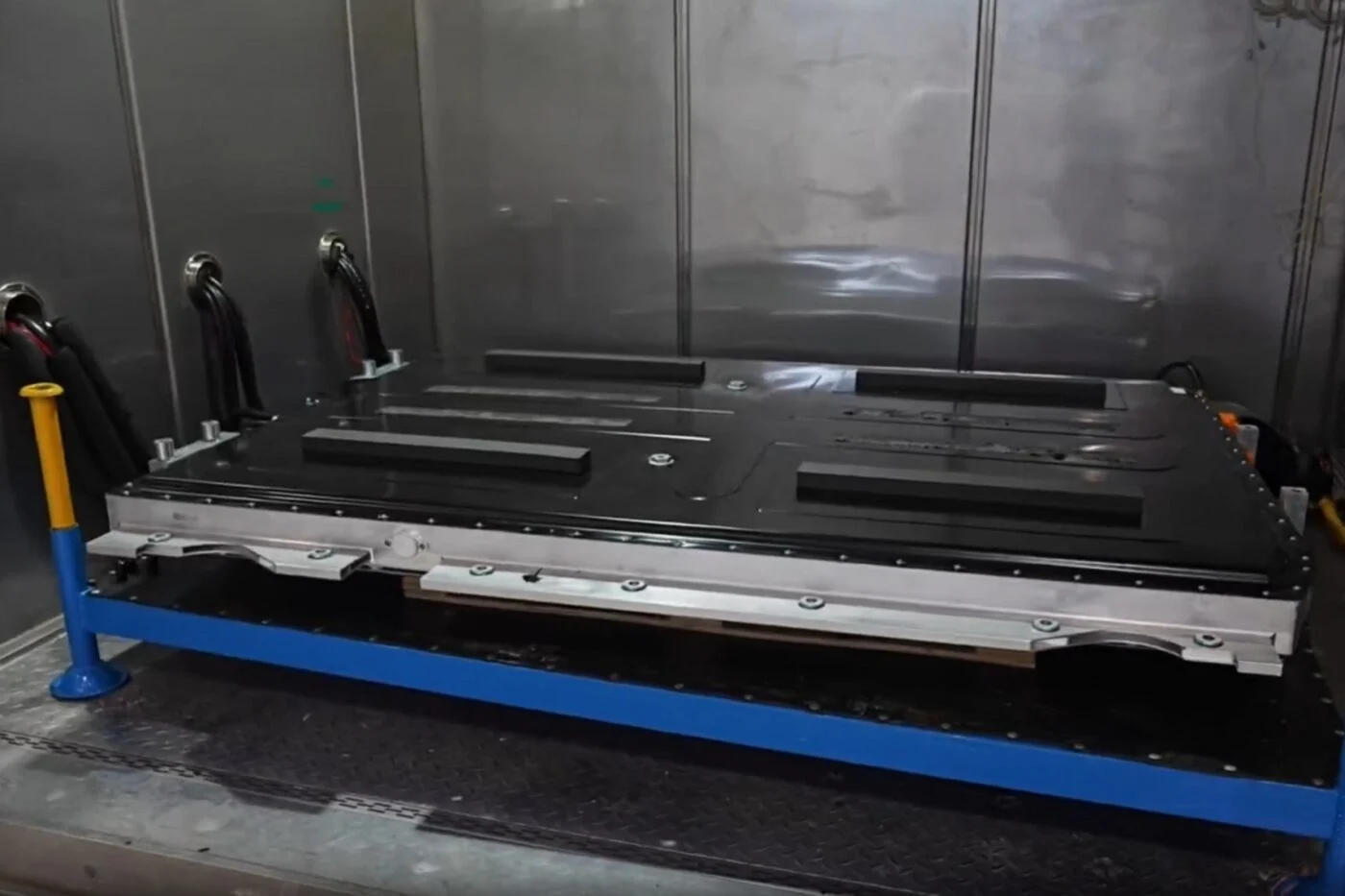
Hongqi's 12C pack, developed with Lishen Battery and FAW's cell subsidiary. Credit: FAW Hongqi, via electrive.
The flash-charging arms race in China found a new front-runner. Hongqi, FAW's premium brand, completed performance tests on a battery with a peak charging rate of 12C, twelve times its nominal capacity. The prototype went from 10 to 70 percent state of charge in 3 minutes 41 seconds, and from 10 to 97 percent in 8 minutes 3 seconds at 25°C. That beats the second-generation BYD Blade Battery, the current production benchmark, which needs about five minutes for the same 10-to-70 sprint. The cell was developed with Lishen Battery and FAW's own cell subsidiary, China Automotive New Energy Battery Technology.
The engineering recipe is a stack of incremental gains rather than one trick. A new anode is paired with an electrolyte formulated for faster lithium-ion transport, then a carbon-swelling coating and bulk doping cut the cell's internal resistance 15 percent against conventional cells of the same chemistry. The thermal problem that 12C creates is handled by a liquid cooling system that holds the temperature spread across the whole pack within three degrees Celsius during charging, with an adaptive control loop watching cell temperature rise in real time and reshaping the power curve to prevent overcharge.
FAW has not said when the technology reaches a production car, which is the usual caveat with test-bench records. The trajectory is the story: BYD's 10-to-70 in five minutes was the headline in March, and it took four months for a competitor to demonstrate a figure a minute and a half faster.
Dongfeng shows a 1.5 MW charger and a kilovolt SiC drive to plug into it
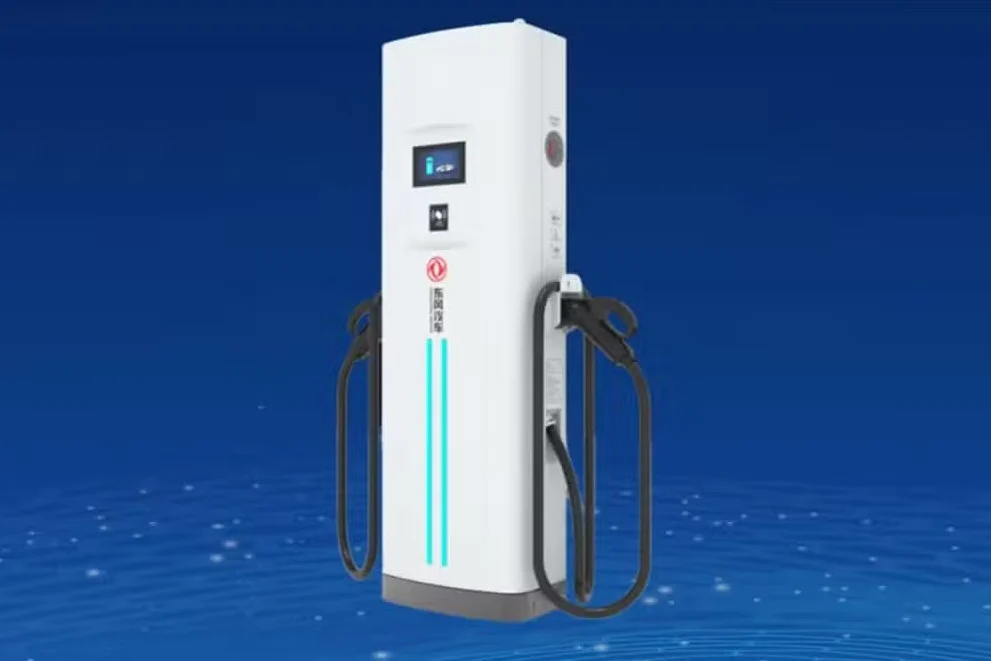
Dongfeng's prototype delivers up to 1.5 MW through a single connector. Credit: Dongfeng, via electrive.
A battery that accepts 12C needs a charger that can feed it, and Dongfeng showed one the next day. Its prototype system delivers up to 1.5 MW per connector, built around a 1.2 MW main unit with flexible power cabinets that extend total output to 2.4 MW and beyond. A single connector carries a peak current of 1,500 A across 150 to 1,000 volts at a system efficiency of at least 96.7 percent, which Dongfeng says puts it in the first batch of Level 1 products under China's new GB 46519-2025 charger efficiency standard. A portfolio spanning 720 kW to 2.4 MW is planned, along with a next-generation unit with integrated storage. Last week's briefing covered i-charging's 1.6 MW MAX entering commercial delivery in Europe; Dongfeng's entry says China's automakers intend to own that class of hardware themselves.
The more interesting half of the announcement sits on the vehicle side. The iD5-300SN is Dongfeng's first kilovolt-class electric drive, built on a 1,500 V-rated silicon carbide power module. It operates from 450 to 1,000 volts, delivers a peak 300 kW, and claims 30 percent higher power density than its predecessor. It drops into today's 800 V platforms and extends to future systems running up to 1,200 V, which is exactly the headroom a 1,000 V charging connector implies. The drive goes into Dongfeng's Mach powertrain family and the first vehicle from Epicland, the brand it is developing with Huawei.
Megawatt cabinets, kilovolt drives, and cells rated for 12C are three parts of one system. This week all three showed up at once, from three different Chinese manufacturers.
Factorial and SK On ask the practical question: can old lines make new cells?
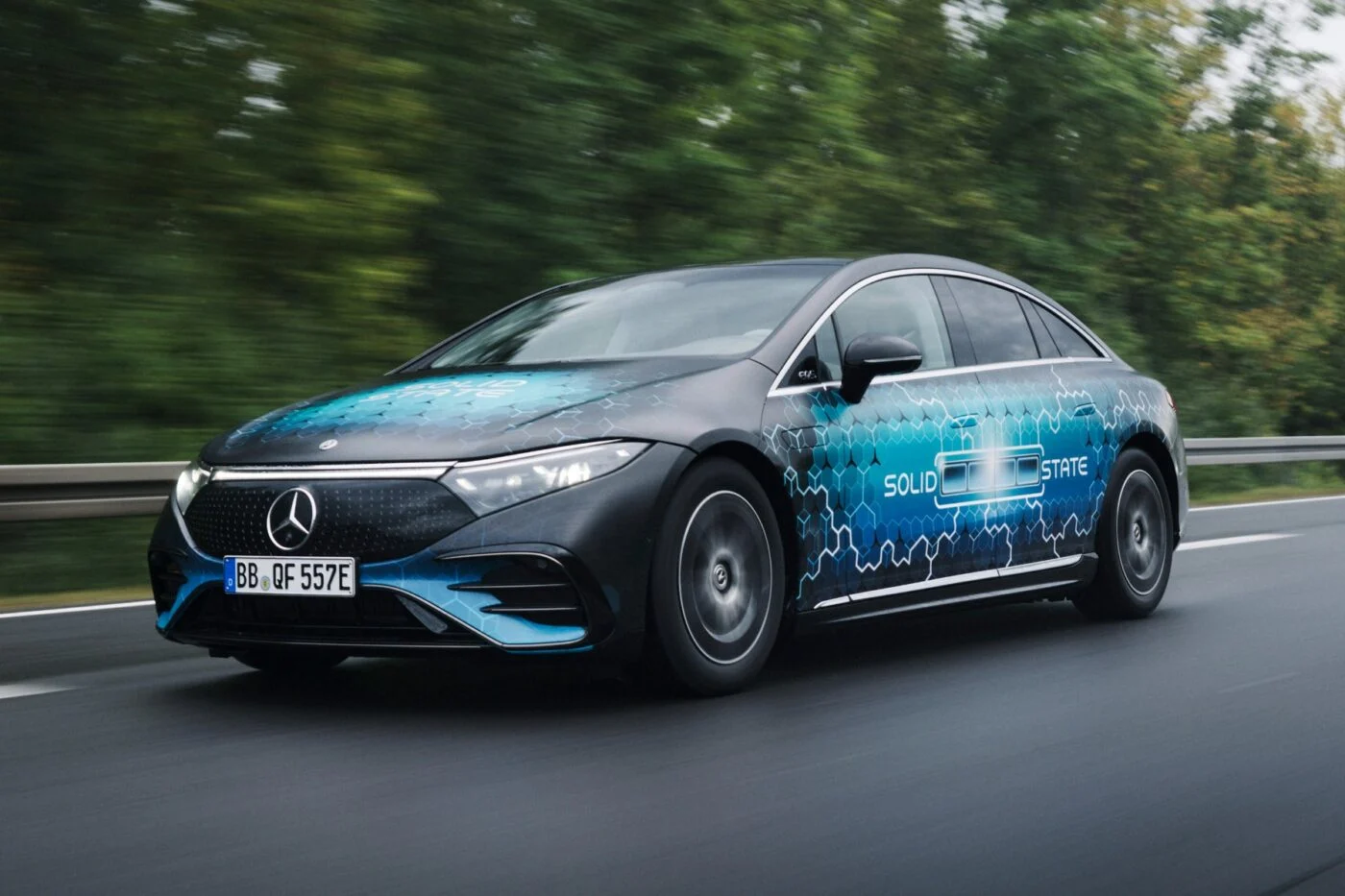
A Mercedes-Benz EQS already road-testing Factorial's solid-state cells. Credit: Mercedes-Benz, via electrive.
Factorial Energy and SK On signed a memorandum of understanding on July 29 to evaluate whether Factorial's FEST solid-state cells can be manufactured on SK On's existing lithium-ion production lines. SK On brings more than 200 GWh of annual capacity worldwide, roughly 100 GWh of it in the US, and an automotive customer list that includes Hyundai Motor Group, Ford, Volkswagen, and Ferrari. Factorial brings cells that are already in road-test vehicles: Mercedes-Benz has an EQS running them, and Stellantis put its high-energy cells in a Dodge demonstrator this June.
Factorial CEO Siyu Huang compressed the thesis into one line: "A battery breakthrough only matters if it can be manufactured at scale." The bet is capital efficiency. Purpose-built solid-state gigafactories cost billions and take years, and China's state-backed plants are already racing ahead under the national standard covered here two weeks ago. If FEST cells can run down a brownfield lithium-ion line with modest retooling, the technology gets a path to volume that skips the factory-construction step entirely. If they cannot, that finding matters just as much, since it would confirm solid-state needs its own dedicated production base.
Worth tracking alongside: Factorial took investment earlier this year from IQT, the CIA-backed strategic investor, aimed at drones and robotics, where solid-state's low-temperature and high-power behavior carries a premium.
Hyundai puts smart charging, V2G, and V2H under one roof: AllDayEnergy
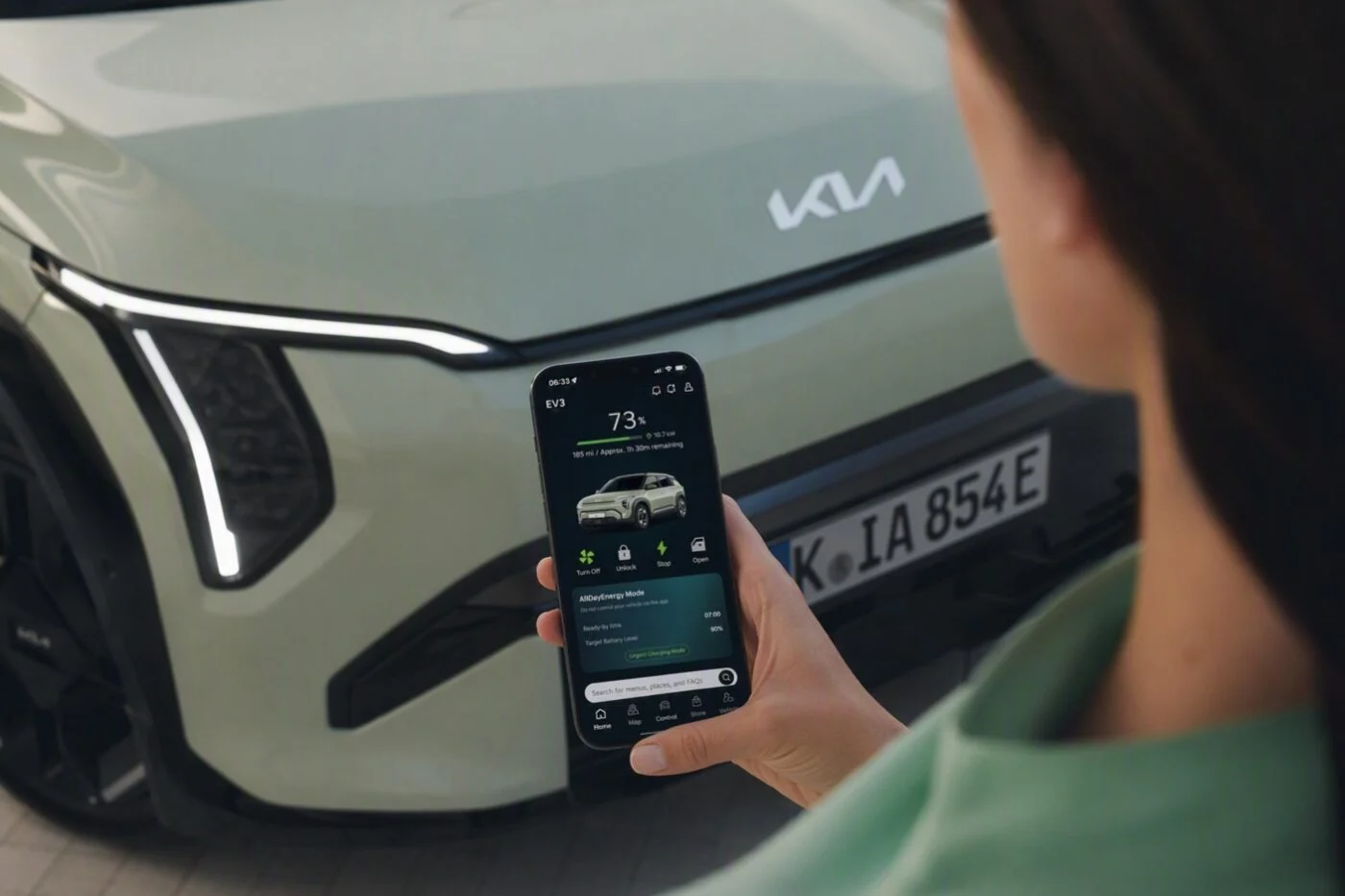
AllDayEnergy covers V1G smart charging, V2G, and V2H across Hyundai, Kia, and Genesis. Brand graphic, not a photo. Credit: Kia, via electrive.
Hyundai Motor Group is consolidating its scattered energy pilots into a single global brand. AllDayEnergy will carry three service tiers across Hyundai, Kia, and Genesis: V1G smart charging that shifts charging times against real-time tariffs and grid load, V2G feed-in to the public grid, and V2H home backup. Phase one launches in the UK in the second half of 2026 through the Kia app, with continental Europe, the US, and Korea to follow. Bidirectional service arrives in the later phases.
The group is not starting cold. It has a large V2G trial running on Jeju island, V2H emergency-power tests in the US during wildfire events, and years of dynamic-tariff charging data from a project in Utrecht. The notable design choice is distribution: the services live inside the existing Hyundai and Kia vehicle apps rather than a third-party aggregator's platform.
Last week's briefing covered National Grid and Eversource paying New England EV owners roughly $1,250 a year through an aggregator, with only five eligible vehicle models. An OEM shipping V2G as a native software feature attacks that eligibility bottleneck from the other side. When the automaker owns the interface, the utility program plugs into the car instead of the reverse.
The EU opens its €1.5 billion 'Battery Booster' window
Cell production at PowerCo's Salzgitter plant, a likely qualifier for the program. Symbolic image. Credit: PowerCo, via electrive.
The European Commission published the call for proposals under its Battery Booster Facility on July 28, opening applications through September 30. The program offers interest-free loans totaling up to €1.5 billion for EV battery cell production in the European Economic Area, covering up to 60 percent of eligible costs with a €500 million ceiling per project.
The eligibility rules are written narrowly. A project must be in its start-up phase, must be the applicant's first global large-scale commercial cell production effort for EVs, and must plan at least 10 GWh of annual capacity. That filters out established Asian cell makers expanding into Europe and points the money at the continent's own first-generation champions: ACC (backed by Stellantis, Mercedes-Benz, and TotalEnergies), Verkor (Renault among its investors), and VW's PowerCo are the plants that fit the description.
The context is the same one driving the GAO's recycling report covered last week: Western battery policy is shifting from subsidizing demand to underwriting the industrial base itself, and interest-free debt for factories in ramp-up is about as direct as that gets.