EV Technology Briefing — compiled and curated by Chris Lee
Robotaxis lose the brake pedal, recycling gets a federal endorsement, and megawatt charging ships
Week of July 21–28, 2026
Five stories this week. The comment window just closed on a federal rule that would let purpose-built robotaxis skip the brake pedal entirely, the first structural rewrite of a safety standard for vehicles with no driver. The GAO put numbers on how fast battery recycling could cut mineral imports. A 1.6 MW charger started rolling off a production line in Portugal, New England utilities started paying EV owners for their electrons, and a new family of SiC modules aims at the transformer itself.
Autonomy & Regulation
The brake-pedal mandate heads for the exit, and the robotaxi production cap goes with it
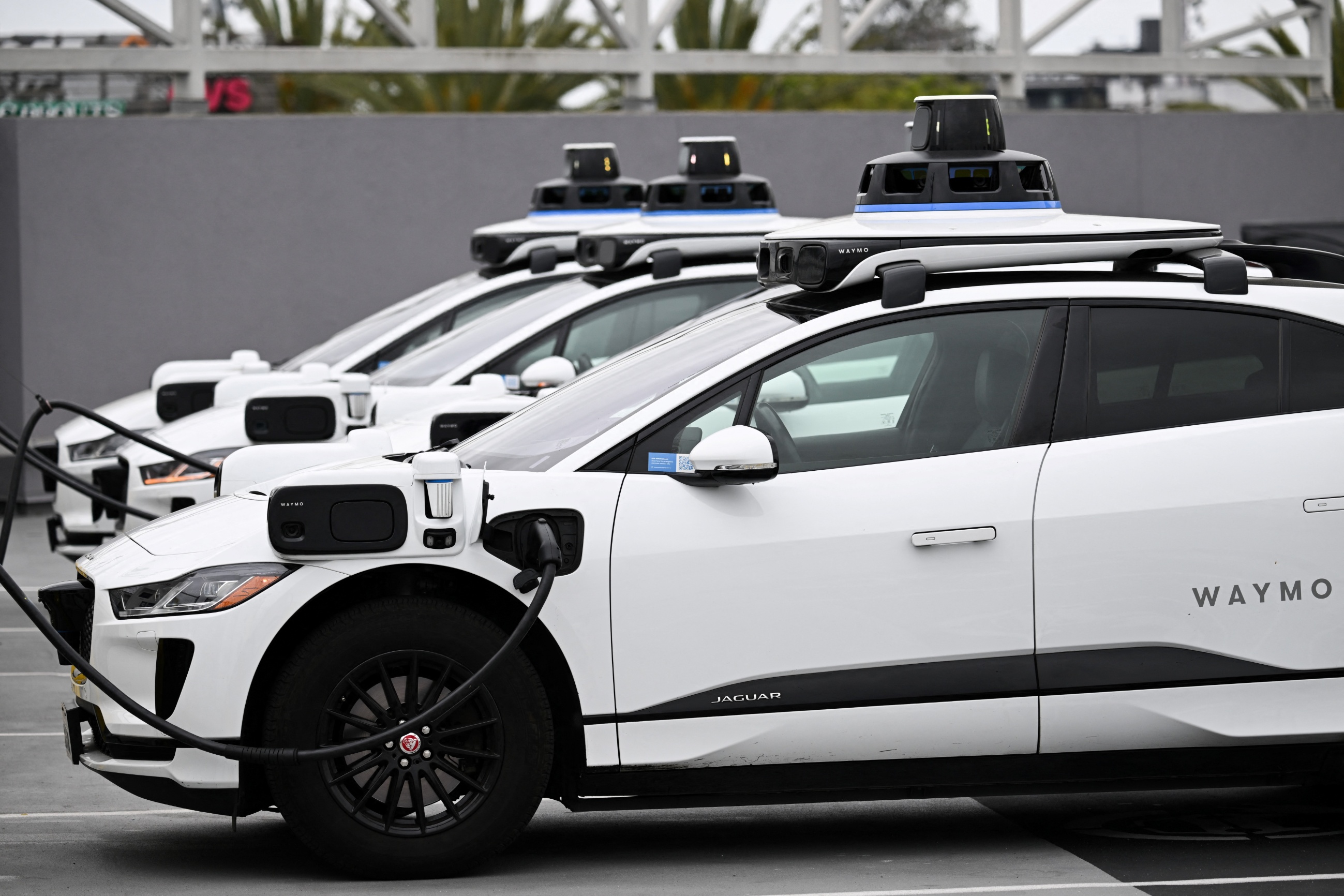
A Waymo autonomous Jaguar at an EVgo charging station in Los Angeles. Credit: Patrick T. Fallon / AFP via Getty Images, via Tech Times.
Last week's briefing led with NHTSA telling robotaxi developers to fix emergency-scene detection by the end of July. This week the other half of the agency's bargain came due. The public comment period on docket NHTSA-2026-0728 closed July 27. It is a proposed amendment to Federal Motor Vehicle Safety Standard No. 135, the light-vehicle brake rule that has required a foot-operated pedal since 1995, and it would remove that requirement for vehicles designed exclusively for automated driving. Stopping-distance requirements stay exactly as they are. The test just starts its clock from the electronic brake command instead of a pedal press.
The engineering change is small. The industrial change is not. Today a pedal-free vehicle can only reach public roads through a Part 555 exemption, capped at 2,500 vehicles per manufacturer per year. Tesla engineered the Cybercab to self-certify under the rules as written and escaped the cap. Zoox took the exemption route and is still waiting on its commercial ruling with the ceiling intact. A finalized rule would give every purpose-built design a permanent certification path with no cap and no petition. NHTSA has even asked whether the rule could take effect immediately on publication, since it removes requirements rather than adding them.
The same day it published the proposal, NHTSA withdrew AV STEP, the voluntary transparency program floated in January 2025. The trade is explicit: fewer design mandates, more scrutiny of real-world behavior, with a performance-based framework targeted for 2028. The open question the rule dodges is the one a passenger would ask first. How do you tell a car with no pedals to stop? NHTSA is "taking no position at this time," leaving that interface to each manufacturer until the behavioral standards arrive.
GAO: battery recycling could cut U.S. mineral imports in two to three years
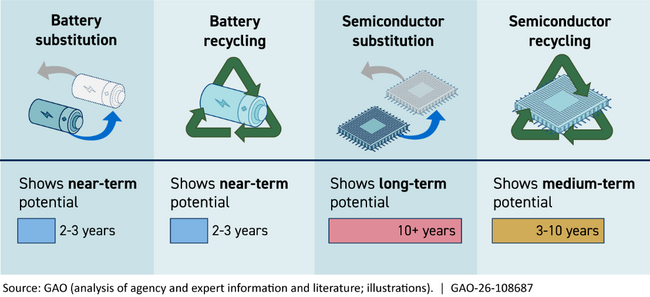
The GAO's read on which technologies can cut mineral-import reliance, and when. Chart, not a photo. Credit: U.S. Government Accountability Office.
The Government Accountability Office released a technology assessment on July 22 asking a blunt question: which technologies could actually reduce U.S. reliance on imported critical minerals, and how soon? For batteries, the answer is unusually near-term. GAO found that recycling technologies, chemical leaching and smelting that recover minerals at high rates, are already mature and offer a path to cutting imports of copper, cobalt, lithium, and nickel within two to three years. Substitution helps too: shifting stationary grid storage to lithium iron phosphate cells would trim cobalt, manganese, and nickel demand on the same timeline.
The bottleneck is not chemistry, it is logistics. Experts told GAO that U.S. recyclers lack capacity, and the feedstock that should feed them, manufacturing scrap and end-of-life packs, is routinely landfilled or exported for processing overseas. The report lays out four policy options: build domestic manufacturing capacity for viable substitutes, build domestic recycling capacity, secure collection and transport of recycling inputs, and keep funding research. Semiconductors got a much colder read. Gallium and indium substitutes are years from matching current materials, so recycling and substitution will not dent chip-mineral imports any time soon.
For the EV supply chain, the report is a federal endorsement of an argument recyclers have been making for years: the fastest new mine in America is the pack that already exists.
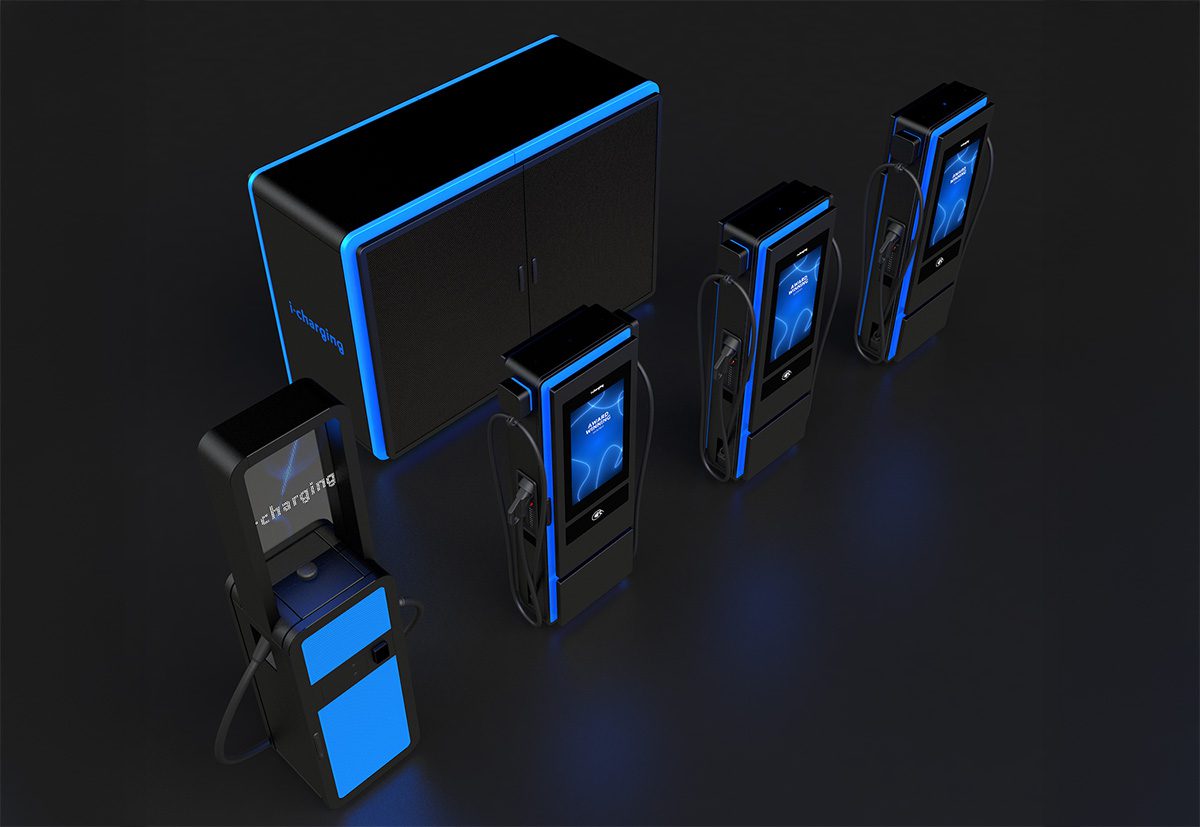
The MAX platform scales from 50 kW to 1.6 MW in a single cabinet. Credit: i-charging, via Charged EVs.
Megawatt charging keeps moving from spec sheet to loading dock. Portuguese charging manufacturer i-charging has begun commercial deliveries of MAX, a heavy-duty charging platform that scales from 50 kW to 1.6 MW within a single cabinet. The first systems left the factory at the end of June and are being installed at customer sites in Portugal now. The platform is built on SOLUM's EV Power Module, runs up to 32 modules in parallel, and is the first commercial product of the two companies' partnership.
The connector story is the notable part for anyone tracking standards. MAX supports CCS, NACS, China's GB/T, and the new Megawatt Charging System in one platform, which is close to the whole global connector map in a single cabinet. Dynamic power allocation spreads the available power in real time across up to eight vehicles at once, adapting to what each vehicle asks for, so a depot can serve a mixed fleet without dedicating a full megawatt to any one stall.
Europe is the proving ground here. Electric trucks, fleet depots, and public hubs are pulling demand toward exactly this class of hardware, and MCS-capable equipment reaching commercial delivery, rather than pilot demos, is the milestone that matters.
New England utilities start paying EV owners to be power plants
EVs at charging stations. Teslas, notably, are not eligible for the New England pilot. Credit: Mario Tama / Getty Images, via The Boston Globe.
National Grid and Eversource have launched a vehicle-to-grid test in New England, working with German aggregator The Mobility House and with Sunrun handling home equipment installs. The pitch to EV owners is direct: let the utility draw from your parked car's battery during demand peaks, get recharged off-peak, and get paid. National Grid estimates a typical participant will earn about $1,250 a year, and the program hands out free bidirectional chargers, hardware that otherwise runs $5,000 to $10,000. Applications stay open through September 30.
The concept has already earned its keep locally. A single electric school bus in Beverly, Massachusetts generated more than $23,000 selling power back to National Grid over two years, and a $50 million federal grant has since put two-way chargers on electric school buses in Boston and four other communities. The economics mirror ConnectedSolutions, the regional program that pays home-battery owners $1,000 to $4,000 a year for the same peak-shaving service. EVs are the bigger prize because Massachusetts alone has more than 150,000 of them, each carrying several times the capacity of a wall battery.
The constraint is the car side. Only five consumer vehicles qualify: the Nissan Leaf, Kia EV9, Polestar 3, Volvo EX90, and Ford F-150 Lightning. No Tesla is eligible; the Cybertruck can push power, but through an incompatible scheme. About 45 households have signed up so far, which makes this a data-gathering exercise more than a virtual power plant. The point is to have the playbook ready when bidirectional hardware becomes standard equipment.
WeEn's new SiC modules go after the transformer, not the car
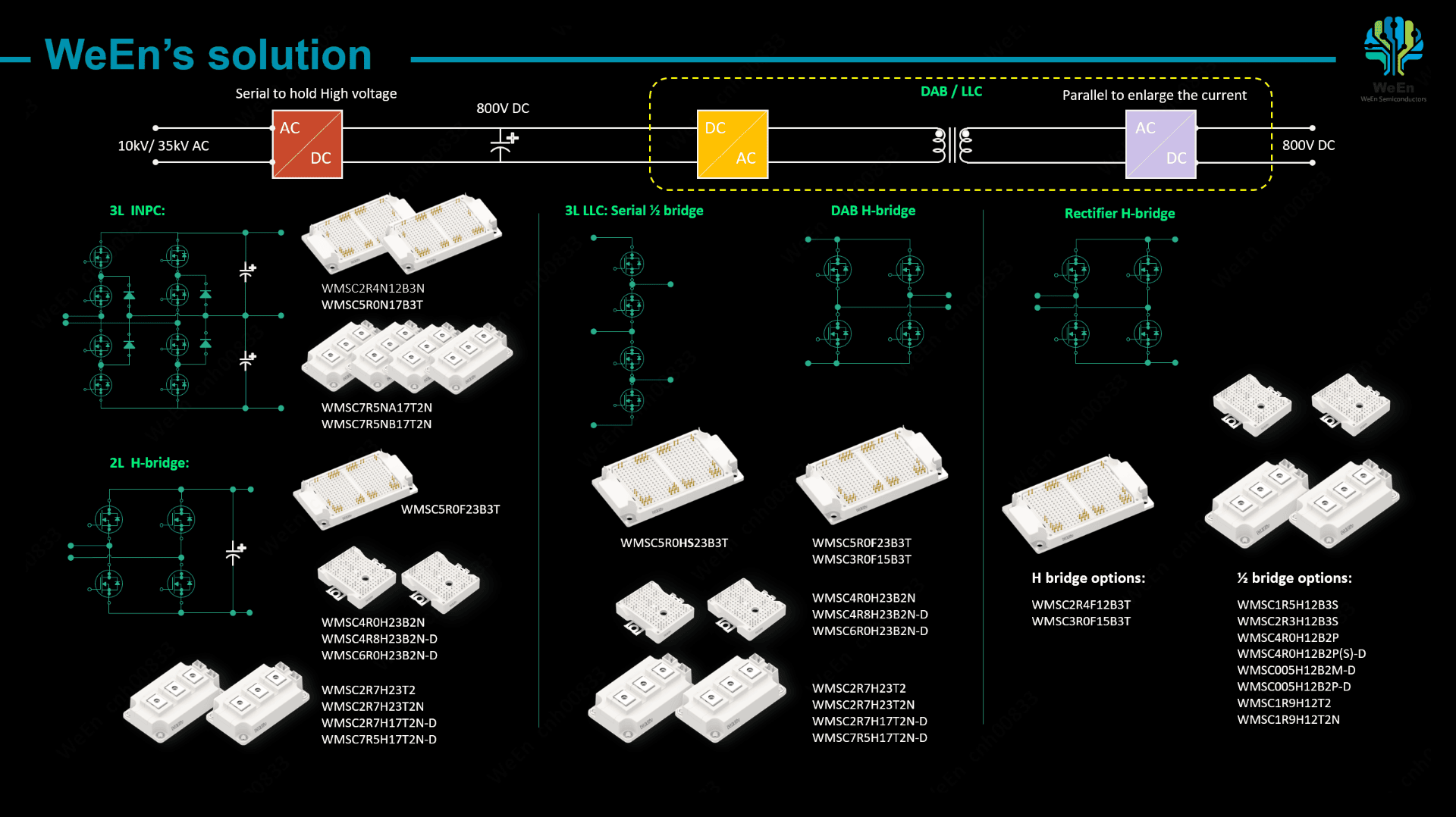
The WMSC family spans 1,200 V to 2,300 V across more than 20 modules. Credit: WeEn Semiconductors, via Charged EVs.
WeEn Semiconductors launched the WMSC family, more than 20 silicon carbide power modules covering AC-DC and DC-DC conversion at ratings from 1,200 V to 2,300 V, with on-resistance figures as low as 1.5 mΩ. The target applications are solid-state transformers, EV chargers, smart grid, and renewables, which puts these parts one layer upstream of the SiC conversation that usually centers on traction inverters.
That upstream layer is where the megawatt-charging math gets decided. A solid-state transformer replaces the big line-frequency iron transformer with high-frequency SiC switching, converting medium-voltage AC to the DC a charging site actually distributes, in a fraction of the footprint and with power routing a passive transformer cannot do. The 2,300 V rating is the tell: that class of device is meant to sit on medium-voltage distribution directly, not behind it.
Put this next to the i-charging story above and the shape of the next-generation charging site is visible. Megawatt cabinets on the dispenser side, solid-state transformers on the grid side, and SiC doing the switching at both ends.