EV Technology Briefing — compiled and curated by Chris Lee
Solid-state gets a rulebook, dendrites give up a secret, and the feds put robotaxis on the clock
Week of July 15–22, 2026
Six stories this week, and the through-line is maturation. China wrote the first legal definition of what counts as a solid-state battery. A German lab finally explained why those batteries crack. Regulators leaned on self-driving cars, and the U.S. fast-charging map filled in a little more. Here is what moved, and why the engineering matters.
Autonomy & ADAS
The feds tell every robotaxi maker to fix emergency-scene detection
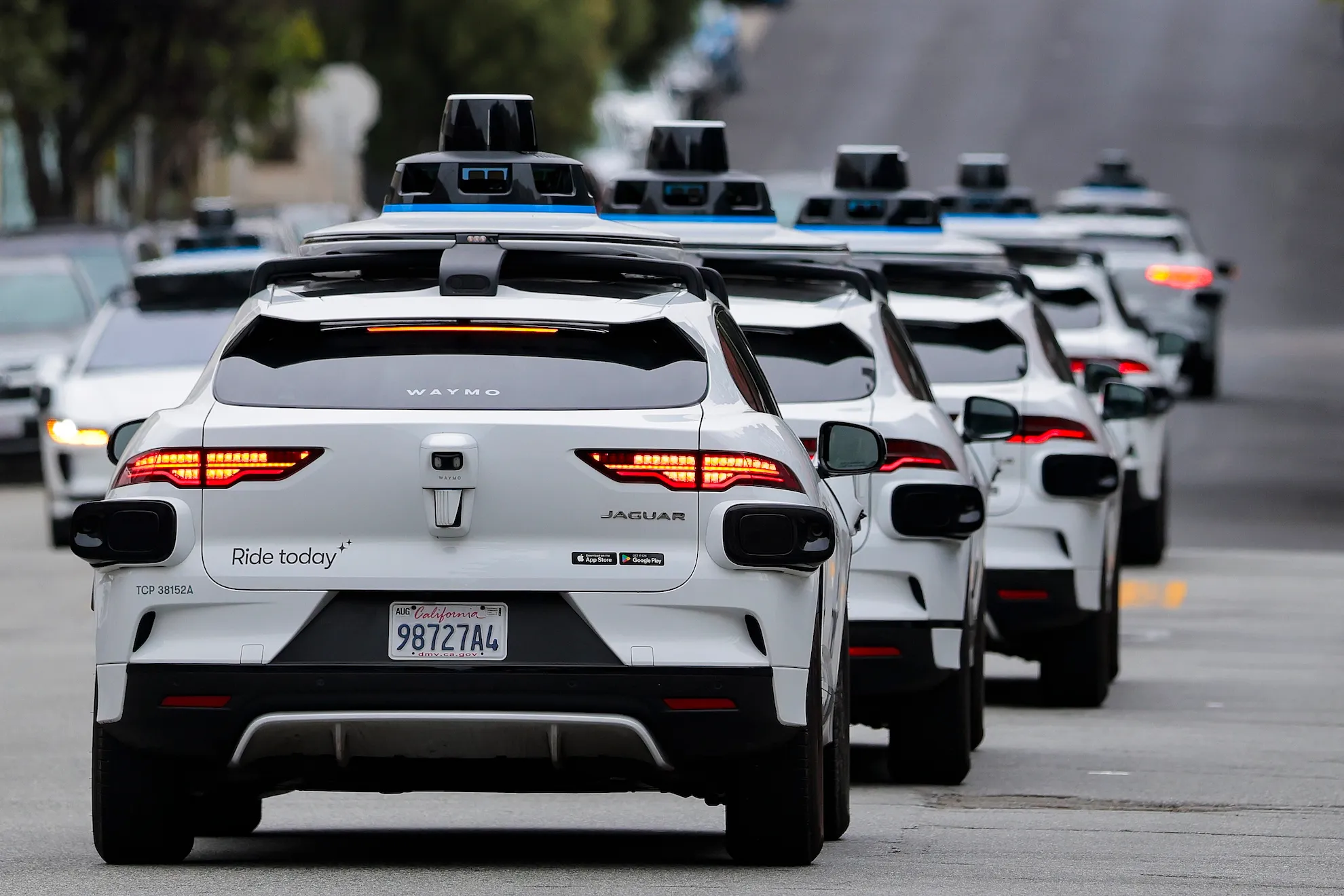
A Waymo robotaxi in San Francisco. NHTSA's letter went to every developer on the DOT's Standing General Order list. Credit: Heather Diehl / Getty Images, via TechCrunch.
NHTSA administrator Jonathan Morrison sent a directive to autonomous vehicle developers that an AV's inability to detect and respond to an emergency scene is a "functional insufficiency," not a rare edge case. The letter named no single company. It went to every developer listed in the Department of Transportation's Standing General Order, and it gave them until the end of the month to bring the agency "solutions."
The timing points at Waymo. Over the July 4 weekend, a fireworks crowd in San Francisco snarled traffic badly enough that several Waymo vehicles ran their batteries flat and had to be towed. A city supervisor is now opening an inquiry into how the cars affected transit and first responders. Morrison's phrasing matters for the whole field: once a regulator calls a behavior a functional insufficiency rather than a corner case, the burden shifts to proving the system handles it.
One counterweight landed the same week. The 2026 Unified Agenda floated changes to Federal Motor Vehicle Safety Standards that would make it easier to sell cars with no steering wheel or pedals, which is exactly what Tesla and Zoox are building toward. Pressure on the software, a lane opening on the hardware.
China's solid-state rulebook takes effect, and "semi-solid" marketing is out
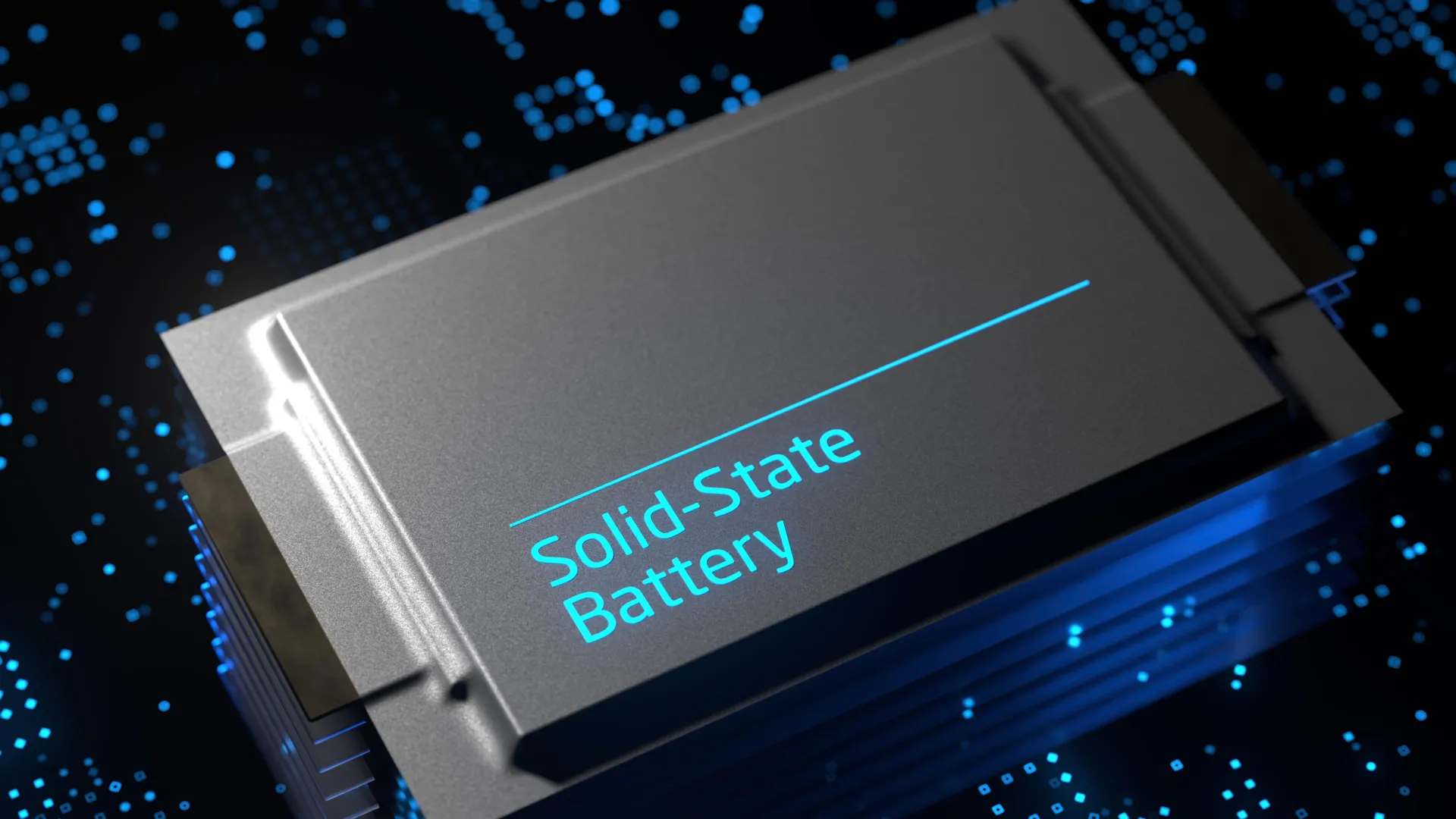
China's GB/T 43568-2026 sets a hard test for what may be called a solid-state cell. Illustration rendered by CarNewsChina.
On July 1 the world's first national standard for automotive solid-state batteries, GB/T 43568-2026, came into force in China. It is a definitions document, and that is the point. To earn the all-solid-state label, a cell now has to survive a six-hour vacuum bake at 120°C, and its residual liquid electrolyte has to come in under 5% of total cell weight. Anything wetter is a hybrid, and can no longer borrow the solid-state name in marketing.
The standard immediately sorted the field by who can actually build to it. Doctex has commissioned a gigawatt-hour line in Tianjin turning out certified cells at 350 Wh/kg, dense enough to add 15 to 20 percent range without changing pack dimensions. Dongfeng says its oxide-polymer hybrid cells also hit 350 Wh/kg, cleared a 170°C oven bake, and held 72% capacity in Mohe winter testing, with 100 demonstration vehicles planned in Hubei for the second half of the year. Gotion ran its pilot line on entirely domestic tooling.
Worth keeping the CATL caveat in view. Its leadership still puts real mass-market solid-state around 2030, held back by solid-interface resistance. A clean legal definition does not fix the physics. It does stop everyone from calling their half-liquid cell something it isn't.
Why soft lithium cracks a hard ceramic, finally pinned down
Max Planck researchers traced dendrite failure to hydrostatic stress inside the lithium itself. Credit: Shutterstock, via ScienceDaily.
Here is the puzzle that has slowed solid-state batteries for years. Lithium is soft, roughly the consistency of a gummy bear. The ceramic electrolyte it has to pass through is stiff and brittle. Yet during charging, lithium dendrites grow off the anode, pierce that ceramic, and short the cell. Soft should not beat hard, and nobody could agree on how it did.
A team at the Max Planck Institute for Sustainable Materials settled it. They prepared and imaged cracked cells under vacuum at cryogenic temperatures, so oxygen, water, and even the microscope's own electron beam could not disturb the sample, then checked the result against phase-field simulation and electron backscatter diffraction. They found no pile-up of lithium ahead of the crack tip. That ruled out the leading theory, that stray electrons seed new lithium inside the electrolyte. What is left is mechanical. Pressure builds inside the trapped dendrite and drives a brittle fracture through the ceramic, the way a steady waterjet cuts stone. Their work is in Nature.
Knowing the mechanism points at the fixes. Toughen the electrolyte so it resists cracking longer, seed it with microscopic voids that steer a growing crack away from the danger zone, or coat the lithium anode to slow dendrites at the source. None of that ships a cell tomorrow. It does tell engineers which knob to turn.
China's battery elder statesman makes the case for sodium
Chen Liquan took China's highest science honor and used the moment to push sodium-ion. Illustration rendered by CarNewsChina.
Chen Liquan, widely called the founding father of China's lithium battery industry, received the National Highest Science and Technology Award in Beijing on July 8. In his address he told the auto industry to scale up sodium-ion cells, and the reason was strategic rather than sentimental. Roughly three quarters of China's lithium is imported. Sodium is abundant at home, so a sodium supply chain is a hedge against a mineral chokepoint.
The economics are catching up to the argument. CATL and Changan have certified sodium cells at 175 Wh/kg for about $0.051 per watt-hour, closing on lithium iron phosphate on cost. Sodium's hard-carbon anode can be made from coal rather than pricey synthetic graphite. Hina Battery is building a 2 GWh sodium line in Wuhan aimed at Dongfeng commercial trucks and Yangtze cargo vessels, with cells holding 90% capacity at −20°C, which is the cold-weather weakness that used to sink the chemistry.
Energy density still trails lithium, so sodium lands first in entry-level cars, heavy logistics, and grid storage rather than long-range flagships. As a way to take pressure off the lithium supply chain, it is arriving on schedule.
Ricardo and Nissan bet on gallium nitride for a cheaper inverter
Project SUITE will build GaN traction inverters at 50 kW and 150 kW for the next Nissan LEAF. Image: Ricardo (brand graphic supplied with the release).
Most of the 800V conversation runs through silicon carbide. This week Ricardo and Nissan pointed at the other wide-bandgap option. Under Project SUITE, a £10 million effort led by Nissan Technical Centre Europe inside the UK's £4 billion DRIVE35 program, Ricardo and RAM Innovations will design a low-cost gallium nitride traction inverter at two power levels, 50 kW and 150 kW, for the all-new Nissan LEAF.
The engineering case for GaN over SiC is switching speed at lower loss and lower cost. Push the switching frequency up and the inverter runs more efficiently and can use smaller passive components, which trims both energy waste and bill of materials. Ricardo says the modules will be validated at the University of Bristol, with partner weeteq layering in AI-based control and health monitoring to improve reliability. The same inverter is meant to carry over into performance, motorsport, and defense vehicles.
The interesting word here is cost. GaN has mostly shown up in onboard chargers and DC-DC converters, not in the main traction path, where SiC dominates. A mainstream inverter aimed at an affordable car is a real test of whether GaN can move up into high-power drive. The project runs three years.
IONNA crosses 122 sites as the U.S. fast-charging map fills in
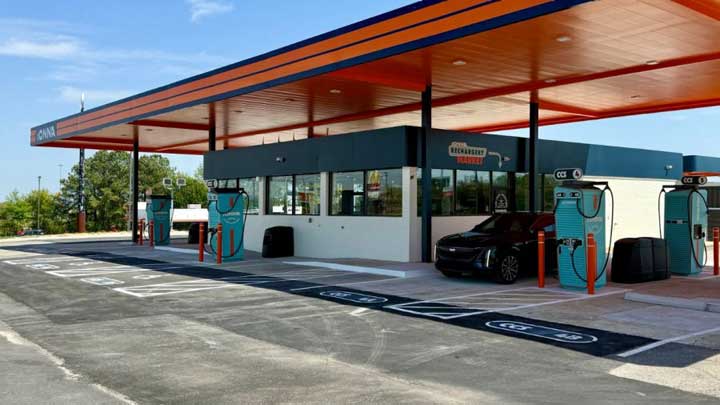
An IONNA "Rechargery" site. The eight-automaker network now runs 1,166 bays across the U.S. Credit: IONNA / GM, via GM Authority.
IONNA, the fast-charging joint venture backed by eight automakers including GM, reached 122 active locations and 1,166 charging bays this month. The stations carry both NACS and CCS connectors, so they serve the legacy fleet and the newer NACS-native cars off the same dispenser. IONNA is also taking over Circle K's existing U.S. charging sites and has laid out a $250 million push in California.
Set against the national picture, this is the build-out catching up to the vehicles. As of July 1 the U.S. counted roughly 74,265 public DC fast-charging ports across all standards, with EVgo leading additions in June. The interesting shift is architectural. New sites are designed around dual-standard dispensers and larger, higher-power installations rather than isolated single stalls, which is what a mixed NACS-and-CCS fleet actually needs.
Charger count on its own is a vanity metric. Reliability and uptime are the real test, and that is where a purpose-built network like IONNA is trying to separate from the early public chargers that gave the category its reputation for being down when you need them.