Theme Park Animatronics Briefing — compiled and curated by Chris Lee
Disney and Universal file a wave of patents for next-generation ride tech
No new animatronic debuted this week, but the patent office stayed busy. Disney and Universal each filed or were granted paperwork pointing at how future rides — and the characters riding along with them — might work: a flying theater that loads flat, ride vehicles with AI built in, a motion-capture upgrade tied to Disney's animatronic shop, and a first granted patent for Imagineering's long-teased HoloTile floor.
October 27, 2026
Disney patents a flying theater that loads flat, then tips riders into the show
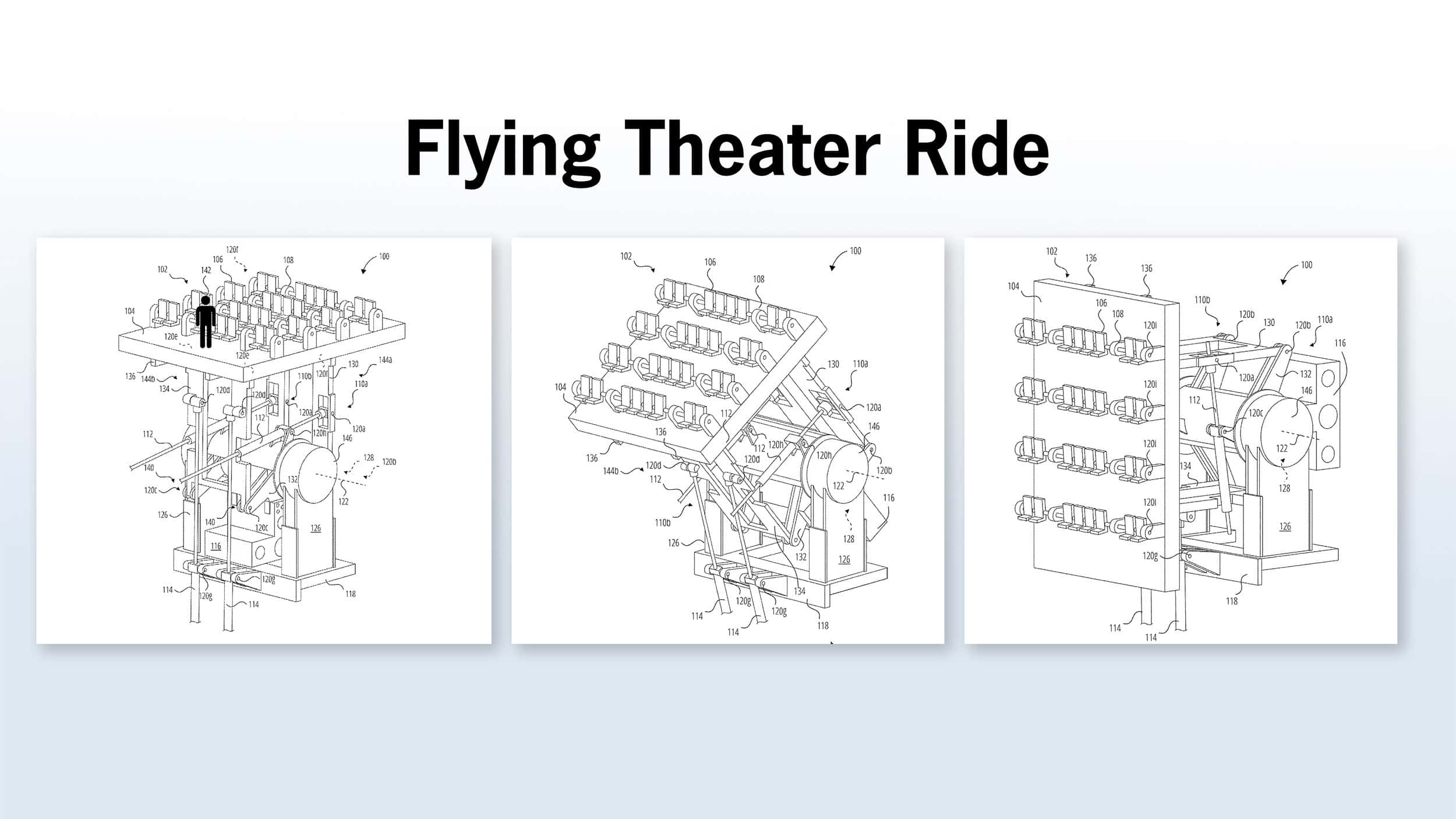
BlogMickey's header image for the flying theater patent filing. Credit: via BlogMickey (no further image credit given).
Disney Enterprises published a patent application this week for a "Flying Theater Ride" system — the ride category that already includes Soarin' at Epcot and Disney California Adventure. The Patent Office published it October 29, under the filing number US 2026/0335777 A1. Disney filed it back in April 2025, credited to inventors James Durand and Stephen Brooks Rowe. It doesn't name a park or attraction. This is a mechanism patent, the kind Imagineering files years before — or instead of — breaking ground on anything.
The pitch is accessibility as much as thrill. Guests board while the cabin sits flat and level, which the filing says should speed up loading and let people using wheelchairs, canes, or other mobility aids get on without transferring. A brake and hub lock the cabin in place during boarding, then rotate it upright once everyone's seated. Seats pivot to stay level through that rotation, and a counterweight offsets the load so the motors driving it can be smaller and cheaper. If the power cuts out, the same counterweight can swing the cabin back to the loading position.
Once upright, a four-link mechanism takes over. It lets the platform rise, drop, heave, and tilt against whatever's mounted in front of it — a projection screen, LED panel, or LCD wall. The filing describes five variations on the basic design and walks through one example built around a canoe ride that tips riders forward at a waterfall drop. For show elements, the list reads like a grab bag: sound, smell, haptics, lighting, pyrotechnics, live actors, and animatronics all get a mention as things riders might encounter once the platform locks into place.
It's the second accessibility-focused ride patent out of Burbank in two months. Disney filed for a boat-ride system in September that would let wheelchair and ECV users load without transferring out of their own chairs. Neither is a confirmed attraction. A patent like this protects an idea Imagineering might use in five years, on a ride nobody's announced yet.
Universal patents an AI system built into the ride vehicle itself
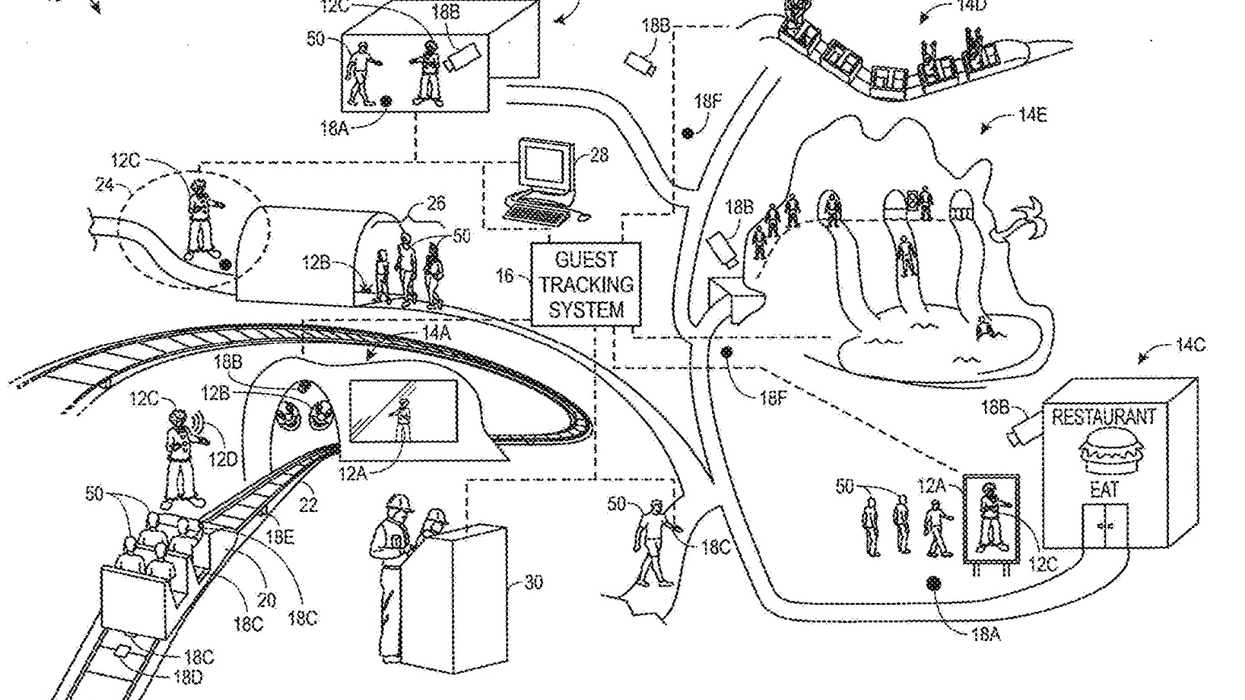
According to Universal's patent application, park-wide sensors would track guests and feed an AI system that personalizes the ride experience. Credit: Image courtesy of Universal.
Universal filed a patent application — "Ride Vehicle Artificial Intelligence Entity Systems and Methods" — for a system that would let characters inside a ride vehicle change based on who's riding. Theme Park Insider found the filing first; blooloop followed up with the details on October 23.
The pitch: park-wide sensors — cameras, proximity and weight sensors, microphones, wearable RFID tags — track where guests are, who they're with, and what they've already ridden. An onboard AI system combines that with an opted-in preference profile to adjust what's inside the vehicle in real time. Visuals, lighting, sound, and the characters themselves can all shift. A character's dialogue, mood, and personality can change depending on who's in the seat, or the system can swap in a different character entirely to match a guest's interests or steer around a kid's fears. It can also spot overlapping interests among strangers sharing a vehicle, and flag a stalled or malfunctioning ride to staff before a guest has to ask.
What the patent doesn't say is what these characters actually are. It describes "interactive animated characters" and "AI entities" throughout, but never specifies whether that means a physical animatronic figure, a projected face, or a screen. For a beat built around physical robotics, that's the catch. This reads as the software layer a future animatronic character could run on, not confirmation that one's coming.
A new Disney motion-capture patent has a direct line to its animatronic shop
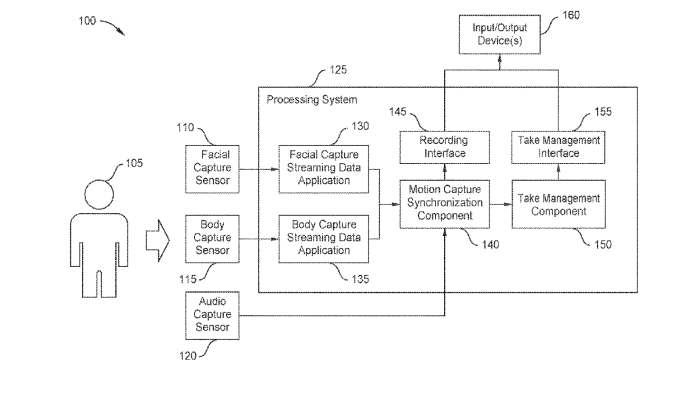
Disney filed a patent for "Real-Time Animation Motion Capture," a system for combining motion-capture data from two different performances into one output: record a first performance to create a data object, then layer in a second pass to refine or extend it without a full reshoot.
The filing is written for film, TV, and games, not for parks. But Disney Food Blog points out Imagineering already has a track record of pulling motion-capture data from a live performance straight into an animatronic. The Scooter figure on Rock 'n' Roller Coaster Starring The Muppets was built that way, with the Muppet performer's movement informing the character's Audio-Animatronic. If this patent improves how that data gets captured and merged, the next animatronic built on the same pipeline should be cheaper and faster to get right: fewer reshoots, less wasted motion-capture time.
Imagineering's HoloTile floor finally gets its patent, with a theme-park angle attached
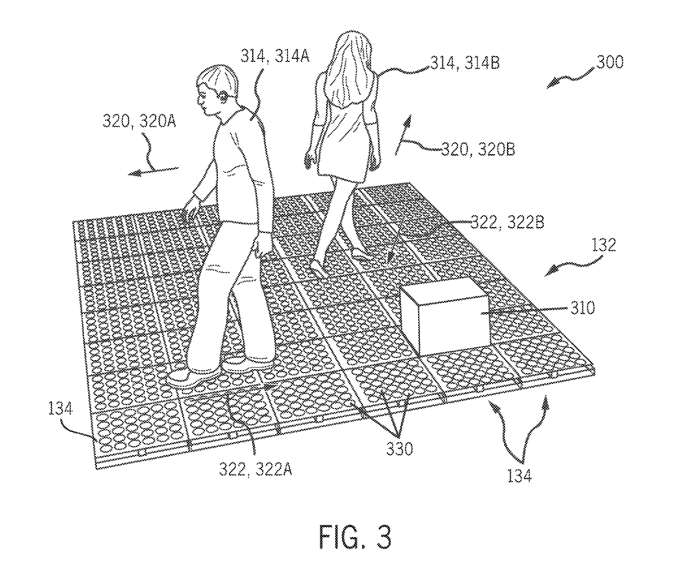
Patent diagram for Disney's granted HoloTile floor patent, "Modular Omnidirectional Actuated Floors Providing a Reconfigurable Video Production Environment." Credit: Disney.
Nearly three years after Walt Disney Imagineering first showed it off, the HoloTile floor has a granted U.S. patent: 12,761,723, "Modular Omnidirectional Actuated Floors Providing a Reconfigurable Video Production Environment," granted October 13 to inventors Lanny Smoot, Frank D. Mezzatesta III, Jack Wetherell, and Robert J. Bristow.
The floor is made of independently moving tiles that shift a performer so they stay centered in front of a camera and a digital background, even while walking, running, or turning in any direction, across a stage much smaller than the distance they appear to cover. The patent frames it as a video-production tool first: reposition the performer, and the camera, background, and props can shift to match.
A related, earlier patent Disney was granted in August 2025 points more directly at parks. It pairs the floor with a screen, projection, or headset, tracks a guest's position, and moves them to match whatever virtual environment they're walking through, all while physically keeping them inside a small, safe footprint. Disney hasn't attached either patent to a specific attraction. Smoot first demonstrated the floor publicly in January 2024, and D23 2024 ran a tabletop version with Star Wars figures walking in front of a curved screen. Three years between demo and granted patent is normal for Imagineering's R&D pipeline, not necessarily a sign anything is close.