A soft-bodied underwater robot swims tight, twisting paths on a single thruster
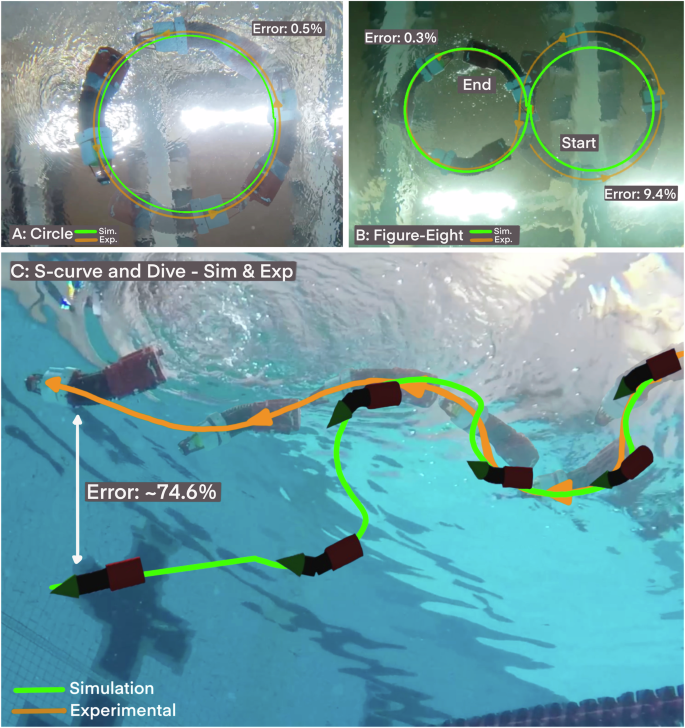
Researchers at Worcester Polytechnic Institute’s Soft Robotics Lab and Merrimack College introduced DRAGON 3D, a compliant underwater vehicle that pairs one propeller with a cable-actuated flexible body. Instead of adding thrusters or fins, the robot bends its own deformable spine to point the thrust vector, which lets it corner, hold depth, and thread through confined spaces that would stall a rigid AUV.
The team built a dynamic model of the coupled thruster-and-body system and validated it against teleoperated runs in pools, a riverbed, and coastal water, demonstrating slalom navigation and depth changes while the robot carried video and environmental sensors. The compliance that makes it maneuverable also makes it gentle around reefs and structures.
The actuation strategy is the relevant part for this field. A soft, cable-driven body that produces lifelike swimming motion from minimal hardware speaks directly to the aquatic creature figures theme parks now stage in water shows.
A muscle-inspired tendon actuator that keeps its force honest as it bends

A team led by Tianchao Han published a design and control scheme for a double tendon-sheath artificial muscle, a cable-in-conduit actuator built around the Hill model of biological muscle, with both series and parallel elastic elements. Tendon-sheath drives are the workhorse of articulated figures because the motors can sit far from the moving joint, but friction in the sheath changes with every bend, so the force that actually reaches the joint drifts unpredictably.
The authors derive a quasi-static torque-transmission model that accounts for those bending-induced losses, and add a way to infer the current bend angle from how much the tendon path has stretched, so the controller can compensate without a sensor out at the joint tip. In testing, bidirectional torque error stayed near 9.8 percent across changing configurations.
Cable-and-conduit actuation is exactly how many animatronic faces and limbs move, so a compliant, muscle-like drive that holds its output force accurate through a changing routing path is directly useful for expressive-figure control.
A 3D-printed origami arm folds its way to four degrees of freedom
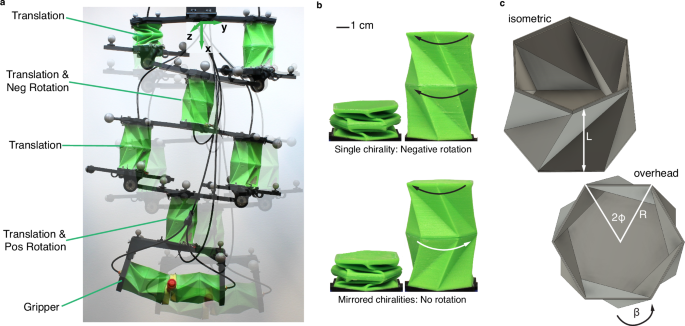
Engineers at Northeastern University’s Institute for Experiential Robotics, with a collaborator at MIT Lincoln Laboratory, printed a soft robotic arm from stacked Kresling-pattern origami joints. Each module collapses and twists like a folded bellows, and chaining them yields four degrees of freedom, three rotational and one that extends and retracts, in a single printed structure with no conventional motors at the joints.
The arm tracked target trajectories to within about 5 mm in the plane and under 10 mm in 3D, handled payloads up to 680 grams, and ran through everyday manipulation sequences including cooking-style motions. Printing the compliant joints directly keeps the parts light and inherently springy.
The draw for character robots is the combination of soft, safe compliance with enough precision and payload to do real work, the kind of lightweight limb you want on a figure that shares space with guests.