A survey maps the actuators and transmissions behind dexterous robot hands
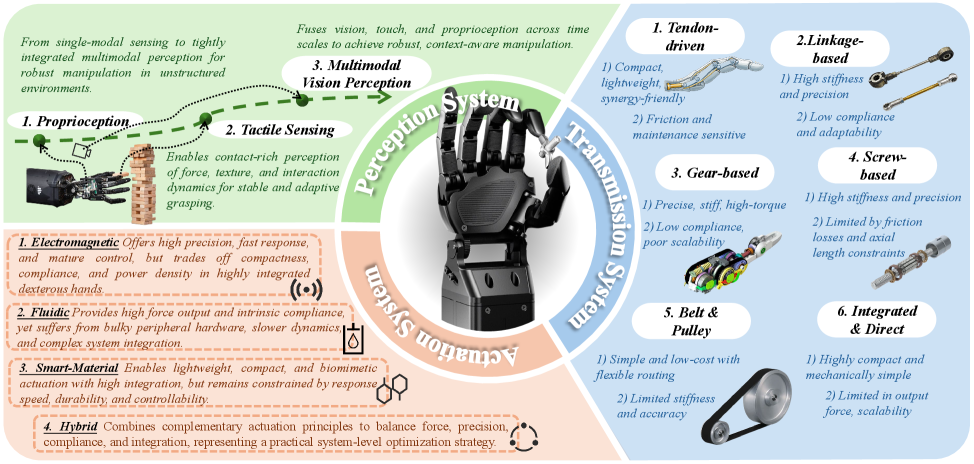
A survey from Xi’an Jiaotong-Liverpool University, Duke Kunshan University, and the Chinese University of Hong Kong catalogs the hardware landscape of robotic dexterous hands, covering 32 representative platforms built between 2006 and 2026 and drawing on more than 220 works across hardware, control, sensing, and datasets. For an animatronics audience, its value is the clean taxonomy of how fingers are driven and how force gets from a motor to a fingertip.
On the actuation side it groups designs into electromagnetic, fluidic, smart-material, and hybrid schemes. On the transmission side it distinguishes tendon-driven, linkage-based, gear-based, lead- and roller-screw, belt-cable-pulley, and direct or integrated arrangements. Tendon-driven and linkage transmissions in particular are the same building blocks used in expressive character hands and animatronic figures.
Led by Weiguang Zhao with corresponding authors Rui Zhang and Kaizhu Huang, the paper consolidates datasets and evaluation practices and flags open limitations, making it a useful reference for choosing an actuation and transmission stack for a compact, expressive hand.
A tendon-driven ‘snake’ robot gets a data-driven dynamics model for real-time control
A team from NTNU and CERN published a system-identification study of a tendon-actuated continuum robot with rolling joints, a cable-pulled, many-segment arm whose control problem is essentially the one animatronics engineers face: nonlinear, high-dimensional, friction-dominated dynamics that are hard to model from first principles. The robot itself was built at CERN for remote maintenance in its accelerator tunnels.
Instead of deriving physics equations, the authors fit the arm’s behavior directly from experimental data using three identification methods (N4SID, ARX, and SINDYc). Their key finding is that despite the robot’s many joints, a compact two-degree-of-freedom model captures the dynamics accurately, because strong kinematic coupling ties the joints together. They then validated the model against real data and used it to design a model-predictive controller fast enough for real-time use.
The work, by Harald Minde Hansen, Bjørn Kåre Sæbø, Kristin Y. Pettersen, Jan Tommy Gravdahl, and CERN’s Mario Di Castro, is a practical template for controlling the cable and tendon mechanisms that animate lifelike figures without hand-tuning a full physics model.