Universal patents animated figures that crawl over your ride vehicle
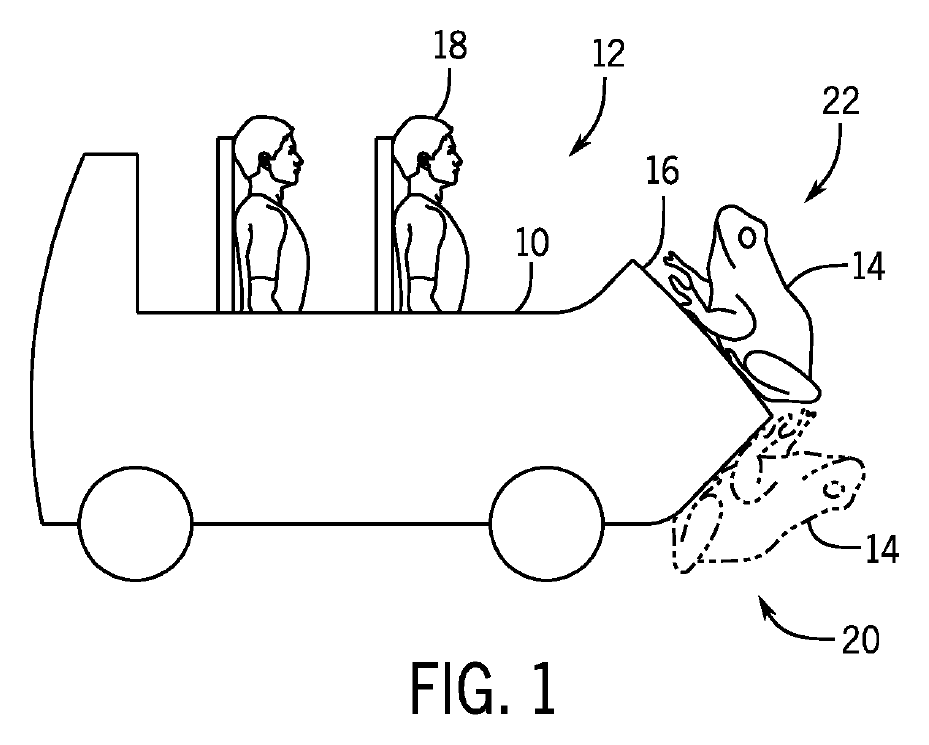
A Universal patent for animated figures that physically crawl across the outside of a moving ride vehicle drew fresh attention this month, via Theme Park Insider. Granted in January 2026 to Universal City Studios, US 12,533,596 describes a figure that travels across a surface instead of sitting bolted to one spot. The mechanism is a fixation system with at least three points of contact: two alternately grip and release the surface while a third stays continuously coupled through a sliding or rolling connection, so the figure is always anchored by at least two points even as one limb reaches forward. That alternating grip-and-release cadence is what produces a convincing crawl rather than a rigid slide.
The gripping is done one of two ways. In the magnetic version, switchable electromagnets on the figure’s contact points pair with magnetic elements in the surface, energized and de-energized in sequence to time each step. In the vacuum version, the surface is perforated and connected to pumps, so suction holds and frees each extremity. The contact points ride along roughly parallel tracks built into the surface, outer tracks for the two alternating limbs and a center track for the constant-contact point, which keeps the figure on a planned route and carries its load as the vehicle accelerates, turns, and vibrates.
For fabrication the interesting part is that it decouples a character’s locomotion from a stationary base. Traditionally an on-vehicle creature is bolted down and only its limbs articulate. Here the whole body relocates along the vehicle, letting a frog or snake appear to scramble over the car toward guests. The alternating multi-point anchoring solves the core problem of never letting go all at once under ride dynamics, and hiding the retention in switchable magnets or vacuum keeps the contact hardware small enough to conceal inside the figure’s feet or belly.
Disney Research’s ReActor retargets captured motion onto very different robot bodies
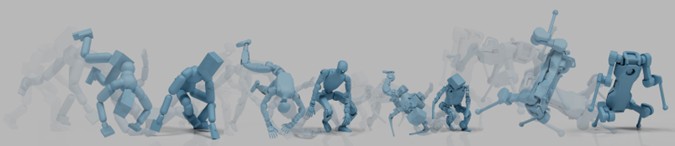
Disney Research unveiled ReActor, a reinforcement-learning system for physics-aware motion retargeting, the problem of taking a captured human movement and making a very differently shaped robot actually perform it. Instead of naively copying joint angles, which produces foot-sliding, self-collisions and other artifacts, ReActor uses a bilevel optimization loop: an outer loop reshapes the reference motion to fit the robot’s morphology inside a physics simulator, while an inner loop trains a tracking policy to execute it on hardware.
The method needs only sparse semantic correspondences between a few rigid bodies (say, “this is the hand”), then produces physically plausible motion with no manual per-joint tuning. The team validated it in simulation and on real hardware across two humanoids and a quadruped with very different degrees of freedom, sizes and proportions.
The line to expressive theme-park character robots is direct. It lets the same animated performance be retargeted onto many different animatronic body plans while staying balanced and lifelike. It is authored by David Müller, Agon Serifi, Sammy Christen, Ruben Grandia, Espen Knoop and Moritz Bächer, and slated for SIGGRAPH 2026.
Seoul National University’s artificial muscle senses its own force as it moves
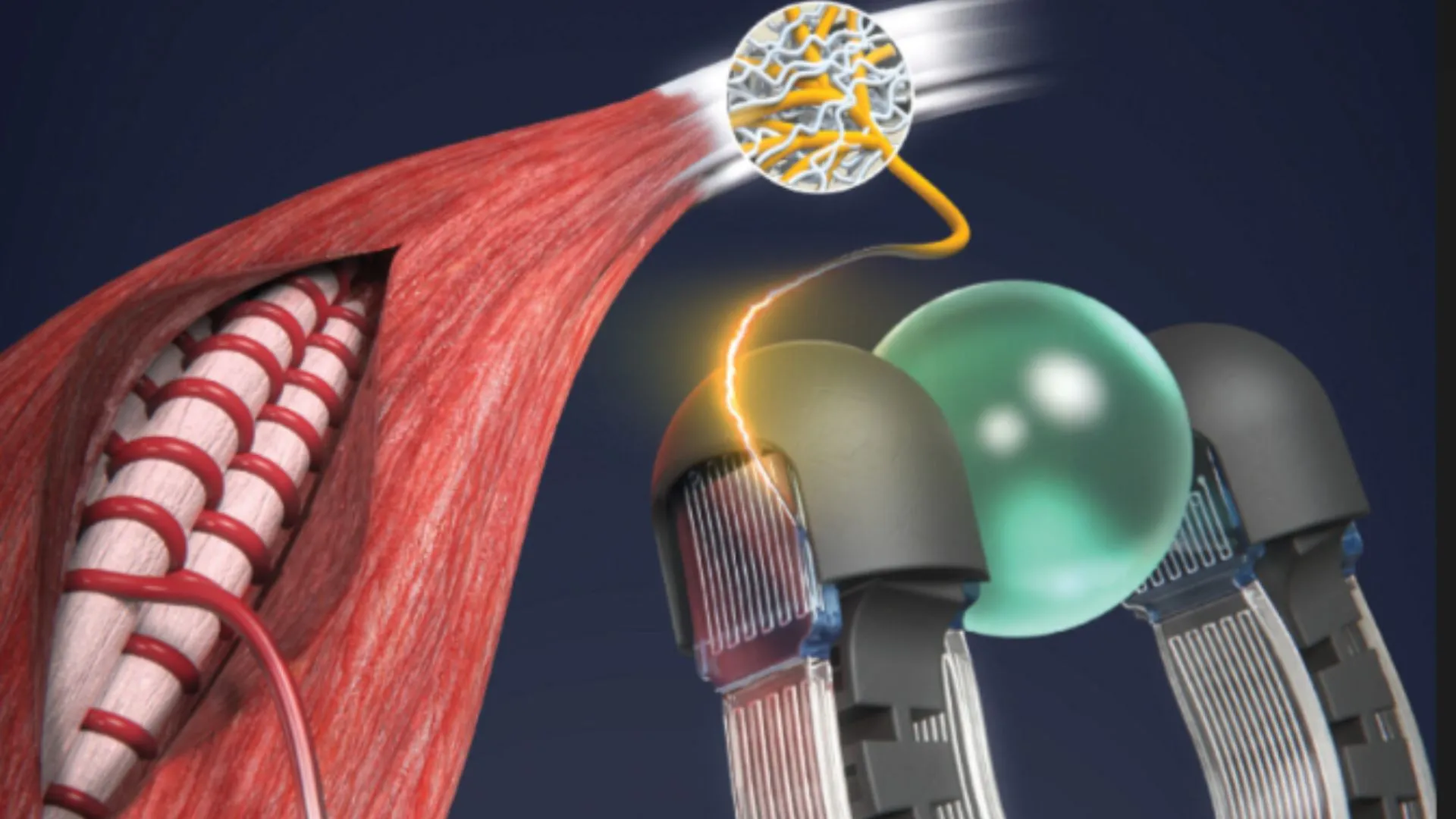
A team at Seoul National University’s College of Engineering unveiled a soft artificial muscle that combines movement and sensing in one body, removing the need for the separate external sensors most actuators rely on. The design threads two liquid-metal channels through a liquid crystal elastomer (LCE): one channel acts as a heater that drives the LCE to contract like a muscle, while the second reads the force and deformation the muscle experiences, giving the actuator its own proprioception.
The unit is built in series from two LCE types, an isotropic segment that behaves like a stiff tendon and a nematic segment that supplies the contractile motion, so motor and sensory signals are processed together within the same fiber. In demonstrations, grippers made from the muscle grasped objects delicately and, on their own, distinguished the objects’ stiffness and size.
The team notes a real limit: heat buildup during repeated actuation causes force drift, pointing to faster cooling or thinner geometries as next steps. Published in Advanced Materials, it is a compelling building block for expressive, self-sensing animatronic figures.
A study finds a near-featureless robot can still convey emotion through body motion
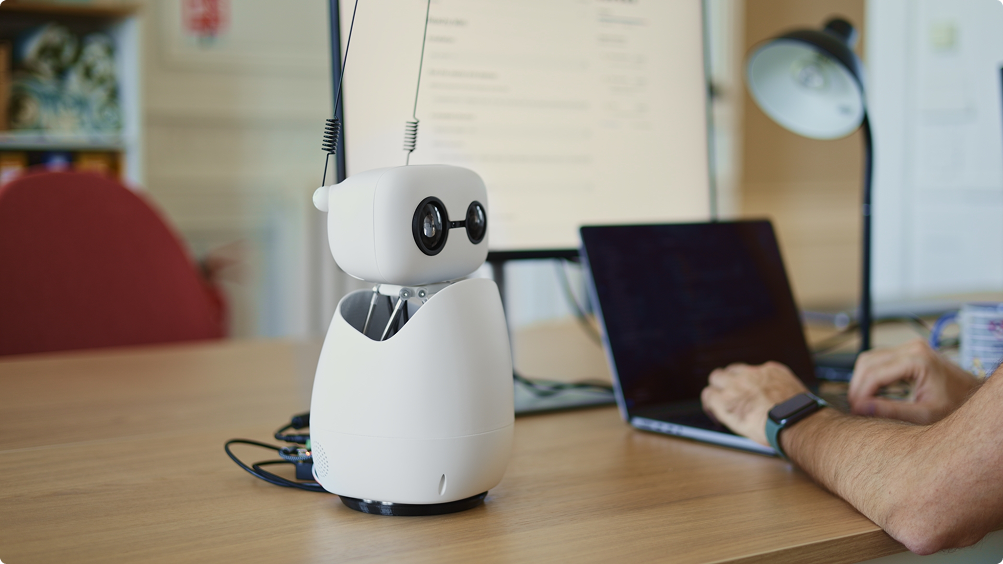
Researchers from the Georgia Institute of Technology, Lancaster University and Ben-Gurion University of the Negev asked whether a character robot with very few expressive degrees of freedom can still convey emotion. Their subject was Reachy Mini, the open-source desktop robot from Pollen Robotics and Hugging Face, which has a 6-DOF head, a rotating base and animated antennae but no facial features at all.
In an online within-subjects study, 100 participants watched ten short clips of the robot performing gestures for emotions such as anger, sadness, interest, amusement, fear, joy and disgust, then labeled each. Exact emotion recognition was modest at 30.5 percent overall, but anger, sadness and interest read far more reliably (81.8, 55 and 62.2 percent). Participants recovered the broader affective meaning much better, hitting roughly 66 percent on valence and 68 percent on arousal.
The takeaway is that sparse, body-only motion is enough to communicate affect and shape social impressions. Positive gestures scored higher on warmth and sociability, valence tracked perceived friendliness, and arousal tracked how alive the robot seemed, useful guidance for animatronic and companion characters that must emote without a full articulated face.